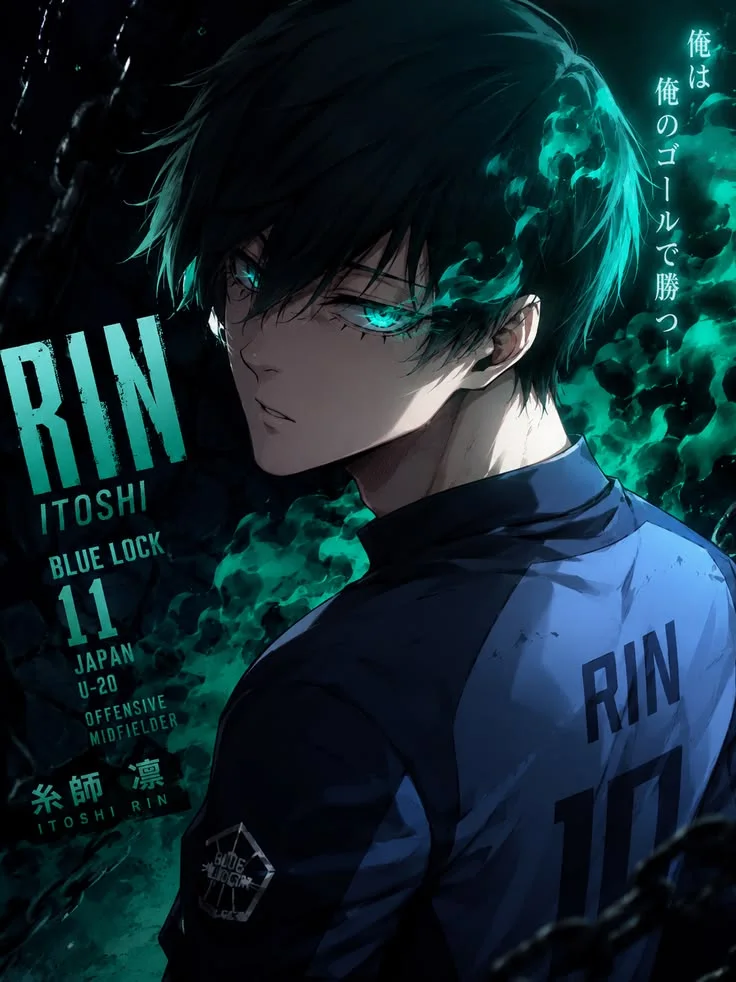
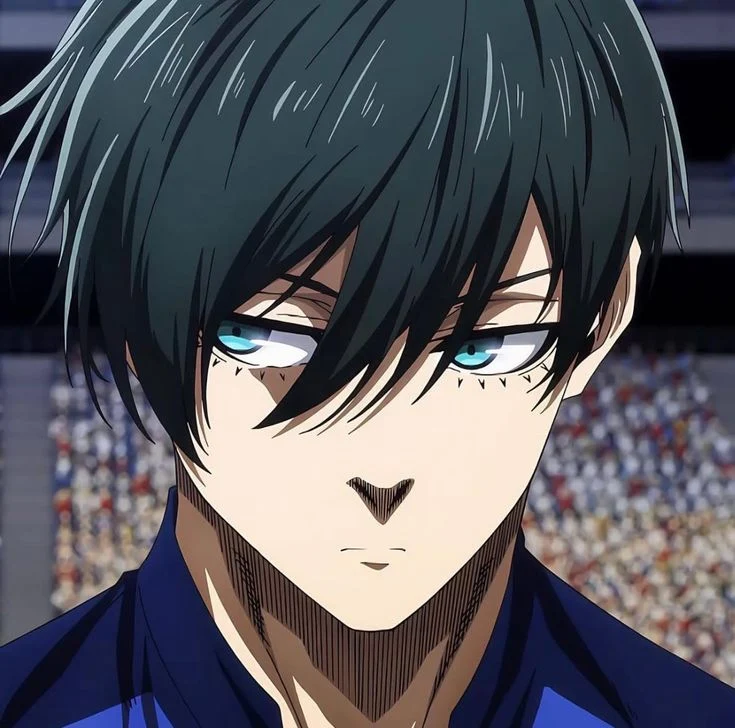
The Boss Monster: His True Ego Was Never About Sae
Chapter 271 is the most important chapter in Rin’s arc because it finally shows where his ego actually comes from. And it is not Sae.
As a kid, Rin watched a popular hero show with his brother. Every other child loved the hero. Rin was obsessed with the Boss Monsters, the villains who knew they were weaker than the heroes and kept fighting anyway. They staked their lives on destroying something stronger than themselves. Even when their bodies were breaking down they kept attacking.
Rin found them more interesting than the heroes. He wanted to be like them.
His true ego is destruction at the cost of life. The desire to fight something stronger than yourself and give everything to destroy it, even knowing you might be destroyed in the process.
This reframes everything. Rin was never really driven by hating Sae. He was driven by a childhood fascination with opponents who refuse to accept their own limits. Sae’s rejection gave that ego a target. But the raw material was always there, inside a kid who watched TV villains and thought they were the most interesting thing on screen.
This also explains why his Flow State only activates against opponents he genuinely considers stronger. It happened against Sae in the U-20 match. It happens against Isagi in the Neo Egoist League. These are the two people he has looked at and thought: that person might actually be stronger than me right now. And instead of backing down, he ignites.
Rin vs Isagi vs Shidou: Three Different Strikers
Blue Lock asks every striker the same question: what does your ego look like when fully expressed?
Isagi’s answer is adaptation. He reads, rebuilds, and evolves every match. His ego grows through understanding.
Shidou’s answer is instinct. He scores because his body is always ready to consume a chance before anyone else can react. His ego is immediate and physical.
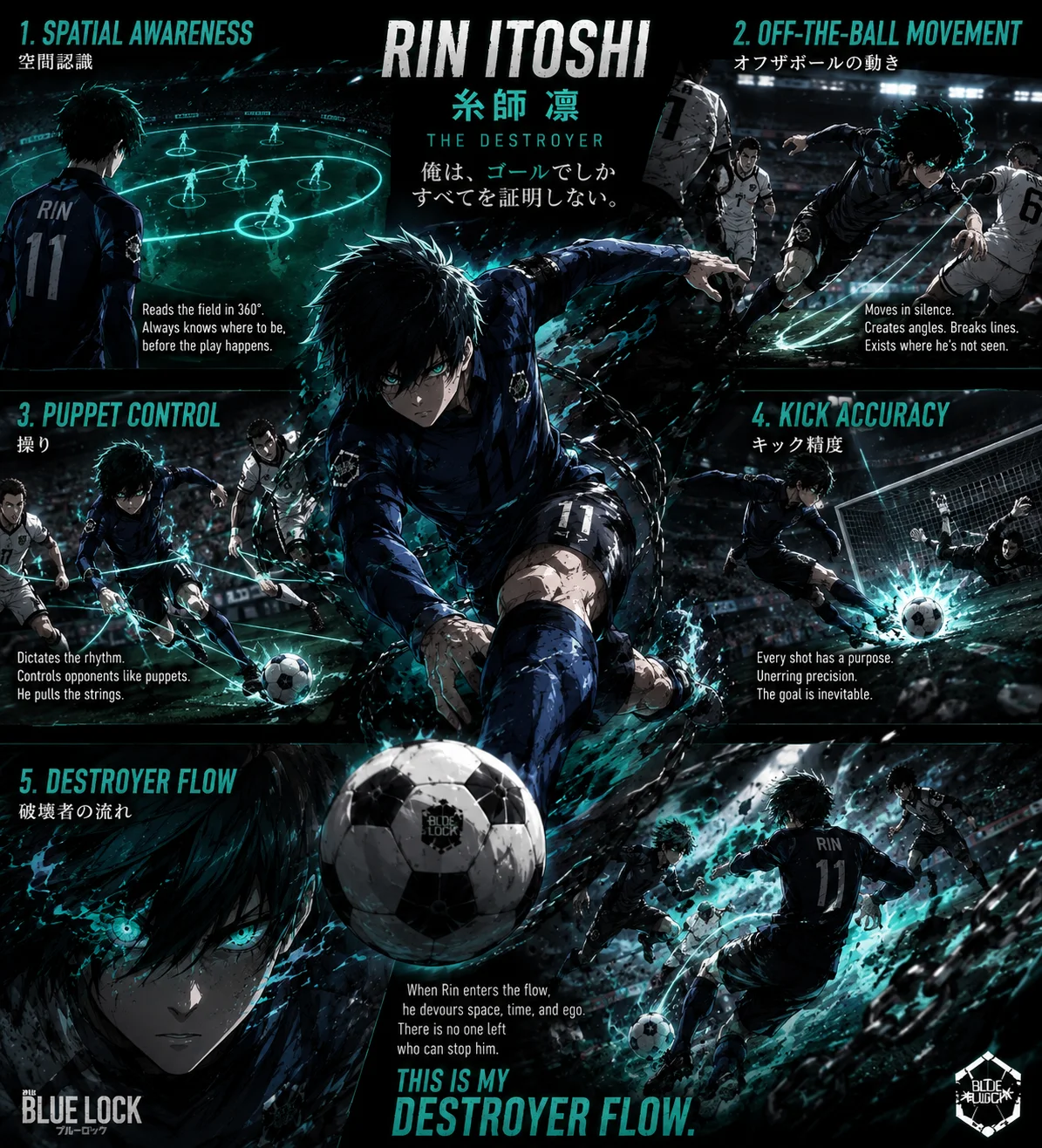
Rin’s answer is domination. He reads the whole field, controls everyone on it, then destroys the strongest opponent in front of him. His ego is calculated first and explosive second.
The gap between Rin and both of them is completeness. Isagi needs time to read and adapt. Shidou needs the right service to unlock his weapon. Rin can produce his best football from almost any situation because his spatial awareness, puppet control, and finishing cover every phase of the game.
But that completeness comes with a cost. Isagi’s ego grows because he always looks forward. Shidou’s ego is uncomplicated because it carries no psychological baggage. Rin’s ego for most of the series points backward at a training pitch and a word that has followed him ever since.
He is the most talented player in the program and also the most self-limiting because of it.
Chapter 275: The Goal That Silences the Phantom
Everything in Rin’s arc builds toward one moment.
He has been fighting Sae’s phantom across the entire Neo Egoist League. Every goal attempt gets dismissed. He resets plays, demands more from teammates, and pushes past reasonable limits trying to find a goal the phantom cannot touch.
Then Isagi appears in front of him during a live attack and challenges him directly, staking everything on stopping the goal. That interruption gives Rin a new idea. In that instant Sae’s phantom disappears.
Not through willpower. Not through a speech. Because Isagi replaced it with something real.
Rin scores his ideal goal off a rabona cross from Charles Chevalier, colliding with Isagi in the process. It is the first goal in the Neo Egoist League that the phantom does not label lukewarm.
The goal itself is not the point. What matters is that for the first time, a moment on the pitch is defined by his rivalry with Isagi rather than his wound from Sae. He is no longer playing against a ghost. He is playing against someone who is actually there.
What Rin Calling Isagi “Demon King” Really Means
At the end of the Neo Egoist League, Isagi scores the winner against Paris X Gen. Bastard Munchen wins 3-2. Rin loses.
He calls Isagi Blue Lock’s Demon King.
In Rin’s vocabulary that is not an insult. From someone who spent his whole career chasing the strongest, calling another player the Demon King is the closest thing to real acknowledgment he has ever given anyone.
It also marks the clearest shift in his character across the whole series. At the start he treated Isagi as barely worth his attention. By the end of the Neo Egoist League he is calling that same player the Demon King and has been offered a place at Real Madrid.
He lost the match. But he found something more useful than revenge. A rival who pushed him to a version of himself that Sae’s phantom never could.
Where Rin Goes Next: World Cup Arc
After the Neo Egoist League, Rin receives an offer from Real Madrid and qualifies for the new Japan U-20 squad entering the PIFA U-20 World Cup.
Both matter. Real Madrid means the professional world is watching. The World Cup means Rin and Sae will share a squad again for the first time since the U-20 match.
The question the series has been building toward is not whether Rin can beat Sae. He already proved that. The question is whether he can play football that has nothing to do with Sae at all. A goal scored not to silence a phantom but because Rin Itoshi, on his own terms, decided that is where the ball needed to go.
That version of Rin is what the whole series has been building toward.
Conclusion: The Striker Who Had to Destroy the Wrong Enemy First
Rin Itoshi is not just Blue Lock’s best player. He is its most honest look at what happens when someone builds their identity around another person’s rejection.
The cold personality is armour. The obsession with destruction is the only language he learned after the person he admired most told him he was worthless. The word lukewarm is not just an insult. It is a cage that followed him from a training pitch all the way to the biggest matches of his career.
What makes his arc worth following is not the talent. It is the slow, match by match work of learning to play for something other than a ghost.
The Boss Monster does not stop fighting when it knows it might lose. It fights because fighting is the most honest thing it can do.
That is Rin. And that is why he is unforgettable.
Frequently Asked Questions About Rin Itoshi
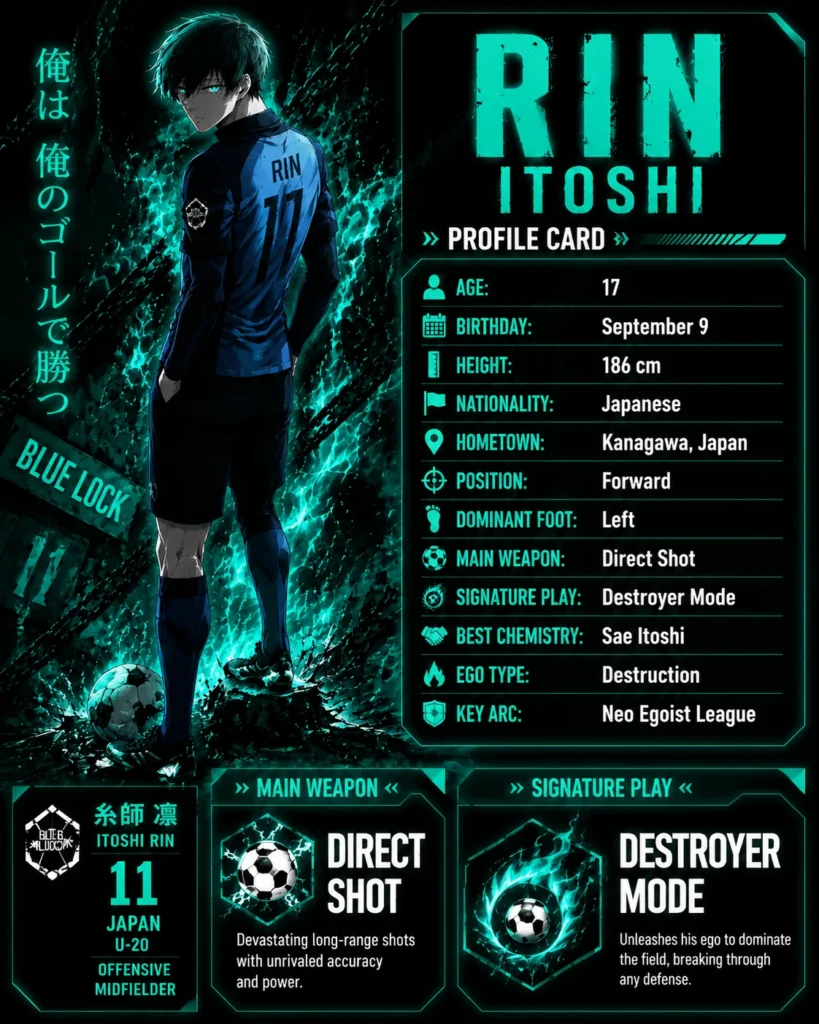
Who is Rin Itoshi in Blue Lock? Rin Itoshi is the deuteragonist of Blue Lock and the program’s top ranked player. He is the younger brother of professional midfielder Sae Itoshi and plays as a center forward. His goal is to become the world’s best striker.
What is Rin Itoshi’s ability in Blue Lock?
His main weapons are puppet control, spatial awareness, kick accuracy, off the ball movement, and Destroyer Flow. His puppet control lets him direct everyone on the pitch without speaking, making players move according to his plan without realising it.
What is Rin’s Destroyer Flow?
It is his Flow State, a heightened mode where he abandons calculated play and switches to pure destruction. He provokes opponents into using their best abilities then overpowers them directly. It only activates when he faces someone he genuinely considers stronger than himself.
Why does Rin call everything lukewarm?
Because Sae used the word to dismiss Rin’s football on the day he ended their shared dream. It became the worst verdict any goal can receive in Rin’s mind, and he applies it to anyone whose football does not meet his standard.
What did Sae say to Rin?
Sae called Rin lukewarm, told him to give up, said he made him want to vomit, called him an annoying eyesore, and told him to never use Sae as an excuse to play football again. This happens in chapter 125 and is the defining moment of Rin’s entire arc.
What happened between Sae and Rin after Blue Lock won the U-20 match?
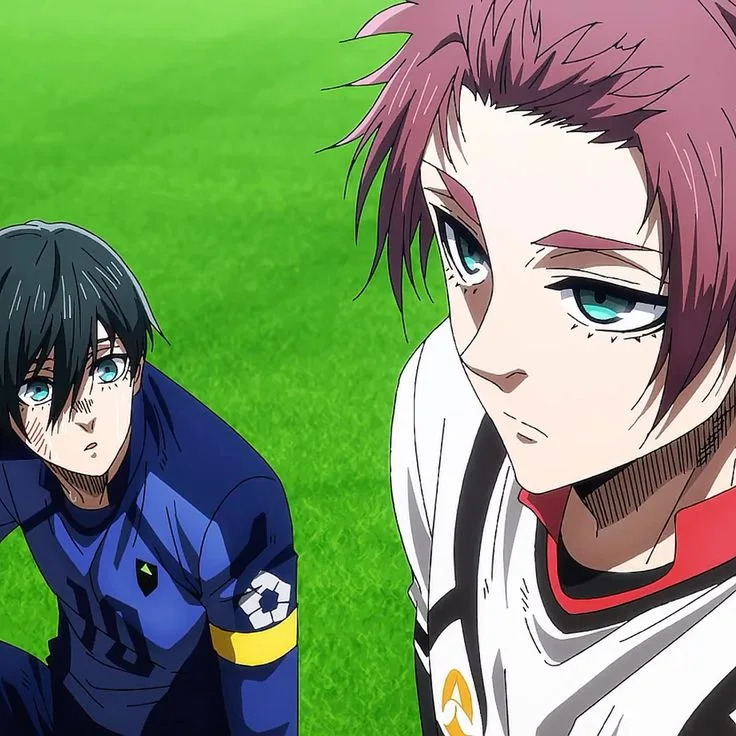
Sae did not speak to Rin after the final whistle. Despite Rin winning their 1v1 during the match and being the best player on the pitch, Sae turned to Isagi instead and acknowledged him as the heart of Blue Lock and the player who would change Japanese football.
That moment is arguably more devastating than the chapter 125 rejection. At least then Sae spoke to him directly. After the U-20 match, Sae looked straight past Rin like he was not there at all, and gave the recognition Rin had been chasing his entire football life to someone else.
That is what turns Isagi from a rival into an obsession for Rin. And that is what the rest of his arc is about.
Is Rin stronger than Isagi?
For most of the series Rin is the more complete player technically. By the end of the Neo Egoist League the gap has closed. Isagi wins their final match, but Rin’s ceiling when fully unlocked remains among the highest in Blue Lock.
Why does Rin call Isagi the Demon King?
After losing the Neo Egoist League final, Rin labels Isagi Blue Lock’s Demon King. From Rin, that is genuine acknowledgment. It signals that Isagi has become the rival who replaced Sae’s phantom, a real present challenge rather than a ghost from the past.
What is Rin’s true ego in Blue Lock?
Revealed in chapter 271, his true ego is destruction at the cost of life. The desire to fight something stronger than yourself and give everything to destroy it even if you are destroyed in the process. He discovered this watching Boss Monster villains on a children’s show as a kid and finding them more compelling than the heroes.