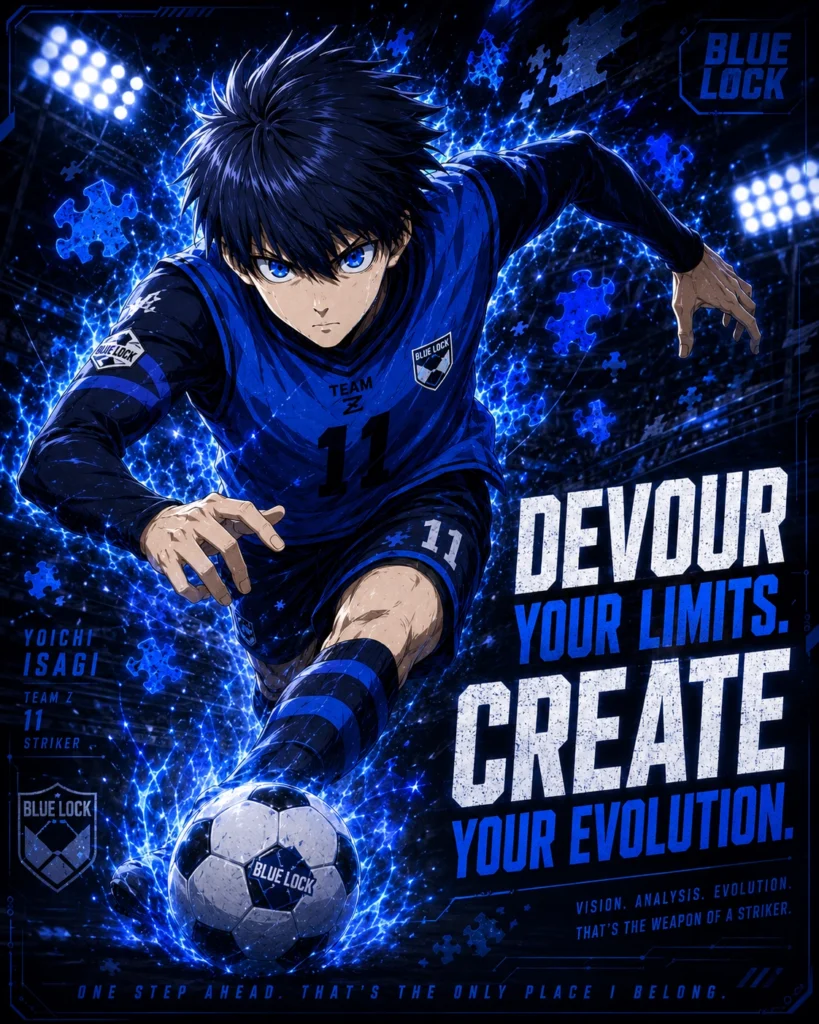
Yoichi Isagi: Decoding the Blue Lock Protagonist's Ego, Evolution, and How to 'Devour' Your Own Potential for Success.
Have you ever felt ordinary, invisible, or unsure of your own talent in a world that seems full of prodigies? Yoichi Isagi, the protagonist of Blue Lock, knows that feeling all too well. At first, he was just another high school forward, easily overlooked and uncertain of his place. But through an unyielding hunger for evolution and an obsession with his ‘ego,’ he transformed into a striker capable of shaking the football world. Imagine if his journey could serve as a blueprint for unlocking your hidden potential.
This article isn’t just a character breakdown, it’s a roadmap. We’ll explore Isagi’s psychological evolution, his tactical intelligence, and the intense mindset that fuels his growth. By analyzing his struggles, victories, and interactions with rivals, you’ll uncover how a focused, self-aware approach can turn limitations into stepping stones.
By the end, you’ll walk away not only with a deep understanding of Isagi’s genius but also with practical lessons for your own life. You’ll learn how to identify your unique ‘weapon,’ strengthen your personal ego without egoism, and push relentlessly toward your goals, whether on the field, at work, or in personal growth.
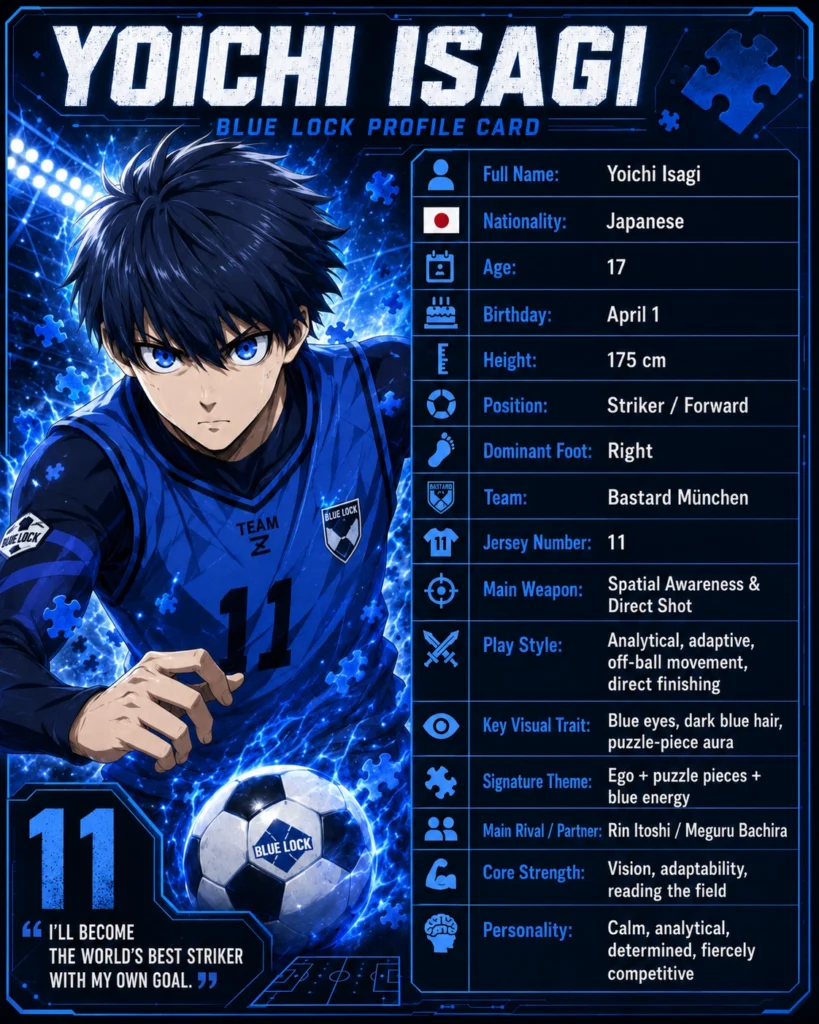
His Foundation: Background and Early Struggles
Yoichi Isagi starts as the everyman of Blue Lock, ordinary, overlooked, and far from a prodigy. His early life was centered on high school soccer, where his dream was simple: win the national championship with his team. There was nothing flashy about him, no innate gimmick, just a dedicated forward focused on teamwork over individual brilliance.
But beneath this apparent normalcy was the seed of something greater: his ego. Initially dormant, it was the drive to be the best striker in the world, quietly waiting for the right challenge to awaken. This is introduced right in Chapter 1/Episode 1, where readers see Isagi’s modest beginnings and perceive him as “just another player.”
Early Journey Before Blue Lock
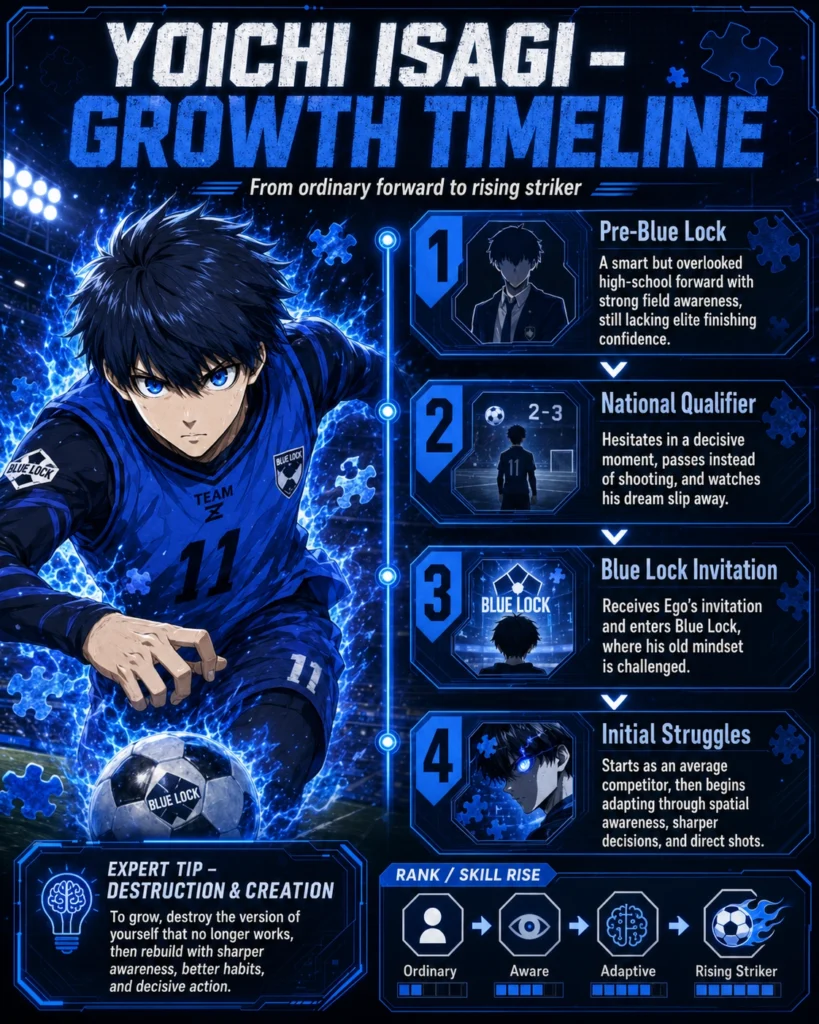
Before the Blue Lock project, Isagi’s style emphasized teamwork and safety, often at the cost of showcasing his true potential. His performance was solid but unremarkable, he was the dependable player, not the standout star.
The pivotal moment came during the national qualifier, where his team lost. That defeat shattered the comfort of “team play” and forced him to confront an uncomfortable truth: playing for others was a compromise of his potential. When the Blue Lock invitation arrived, it demanded a radical shift in mindset, to embrace ego, competition, and self interest over the familiar safety of teamwork.
Initial Struggles in Blue Lock
Once inside Blue Lock, Isagi faced a harsh reality. He was surrounded by exceptionally talented peers and had to unlearn ingrained habits, such as over-passing or avoiding risk. He began as one of the lowest-ranked players, struggling to assert himself. But his strength lay in independent improvement. Without relying on mentors, he analyzed, adapted, and evolved his playstyle rapidly, turning weaknesses into stepping stones.
Here’s a Tip: Embrace “destruction and creation.” Just as Isagi had to dismantle old beliefs about teamwork to awaken his ego, don’t be afraid to break old habits or methods that no longer serve your goals. True growth often requires leaving your comfort zone behind.
The Arsenal: Isagi’s Key Abilities and ‘Weapons’ Explained
Yoichi Isagi’s rise in Blue Lock isn’t just about raw talent, it’s a masterclass in self-awareness, adaptability, and strategic thinking. His arsenal of skills forms the backbone of his transformation from an ordinary player into a top-tier striker. Let’s break down his core abilities and the lessons they offer for personal growth.
Spatial Awareness – The Foundation of Genius
At the heart of Isagi’s game lies spatial awareness. This isn’t just knowing where the ball is; it’s perceiving the entire field, anticipating player movements, and identifying the best scoring zones. From his first selection match to early encounters against Team V, Isagi’s ability to read the field allowed him to exploit gaps others didn’t see, giving him a tactical edge.
Real-world takeaway: Developing situational awareness like athletes or business professionals scanning environments can enhance decision making. Techniques from The Inner Game of Tennis by W. Timothy Gallwey illustrate how heightened awareness can improve performance under pressure.
Direct Shot – Precision in Action
Isagi’s Direct Shot is his signature move, evolving from a lucky strike into a high precision, reliable goal scoring weapon. Combined with his spatial intelligence, it allows him to strike at exactly the right moment and place, often when defenders least expect it.
Lesson for you: Repetition plus deliberate practice turns raw talent into consistent performance. Identify your “Direct Shot” in your field, a skill you can master and deploy under pressure.
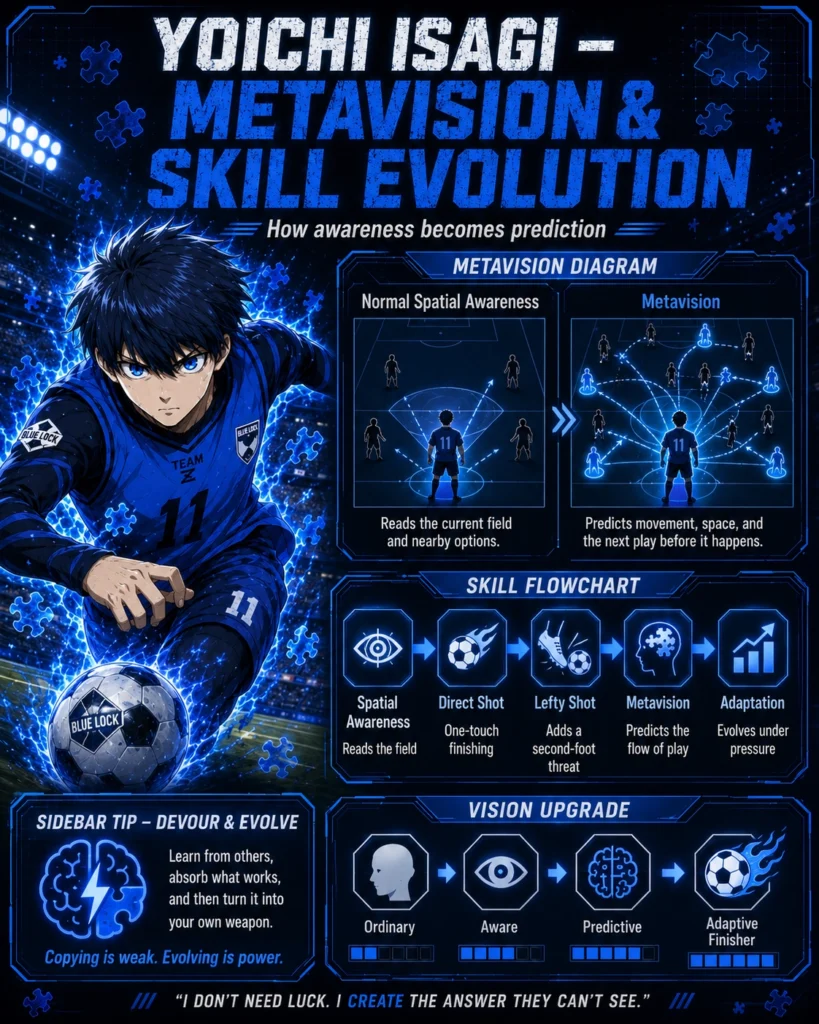
Metavision – Seeing Several Moves Ahead
The ultimate evolution of spatial awareness is Metavision. With it, Isagi processes the field in real time, predicts multiple steps ahead, and controls the flow of the game. Reddit fans highlight this as a pivotal moment: “Metavision brought him from barely useful to top 3.”
Visual Suggestion: A diagram showing normal awareness vs. Metavision, with arrows representing multiple predicted movements, to illustrate how he anticipates plays before they happen.
Adaptability and ‘Devouring’ Skills
Isagi doesn’t just observe, he learns from others and integrates their strengths into his own style. Whether it’s off ball movement from Naruhaya, reflexes from Hiori, or metavision from Kaiser, he “devours” what works and evolves it uniquely.
Expert Tip: Don’t copy blindly. Instead, analyze, adapt, and integrate lessons into your own methods, creating something new that fits your strengths.
Analytical Mind and Game IQ
His strategic intelligence lets him break down plays, find patterns, and create opportunities where none seem to exist. Coupled with off ball movement, Isagi is always in the right place at the right time, turning observation into decisive action.
Real world application: Just like Isagi, developing analytical skills and situational adaptability can make you a strategic performer in any competitive environment.
The Forge of Ego: Isagi’s Psychological Evolution
Yoichi Isagi’s transformation isn’t just physical, it’s a journey of the mind. In Blue Lock, his growth demonstrates how refining one’s psychological approach can unlock extraordinary performance.
The Initial Spark
Everything changed when Isagi realized that playing “ordinary” soccer was holding him back. Jinpachi Ego’s ruthless philosophy challenged him: to be the best striker in the world, he needed to embrace his ego, prioritizing personal growth and goal-scoring, even if it conflicted with teamwork norms.
This moment parallels Carol Dweck’s concept of growth vs. fixed mindset (Mindset, 2006). Early on, Isagi relied on existing structures and comfort zones, a fixed mindset. The Blue Lock challenge pushed him into a growth mindset, seeking continuous improvement and learning from failure.
Defining Moments & Awakening
Isagi’s first goal in Blue Lock was more than a statistic, it marked the awakening of his “smell of a goal,” the instinctive drive to capitalize on opportunities. From hesitation to calculated risk-taking, he began to analyze opponents, absorb their strengths, and surpass them.
Expert Tip: Seek out rivals and mentors. Observe what makes them excel, then integrate those lessons into your own strategy, don’t mimic, evolve your unique approach.
The ‘Devouring’ Mindset
As Isagi progressed, he developed the ability to devour others’ abilities: off ball movements, reflexes, tactical insights, even psychological tricks. This mindset turned rivals into teachers and setbacks into fuel for improvement.
Real world application: Professionals can adopt this mindset by analyzing competitors or top performers and internalizing techniques that align with their strengths.
Flow State & Peak Performance
Through constant practice and mental sharpening, Isagi reaches moments of psychological peak performance, where intuition guides action and decisions feel effortless, the flow state. This is where his spatial awareness, metavision, and decision making converge to maximize output under pressure.
Resilience & Learning from Failure
Doubt, losses, and setbacks aren’t obstacles, they’re the forge of greatness. Each failure refined Isagi’s focus, resilience, and understanding of his ego.
Expert Tip: Don’t dwell on failure. Critically evaluate setbacks, extract lessons, and use them as a stepping stone toward future success.
Defining the Ego
By the Neo Egoist League, Isagi’s ego is fully clarified: his ultimate goal and unwavering focus define his actions. Understanding what you’re truly willing to dedicate or sacrifice allows you to channel energy efficiently, just like Isagi channels every move toward his ultimate ambition.
Suggested Visuals / Infographics
- Psychological Evolution Table: Track Isagi’s progress across key attributes over time. Example layout:
Attribute | Initial Blue Lock | Second Selection | U-20 Match | Neo Egoist League (Current) |
Spatial Awareness | Instinctive (2/5) | Developing (3/5) | Advanced (4/5) | Metavision (5/5) |
Direct Shot Accuracy | Decent (2/5) | Improved (3/5) | Pinpoint (4/5) | Unstoppable (5/5) |
Game IQ | Budding (2/5) | Analytical (3/5) | Strategic (4/5) | Genius (5/5) |
Ego Level | Latent (1/5) | Awakened (3/5) | Refined (4/5) | Dominant (5/5) |
Physicality | Average (2/5) | Improved (3/5) | Agile (3.5/5) | Explosive (4/5) |
- Sidebar Callout: “Expert Tip – Define your ego: Clarify your ultimate goal and what you’re willing to sacrifice.”
- Flow State Illustration: Diagram showing focus, spatial awareness, and metavision merging, representing peak mental performance.
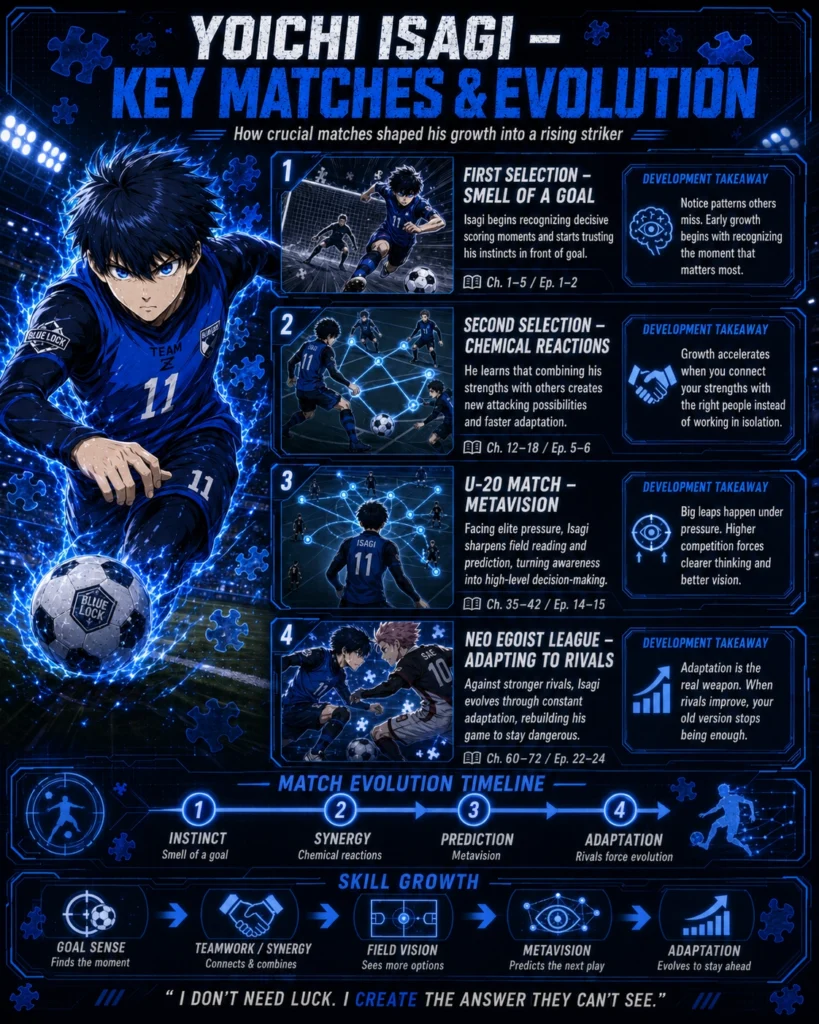
Crucible Moments: Critical Matches and Breakthroughs
Yoichi Isagi’s growth isn’t just measured in goals, It’s defined by pivotal games and high-pressure challenges that shaped his skill, mindset, and ego. These matches act as a playbook for overcoming obstacles, learning from rivals, and evolving under pressure.
First Selection – The Smell of a Goal
In the First Selection, Isagi experienced his first true awakening. Scoring against Team V, he began to sense opportunities before they materialized, noticing Barou’s predatory movements and exploiting defensive weaknesses. This match marked the formation of his original team and the start of his strategic thinking.
Personal Takeaway: Recognize your unique opportunities early. Being aware of your environment and anticipating key moments gives you an edge in competitive scenarios.
Second Selection – Solo Challenge and Refinement
During the Second Selection, Isagi faced a solo challenge, forcing him to form a new team while refining his Direct Shot. He observed and devoured Rin Itoshi’s playstyle, learning the concept of “chemical reactions” in teamwork, how combining different strengths creates exponential results.
Lesson for readers: Collaboration doesn’t mean compromise. Study the best, extract strategies, and integrate them into your unique approach to create synergy.
Third Selection & U-20 Match – Metavision in Action
In the Third Selection and U-20 match, Isagi’s Metavision came to the forefront. He led the Blue Lock Eleven against superior opponents, showcasing strategic foresight, spatial mastery, and decisive off ball movement. His ability to process multiple possibilities simultaneously made him indispensable.
Real world takeaway: Developing foresight and analytical thinking allows you to anticipate challenges and position yourself for success.
Neo Egoist League – Facing World-Class Rivals
The Neo Egoist League tested Isagi against world class youth players. Clashes with Kaiser pushed him to constantly evolve his Metavision and adaptability, proving that growth often comes from facing and learning from superior competition.
Expert Tip: Seek challenging rivals. They reveal gaps in your skillset and inspire you to push beyond your limits.
The Catalyst Crew: Relationships and Rivalries
Yoichi Isagi’s evolution in Blue Lock is shaped by the people around him. Rivals, allies, and unattainable ideals act as catalysts, each interaction pushing him to discover new skills, refine his ego, and elevate his game.
Isagi and Bachira Meguru – Creative Synergy
Bachira sparks creative collaboration and mutual inspiration. In Chapters 7-10 (Episode 3), their first interactions highlight how Bachira’s unpredictable style forces Isagi to think faster and explore possibilities he hadn’t noticed, laying the foundation for his strategic creativity.
Takeaway: Find collaborators who challenge and inspire you. The right partnership can unlock creativity and perspective you cannot achieve alone.
Isagi and Rin Itoshi – The Ultimate Rival
Rin is Isagi’s ultimate rival. Between Chapters 20-25 (Episodes 6-7), their “devouring” dynamic is clear, each learns from the other’s strengths, constantly pushing Isagi to refine his Metavision and ego. The exchanges show Isagi adapting in real time to Rin’s moves, turning competition into accelerated growth.
Lesson: True rivals do more than compete. They reveal blind spots and drive improvement when observed and integrated thoughtfully.
Isagi and Seishiro Nagi – Genius vs. Cultivated Skill
Chapters 15-18 (Episodes 4-5) highlight Nagi’s innate genius, contrasting with Isagi’s cultivated skills. Observing Nagi pushes Isagi to focus on synergy and intentional improvement, showing that deliberate practice can rival raw talent.
Isagi and Itoshi Sae – The Unattainable Ideal
In Chapters 30-32 (Episode 12), Sae represents the ideal Isagi aspires to reach. She inspires him to push beyond comfort zones and sharpen his Metavision, proving that striving for high standards accelerates growth even when perfection is unattainable.
Isagi and Michael Kaiser – Intense Rivalry
Kaiser tests Isagi at every turn in Chapters 60-70 (Episodes 22-24). Their clashes force Isagi to constantly adapt and invent strategies, illustrating that resilience and innovation under pressure distinguish exceptional performers.
Expert Tip: Learn from Rivals
Don’t just compete, analyze what makes your rivals excel and integrate those lessons into your own methods. This approach turns competition into a source of skill and insight rather than stress.
Isagi’s Blueprint: Philosophy for Unstoppable Growth
Yoichi Isagi’s rise in Blue Lock is not just a story of skill but of a philosophy that fuels relentless growth. His mindset, refined through rivalry, failure, and constant self-analysis, provides a blueprint for anyone striving to unlock their potential.
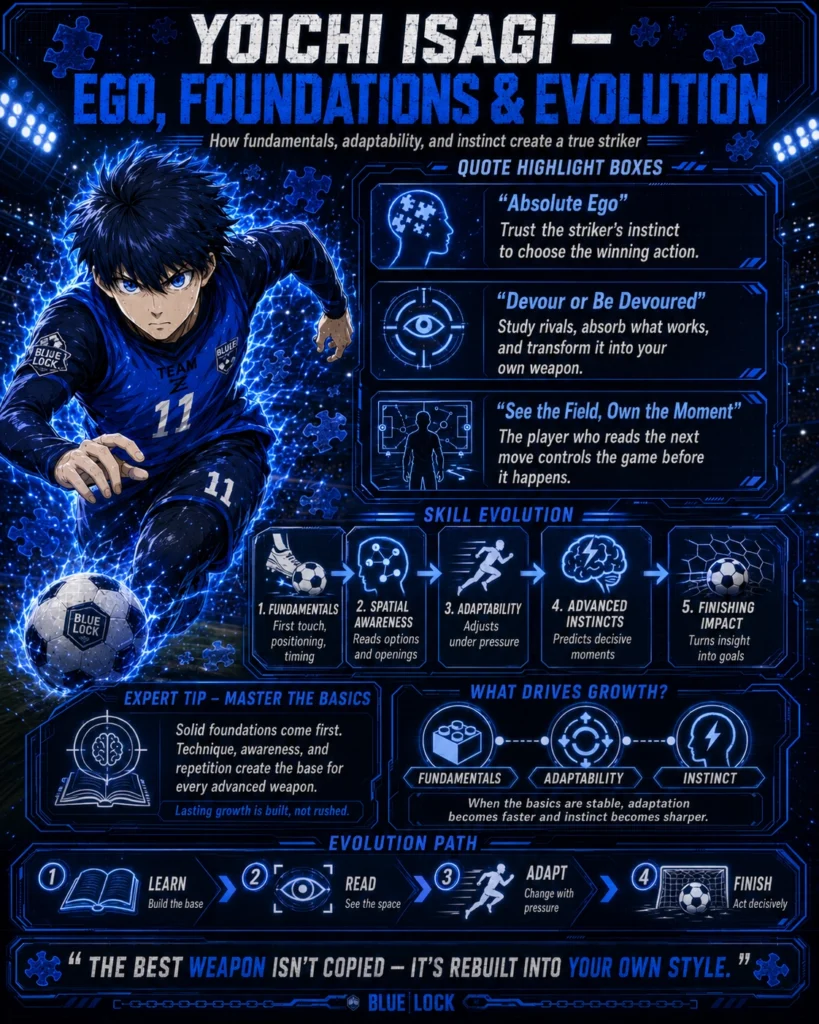
The Absolute Ego
At the core of Isagi’s philosophy is the absolute ego, the unwavering belief that he is the player who must score. Early internal monologues and dialogues in Chapters 1-5 (Episode 1-2) show him wrestling with hesitation, then gradually committing to taking responsibility for decisive moments on the field. This belief drives him to act decisively rather than defer to others.
Lesson: Develop confidence in your unique role. Understand your strengths and commit fully to taking action when opportunities arise.
Devour or Be Devoured
Isagi’s motto, “Devour or Be Devoured,” reflects his approach to competition. He analyzes opponents, absorbs effective strategies, and surpasses them. For example, during Chapters 20-25 (Episodes 6-7), he internalizes Rin Itoshi’s movements and patterns, transforming observed techniques into tools that enhance his own play.
Real world application: Study top performers and rivals. Analyze what works, adapt it to your strengths, and make it your own instead of simply copying.
Constant Evolution and Adaptability
Isagi understands that growth requires constant adaptation. He discards outdated methods and develops new “weapons” to remain ahead. His journey shows that progress is iterative: every setback, every rival interaction, every match is a chance to refine skills and mindset.
Lesson: Never settle for comfort. Continuously review, refine, and innovate in your craft.
The Unsung Ego
While his goals and shots grab attention, it is Isagi’s adaptability and analytical thinking that define his genius. Observing the flow of play, anticipating opponents’ moves, and adjusting in real time demonstrate that true success comes from strategy, not just raw talent.
The Smell of a Goal
This predatory instinct is more than intuition. As seen in Chapters 7-10 (Episode 3), Isagi develops a “sense” for scoring opportunities, aligning spatial awareness and timing to exploit openings. It is the culmination of awareness, analysis, and ego driven decisiveness.
Mastery of the Basics
Even as he acquires advanced skills, Isagi never stops refining the fundamentals, spatial awareness and the Direct Shot. This principle underlines the importance of solid fundamentals before attempting complex strategies.
Expert Tip: Master the basics first. Build strong foundational skills so you can effectively apply advanced techniques under pressure.
My Isagi Moment: A Personal Journey of ‘Devouring’
Everyone faces moments that test their focus, confidence, and ability to take decisive action. For me, that moment came during a high stakes project at work. I was responsible for delivering a complex analysis under tight deadlines, and despite preparation, I felt overwhelmed by competing opinions and the sheer scale of the task. It was easy to defer or rely on others, but I knew I had to step up.
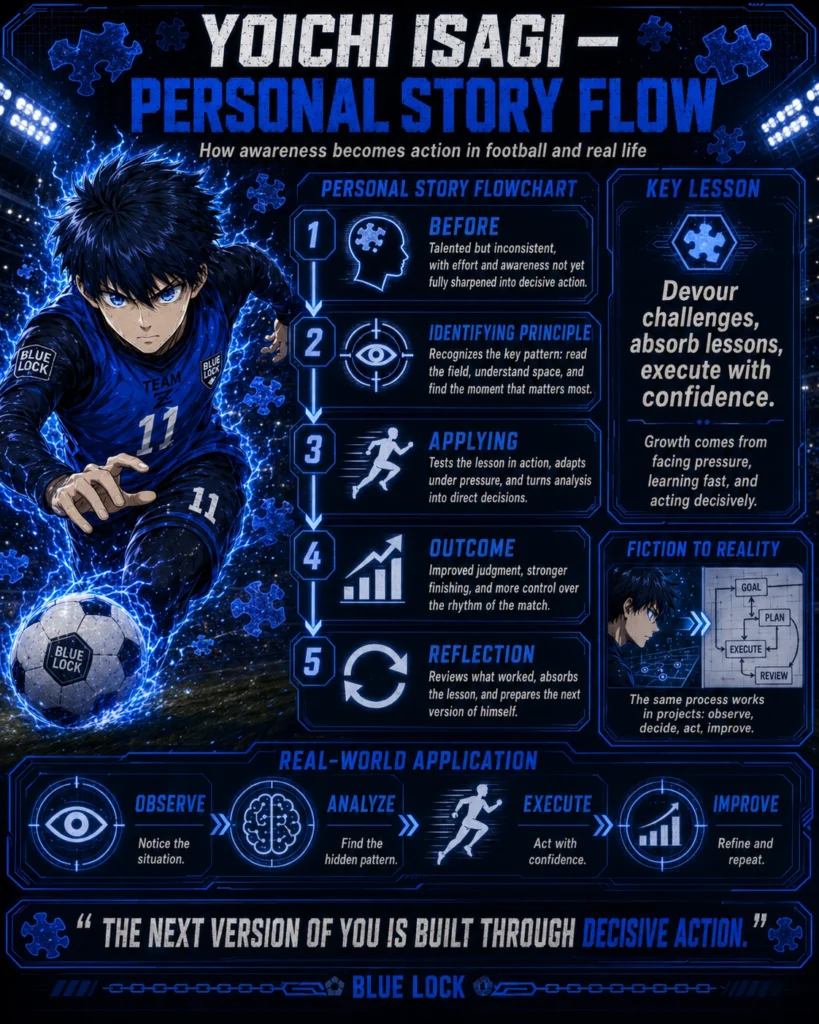
Identifying the Isagi Principle
At that point, I remembered Isagi’s mindset from Blue Lock. His principle of “Devour or Be Devoured” resonated deeply. He doesn’t wait for opportunities; he analyzes, absorbs, and leverages every advantage to surpass his rivals. For me, the rivals were the challenges themselves. tight deadlines, unfamiliar tasks, and the pressure of delivering flawless results.
Applying the Principle
I consciously applied Isagi’s approach. First, I broke down the project into smaller, actionable tasks, mapping them like Isagi analyzes the field. I studied the best practices of my peers, extracting techniques I could adapt rather than copying blindly. Each day, I refined my process, continuously assessing what worked and what needed adjustment, much like Isagi evolving his Direct Shot and Metavision during matches.
I also embraced his absolute ego mindset. I told myself that this project was mine to own and executed each decision with accountability and focus, avoiding unnecessary hesitation or deferring responsibility.
The Outcome
By the end, the project was not only completed on time but received commendation for clarity and insight. More importantly, I gained confidence in my ability to confront complex challenges independently, applying strategic thinking and adaptability inspired by Isagi’s example.
Reflection
This experience transformed my approach to challenges. Like Isagi, I learned that true growth comes from analyzing obstacles, absorbing lessons from others, and executing decisively. Challenges are no longer threats but opportunities to refine skills, test resilience, and elevate performance.
Tools Inspired by Isagi
I also implemented personal development frameworks that mirrored his tactical mindset:
- SMART Goals for clear, measurable objectives
- SWOT Analysis to identify strengths, weaknesses, opportunities, and threats
These tools helped me plan strategically, just as Isagi plans his plays with awareness and foresight.
Takeaway: Adopting a proactive, analytical, and ego driven mindset, while remaining adaptable can turn daunting challenges into opportunities for growth, much like Isagi transforms every match into a platform for evolution.
Unleashing Your Inner Striker: Lessons from Isagi for Personal Growth
Yoichi Isagi’s journey in Blue Lock is powerful because it feels surprisingly real. He is not the strongest, fastest, or most naturally gifted player at the start. His real strength is the way he studies himself, learns from pressure, and turns every weakness into a new weapon.
Identify Your Weapon
In Isagi’s case, his weapon begins with spatial awareness and later evolves into Direct Shot, Metavision, and sharper decision-making. For you, a “weapon” could be writing, public speaking, problem-solving, leadership, creativity, discipline, or emotional intelligence.
The key is not just finding what you are good at. It is refining that strength until it becomes reliable under pressure. Ask yourself: What do people often depend on me for? What skill feels natural but still has room to grow? What advantage can I sharpen daily?
Expert tip: Identify your weapon and train it with intention. Like Isagi refining his spatial awareness and Direct Shot, your strength only becomes powerful when you practice it consistently.
Cultivate a Healthy Ego
Isagi’s ego is not empty arrogance. It is focused on ambition. He believes he must become the one who scores, but that belief comes with responsibility, effort, and constant self-analysis. This is the difference between confidence and pride.
In real life, a healthy ego means trusting your ability to grow. It means saying, “I can become better,” instead of waiting for someone else to choose you, approve you, or rescue you. You take ownership of your goals and actions.
Develop Metavision in Your Field
Metavision is Isagi’s ability to read the field, predict movements, and act before others fully understand what is happening. Outside Blue Lock, this means learning to observe your environment with more focus.
At work, it could mean noticing market trends before competitors do. In studies, it could mean understanding which topics matter most before exams. In personal growth, it could mean recognizing habits that are slowly holding you back.
Expert tip: Cultivate Metavision in your field. Observe patterns, anticipate challenges, and prepare for opportunities before they fully appear.
Embrace Destruction and Creation
One of Isagi’s strongest lessons is that growth often requires letting go. He had to destroy his old belief that safe teamwork was always the right answer. Only then could he create a stronger version of himself.
You may need to do the same. Maybe an old routine no longer works. Maybe a belief about your limits is outdated. Maybe your current strategy helped you reach one level but cannot take you to the next.
Expert tip: Do not be afraid to dismantle old methods that no longer serve you. Growth often begins when comfort ends.
Learn from Rivals and Failure
Isagi does not waste time hating his rivals. He studies them. Rin, Nagi, Kaiser, and others force him to see his weaknesses clearly. Instead of breaking under pressure, he uses competition as information.
Your rivals can do the same for you. They show what is possible. They reveal gaps in your skillset. Failure works the same way. It can either become proof that you should stop, or evidence that you need a better strategy.
Isagi’s imperfections matter because they make his evolution believable. His doubt, losses, and frustration are not signs of weakness. They are the pressure points that create his biggest breakthroughs.
Choose Consistency Over Bursts
Isagi’s growth is not instant. Every major breakthrough is built on smaller lessons, repeated analysis, and constant adjustment. He improves because he keeps showing up mentally and physically.
That is also how real progress works. One intense effort may feel exciting, but consistency creates lasting change. Ten focused minutes every day can become more powerful than one random burst of motivation every few weeks.
Expert tip: Choose consistency over bursts. Small daily improvements build the kind of momentum that eventually looks like talent.
Use Feedback as Fuel
Isagi constantly learns from what the field gives him. A failed move, a rival’s reaction, a missed opportunity, or a successful goal all become feedback. He does not ignore information just because it hurts his pride.
This is a major personal growth lesson. Feedback is not an attack. It is data. Positive feedback shows what to repeat. Critical feedback shows what to refine. The faster you can learn from both, the faster you evolve.
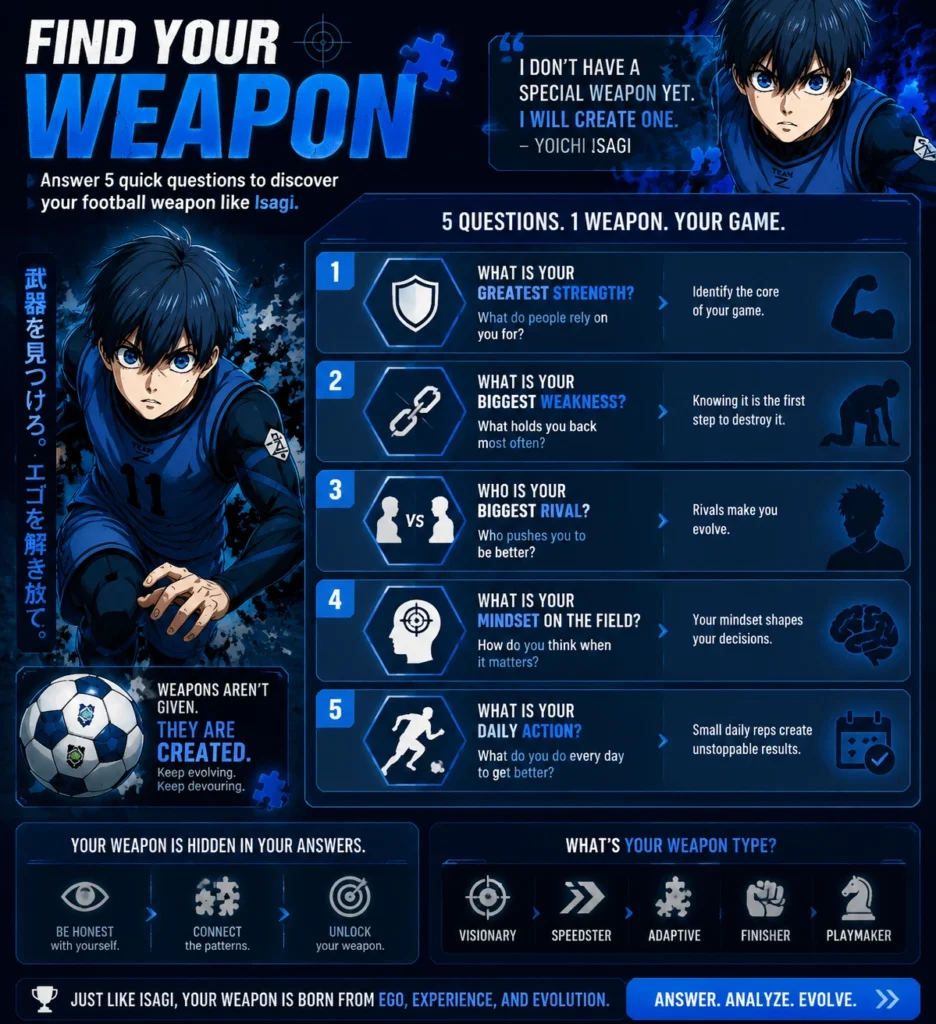
Quick Self-Check: What Is Your Isagi Weapon?
Ask yourself these five questions:
- What skill gives me the strongest advantage right now?
- What weakness keeps showing up when I am under pressure?
- Who is my “rival” or role model, and what can I learn from them?
- What old habits or beliefs do I need to destroy to grow?
- What one action can I repeat daily to sharpen my weapon?
Your answers will show where your next evolution should begin.
What’s Your Weapon?: Interactive Self-Reflection
Isagi’s growth becomes powerful when you stop seeing it as just fiction and start asking, “How can I apply this to my own life?” His journey is really about self awareness, focus, competition, and the courage to evolve. This short reflection will help you identify your own “weapon” and understand where your next breakthrough might come from.
1. What is your “spatial awareness” in your field?
Isagi notices patterns others miss. He reads the field, tracks movement, and understands where the best opportunity will appear.
Ask yourself: What do I notice that other people often overlook?
Maybe you understand customer behavior, spot errors quickly, read people well, or see creative angles others miss. That hidden awareness could be your biggest advantage.
2. What is your “Direct Shot”?
Isagi’s Direct Shot is simple, sharp, and effective. It is the action he can trust when the moment arrives.
Ask yourself: What is the one action that moves me closest to my goal?
It could be publishing consistently, improving one core skill, reaching out to clients, studying daily, practicing sales calls, or building a stronger portfolio. Your Direct Shot is the action that creates real progress.
3. Who are your rivals?
In Blue Lock, rivals are not just obstacles. They are mirrors. Rin, Nagi, Barou, and Kaiser all reveal something Isagi needs to learn.
Ask yourself: Who challenges me, inspires me, or makes me feel behind?
Instead of feeling threatened, study them. What do they do better? What system, habit, skill, or mindset can you “devour” and adapt into your own style?
4. What do you need to destroy?
Isagi could not grow until he let go of his old habit of playing safe. His evolution required destruction before creation.
Ask yourself: What belief, routine, or method is holding me back?
Maybe you are waiting for perfect conditions. Maybe you avoid risk. Maybe you keep using a strategy that worked before but no longer fits your goals. Growth often begins when you stop protecting the old version of yourself.
5. What is your ultimate goal?
Isagi’s ego becomes stronger when his goal becomes clear. He knows what he wants: to become the best striker.
Ask yourself: What am I truly chasing?
Be specific. Do you want to become financially independent, build a career, master a skill, grow a business, improve your health, or become more confident? Once the goal is clear, your ego becomes direction, not arrogance.
6. How strong is your ego for it?
A healthy ego means you believe your goal matters enough to fight for it. It does not mean ignoring others. It means refusing to abandon yourself.
Ask yourself: Am I willing to improve, sacrifice comfort, accept feedback, and stay consistent for this goal?
If the answer is yes, you have already taken the first step toward your own Isagi moment.
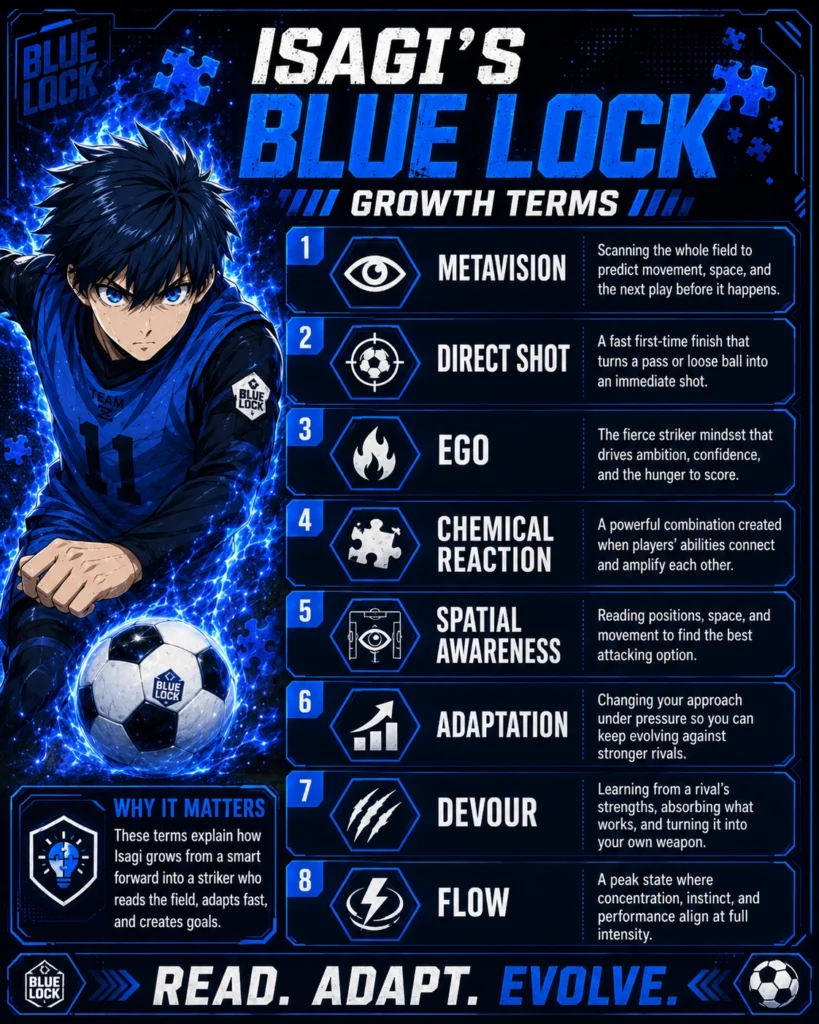
Key Concepts and Terminology Relevant to Isagi
To understand Yoichi Isagi’s growth, you need to understand the key Blue Lock terms connected to his journey. These ideas are not just football terms. They explain how Isagi thinks, adapts, competes, and evolves into a sharper version of himself.
Term | Meaning in Isagi’s Journey |
Ego | Isagi’s deep self-belief and desire to become the striker who decides the game. For him, ego is not just arrogance. It is the hunger to take responsibility, score goals, and keep evolving. |
Metavision | The advanced form of Isagi’s spatial awareness. It allows him to scan the field, read player movements, predict future plays, and position himself before the opportunity fully appears. |
Spatial Awareness | Isagi’s natural ability to understand where players, the ball, and the goal are at all times. This helps him find open spaces, predict chances, and appear in the right place at the right moment. |
Flow State | A peak mental state where Isagi becomes fully focused on the match. His decisions feel faster, his movements become sharper, and he plays with instinctive confidence. |
Devouring | Isagi’s method of studying opponents, understanding what makes them strong, and turning those lessons into part of his own playstyle. He does not simply copy others. He adapts and evolves their strengths into something that fits him. |
Direct Shot | Isagi’s signature scoring technique. He shoots immediately after receiving the ball, without wasting time on extra touches. It works because his positioning and timing are already prepared. |
Chemical Reaction | A powerful moment created when two or more players combine their unique weapons. For Isagi, these reactions often help him unlock new scoring chances through teamwork, instinct, and shared vision. |
Weapon | A player’s most reliable strength. For Isagi, his main weapons include spatial awareness, Direct Shot, adaptability, and later Metavision. His journey is about discovering these weapons and sharpening them under pressure. |
These terms show why Isagi is such a compelling protagonist. His power does not come from one flashy skill. It comes from how he understands himself, studies others, and keeps upgrading his game. That is what makes his evolution feel earned.
Conclusion
Yoichi Isagi’s journey is powerful because it begins in such an ordinary place. He is not introduced as an unstoppable genius. He is a player filled with doubt, hesitation, and unrealized potential. Yet through ego, adaptability, failure, and relentless self-improvement, he transforms into one of Blue Lock’s most fascinating strikers.
His story proves that growth is not only about talent. It is about learning how to read your environment, sharpen your strengths, challenge your limits, and turn pressure into evolution. Isagi’s true genius is not just his Direct Shot or Metavision. It is his ability to rebuild himself whenever the game demands something new.
That is the lesson readers can take beyond Blue Lock. Identify your weapon. Build a healthy ego. Study your rivals. Learn from failure. Master the basics. Stay consistent. When challenges appear, do not run from them. Devour them, learn from them, and use them to create a stronger version of yourself.
In the end, Isagi reminds us that greatness is not reserved only for prodigies. Sometimes, the person who evolves the fastest becomes the most dangerous player on the field.
Accuracy note: This analysis reflects Isagi’s development as of May 2026, with the manga progressing through the U-20 World Cup Arc around Chapter 345 to Chapter 346, while the anime’s second season covered Blue Lock vs. U-20 Japan and a third season adapting the Neo Egoist League arc has been announced. This section should be reviewed and updated as new manga chapters and anime episodes are released.