Michael Kaiser Character Analysis: Blue Lock’s Tragic Emperor
Beyond the Golden Ego
In Blue Lock, rivals are not just obstacles. They are the pressure that forces players to evolve. Michael Kaiser is one of the strongest examples of this. He enters the story with a golden aura, a cold smile, and the confidence of someone who believes the field belongs to him.
At first, Kaiser seems easy to define. He is arrogant, gifted, and obsessed with proving his superiority. But the more we see of him, the clearer it becomes that he is not just a simple antagonist. He is a catalyst. His presence pushes Isagi Yoichi to think faster, play smarter, and confront a level of football far beyond what he had known before.
What makes Kaiser so compelling is the tension between his talent and his insecurity. He carries himself like an emperor, yet beneath that image is a player shaped by pressure, ambition, and emotional wounds he refuses to show. His actions are often cruel and calculated, but they also reveal a desperate need to control his own story.
This analysis looks beyond Kaiser’s golden ego to explore who he really is. We will break down his psychology, playing style, motivations, rivalry with Isagi, and larger role in Blue Lock. More importantly, we will examine why Michael Kaiser remains one of the series’ most fascinating characters: brilliant, damaged, dangerous, and impossible to ignore.
The Golden Emperor’s Blueprint: Abilities, History, and Psyche
Key Biographical Information and First Appearance
Michael Kaiser is a German U-20 striker from Bastard München and one of the most important foreign players introduced in the Neo Egoist League. He is not a Blue Lock player trying to climb the system. He enters as someone already recognized on the world stage, which makes his presence feel different from the start.
Kaiser’s manga debut is listed as Chapter 149, while his first major role begins around the Bastard München introduction in Chapter 156. In the anime, his debut is connected to Episode 38, the final episode of Season 2. This makes him a bridge between the Japan-focused story and the wider world of elite football.
When Kaiser appears, the story’s power scale changes. Before him, Isagi’s rivals were mostly players inside Blue Lock, such as Rin, Nagi, Barou, and Bachira. Kaiser raises the standard. He is a member of the New Generation World XI, the ace of Bastard München, and the kind of striker Isagi must surpass if he wants to compete globally.
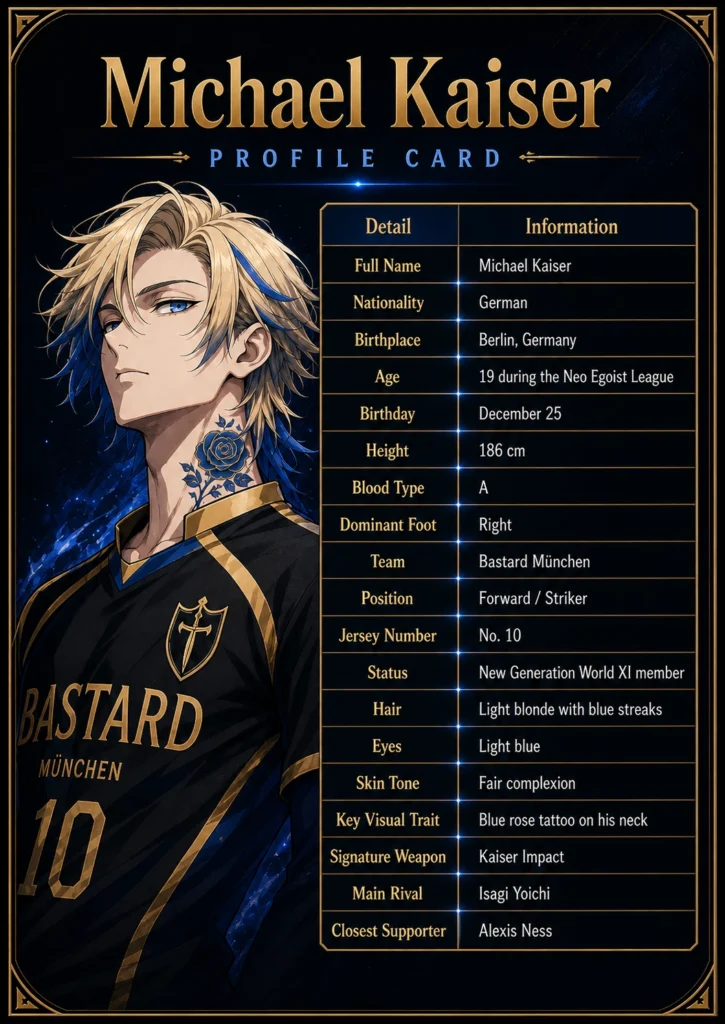
Kaiser’s design tells the reader a lot before he even speaks. His blonde hair, blue streaks, sharp eyes, and blue rose tattoo create an image that feels elegant but threatening. He looks like a prince, plays like an emperor, and behaves like someone who expects the whole field to obey him. His listed profile details include his age, height, birthday, dominant foot, team, and signature weapon.
Abilities, Playstyle, and Kaiser Impact Analysis
Kaiser’s football is built on control. He does not simply chase the ball or depend on raw emotion. He reads the field, understands where danger will appear, and moves into the best position before others can react. That is why his goals often feel sudden. He is already in the right place while everyone else is still processing the play.
Kaiser Impact
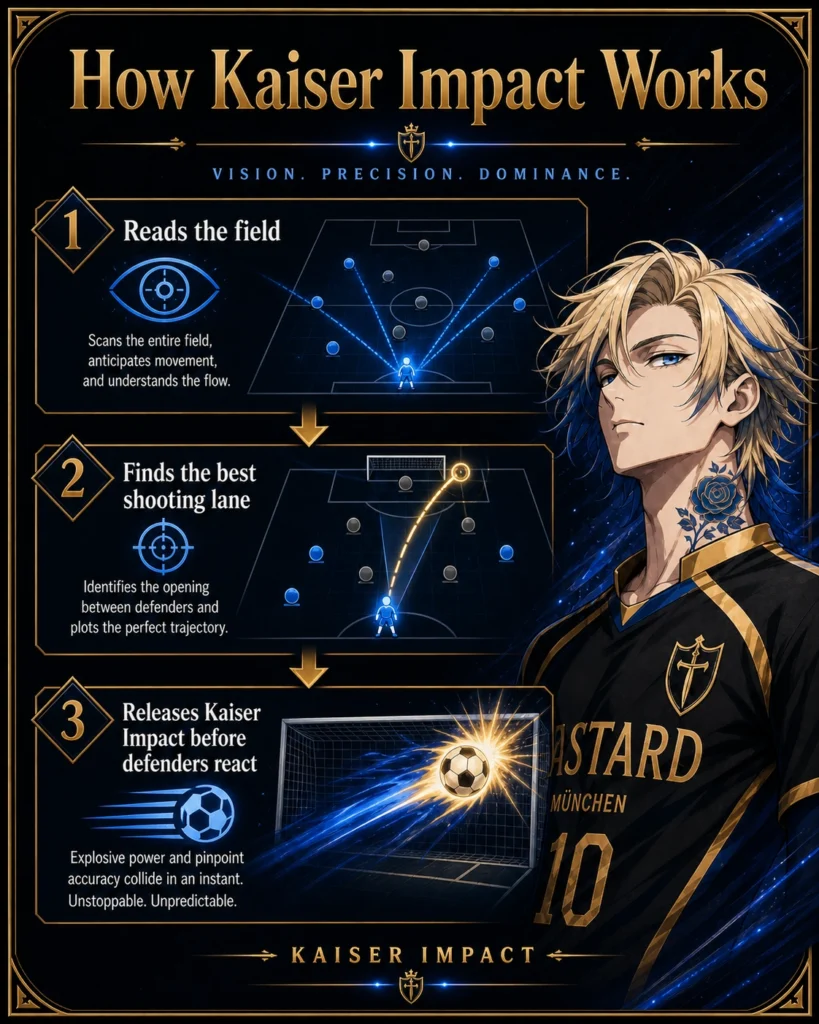
Kaiser Impact is his most famous weapon. It is a fast, precise right-footed shot that gives defenders and goalkeepers very little time to respond. The power of the shot is not only in the ball speed. The real danger comes from how quickly Kaiser can release it and how accurately he can aim it.
What makes Kaiser Impact so effective is the full setup behind it. Kaiser uses his field vision to find space, his positioning to receive the ball at the right moment, and his shooting technique to finish instantly. Isagi later recognizes Kaiser’s “golden formula” as a combination of Metavision and Kaiser Impact, which becomes a major clue for Isagi’s own evolution.
Exceptional Spatial Awareness
Kaiser’s spatial awareness is one of the biggest reasons he feels so dominant. He does not need to run randomly or force every play. Instead, he studies the field and chooses the most valuable space. This allows him to appear in dangerous positions at exactly the right time.
This is also why Isagi becomes so obsessed with understanding him. Kaiser shows Isagi what a higher level of vision looks like. For Isagi, Kaiser is not just a rival to defeat. He is also a model to study, break down, and eventually surpass.
Tactical Genius
Kaiser is not only a finisher. He is also a manipulator. He understands how to use teammates, pressure opponents, and control the emotional rhythm of a match. His connection with Alexis Ness is a strong example. Ness often acts like Kaiser’s loyal support system, feeding him the kind of passes that allow him to dominate.
But this is also where Kaiser’s weakness appears. His style depends heavily on control. When Isagi starts reading the same spaces and interrupting his plans, Kaiser becomes visibly irritated. That reaction is important because it shows that Kaiser’s confidence is not as unshakable as it first seems.
Physical Prowess
Kaiser’s physical ability supports everything he does. His speed, agility, balance, and endurance allow him to move smoothly through tight spaces and stay dangerous throughout the match. He is not written as a pure physical monster like some other players, but his body is perfectly suited to his playstyle.
He does not waste movement. He moves with purpose. That efficiency makes him feel calm, sharp, and difficult to read.
The Psychological Pressure of His Playstyle
Kaiser’s greatest impact is not only technical. It is psychological. He makes opponents feel late. He makes teammates feel dependent. He makes Isagi feel the gap between local genius and world-level genius.
That pressure is why Kaiser works so well as a narrative rival. He does not simply block Isagi’s path. He forces Isagi to evolve. Every time Kaiser dominates the field, he silently asks one question: “Can you really stand on the same stage as me?”
Kaiser’s Signature Moves and Stats Comparison
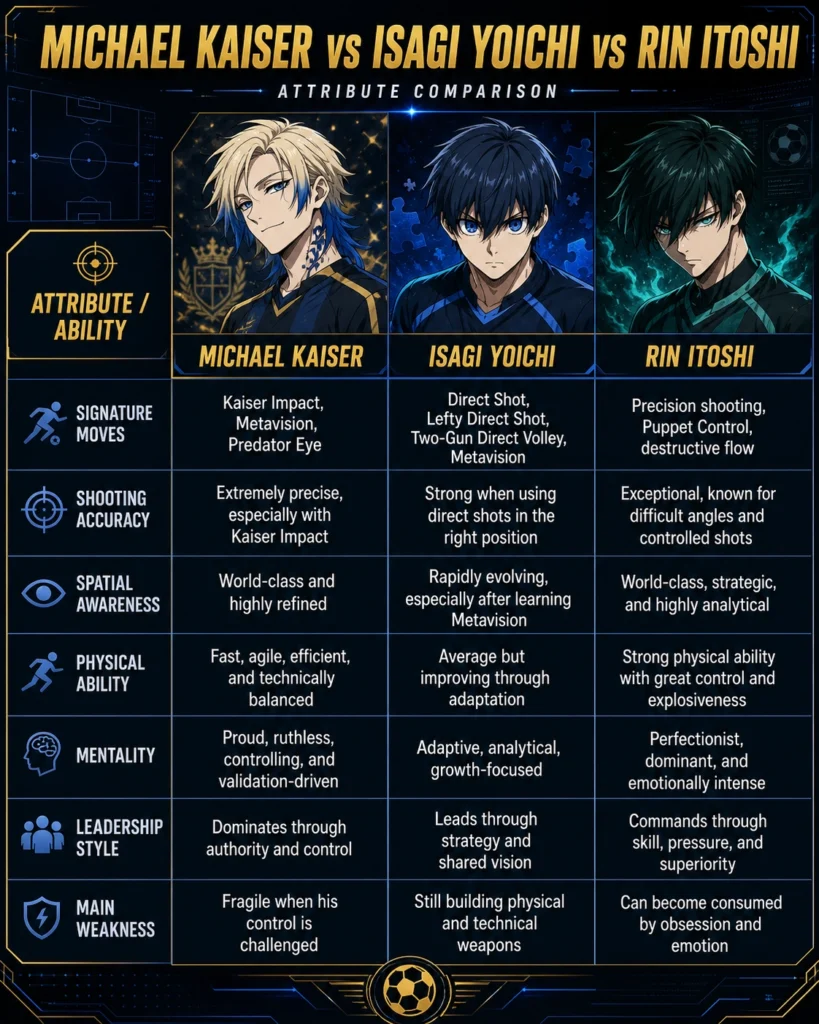
Kaiser’s biggest advantage is balance. He combines elite vision, sharp movement, and a world-class finishing weapon. Isagi is better at adaptation, while Rin is more naturally overwhelming in one-on-one dominance and shooting variety. Kaiser sits between them as a complete world-stage striker who already knows how to control a professional system. Isagi’s newer weapons, including the Two-Gun Direct Volley, show how quickly he is closing the gap, which is exactly why Kaiser begins to feel threatened during the later Neo Egoist League arc.
Psychological Profile: The Blueprint of a Blue Lock Genius
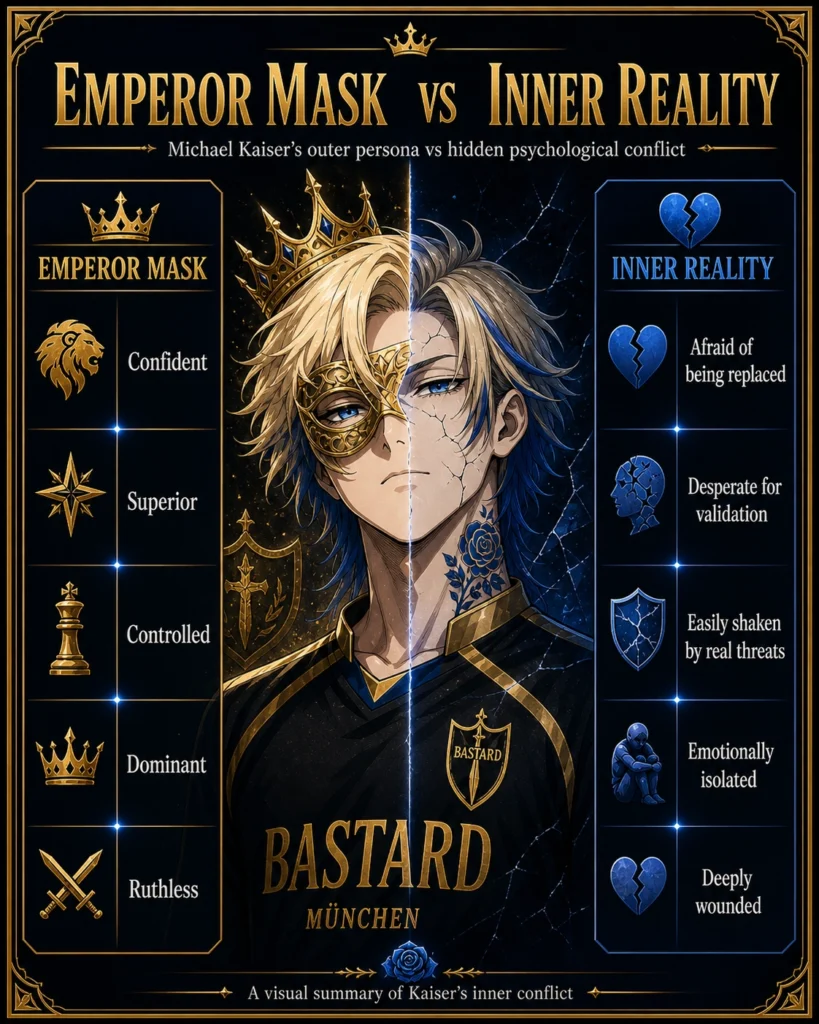
Kaiser’s personality is built around superiority, but that superiority does not feel completely peaceful. He acts like someone who must stay above everyone else to feel safe. His arrogance is real, but it also works like armor.
The Superiority Complex
Kaiser wants to be seen as untouchable. He talks, moves, and plays like an emperor because that image protects him. If others see him as perfect, they cannot easily question him. But when Isagi starts challenging him, Kaiser’s calm image begins to crack.
This makes his superiority complex more interesting. It is not just confidence. It feels like a defense mechanism. Kaiser needs control because losing control threatens the identity he has built for himself.
The Drive for Validation
Kaiser does not only want to win. He wants proof that he is special. His desire to become a symbol of the impossible shows that his ambition is deeper than simple pride. He wants his existence to mean something.
That is why Isagi bothers him so much. Isagi does not defeat Kaiser by being louder or flashier. He threatens him by understanding the same field and slowly taking away his sense of uniqueness.
Coping With Setbacks
When Kaiser feels challenged, he often responds with arrogance, coldness, or aggression. He dismisses others because admitting their value would weaken his own image. This is especially clear in how he reacts when Isagi begins to interfere with his plans.
Instead of calmly accepting Isagi’s growth, Kaiser treats it like an insult. That reaction reveals the real conflict inside him. He wants to be above everyone, but Blue Lock keeps placing people in front of him who refuse to kneel.
The Burden of Genius
Kaiser’s genius isolates him. He has Ness beside him, but even that relationship feels unbalanced because Ness often exists to support Kaiser’s image. Kaiser is surrounded by people, yet emotionally he feels alone.
That loneliness is part of what makes him compelling. He is brilliant, cruel, elegant, and damaged. He is not just a rival for Isagi. He is a warning of what ego can become when it is mixed with fear, control, and the need to be worshipped.
The Genesis of an Emperor: Backstory and Core Motivations
Unveiling Kaiser’s Past: What We Know
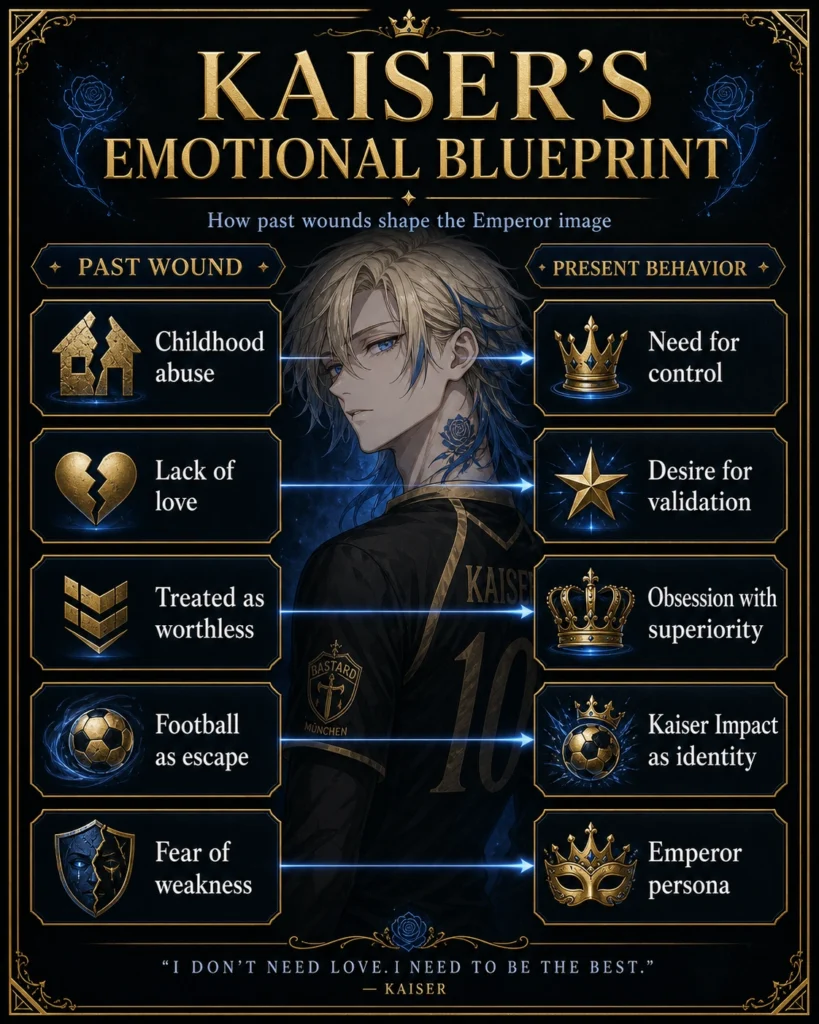
Michael Kaiser’s backstory changes the way we understand him. Before his past is revealed, he looks like a simple arrogant genius. After it, his “Emperor” image feels less like pure confidence and more like a mask built for survival.
In Blue Lock Chapter 260, “Piece of Trash,” Kaiser’s childhood is shown as deeply painful. He grows up in an abusive home with his father, Frederick Kaiser, while his mother, Alice Love, is absent from his life. His father treats him with cruelty, forces him into stealing, and makes him feel less like a child and more like something disposable. This chapter is the key source for understanding the roots of Kaiser’s trauma.
One of the most important details is Kaiser’s relationship with the football he buys for himself at age 12. In a life where he has almost no comfort, the ball becomes his only companion. It is something he can hold, kick, protect, and return to. This makes football more than a sport for him. It becomes proof that he still exists.
The origin of Kaiser’s violent edge also comes from this past. When his father threatens the one thing Kaiser values, Kaiser finally snaps. This moment helps explain the emotional foundation behind Kaiser Impact. The shot is not only a technical weapon. Symbolically, it comes from years of pain, anger, and the need to strike back at a world that treated him as worthless. (The Escapist)
His backstory continues in Chapter 261, “Malice,” where Ray Dark brings Kaiser into the football world. Kaiser struggles to accept kindness, fails to connect naturally with others, and begins building a football identity around malice. Instead of seeking friendship, he chooses control. Instead of trusting teammates, he looks for someone who will submit to him, which later explains his unhealthy dynamic with Alexis Ness.
Confirmed Facts, Interpretation, and Fan Theories
Type | What It Means |
Confirmed Manga Detail | Kaiser had an abusive childhood, was neglected by his family, bought a football as a personal escape, and was later discovered by Ray Dark. |
Confirmed Character Trait | He has a superiority complex, enjoys breaking opponents mentally, and wants to become a symbol of the impossible. |
Strong Interpretation | His arrogance works as emotional armor. He acts like an emperor because deep down, he does not want to feel powerless again. |
Fan Theory | Some fans believe his worn out ball and rough early life suggest he rose from poverty and built himself from nothing. This fits his story, but it should be treated as interpretation, not confirmed fact. |
This separation matters because Kaiser is easy to over-explain. The manga gives us enough confirmed material to understand his pain, but some parts of his psychology still require careful interpretation.
The Relentless Pursuit of Superiority
Kaiser does not simply want to win. He wants to dominate so completely that nobody can deny his value. His dream of becoming a “symbol of the impossible” shows that his ambition is not ordinary pride. He wants to turn himself into something unforgettable.
That is why his “King” or “Emperor” mentality feels so intense. For Kaiser, being at the top is not just about scoring goals. It is about proving that the child once treated as trash can become someone untouchable. Every goal becomes a statement. Every defeated opponent becomes proof that he is no longer weak.
But this also makes him fragile. When Isagi starts reading the same field, interrupting his plays, and stealing attention from him, Kaiser reacts as if his entire identity is being threatened. Isagi is not just another rival. He is a direct attack on the image Kaiser built to protect himself.
How His Ambition Connects to Blue Lock’s Themes
Kaiser fits perfectly into Blue Lock because the series is obsessed with ego, evolution, and the hunger to become the best. But Kaiser shows the darker side of that hunger. His ego is powerful, but it is also wounded. His football is brilliant, but it is shaped by fear, anger, and the need for validation.
This makes him a strong contrast to Isagi. Isagi evolves by understanding himself and others. Kaiser evolves by trying to crush anything that threatens his throne. Both are egoists, but their egos come from very different places.
That is what makes Kaiser so compelling. He is not evil for the sake of being evil. He is a player who turned pain into talent, loneliness into control, and insecurity into a royal image. His tragedy is that even after reaching the world stage, he is still fighting the feeling that he is not enough.
His Web of Influence: Relationships, Rivalries, and Impact
Kaiser and Isagi: A Rivalry Built on Threat and Evolution
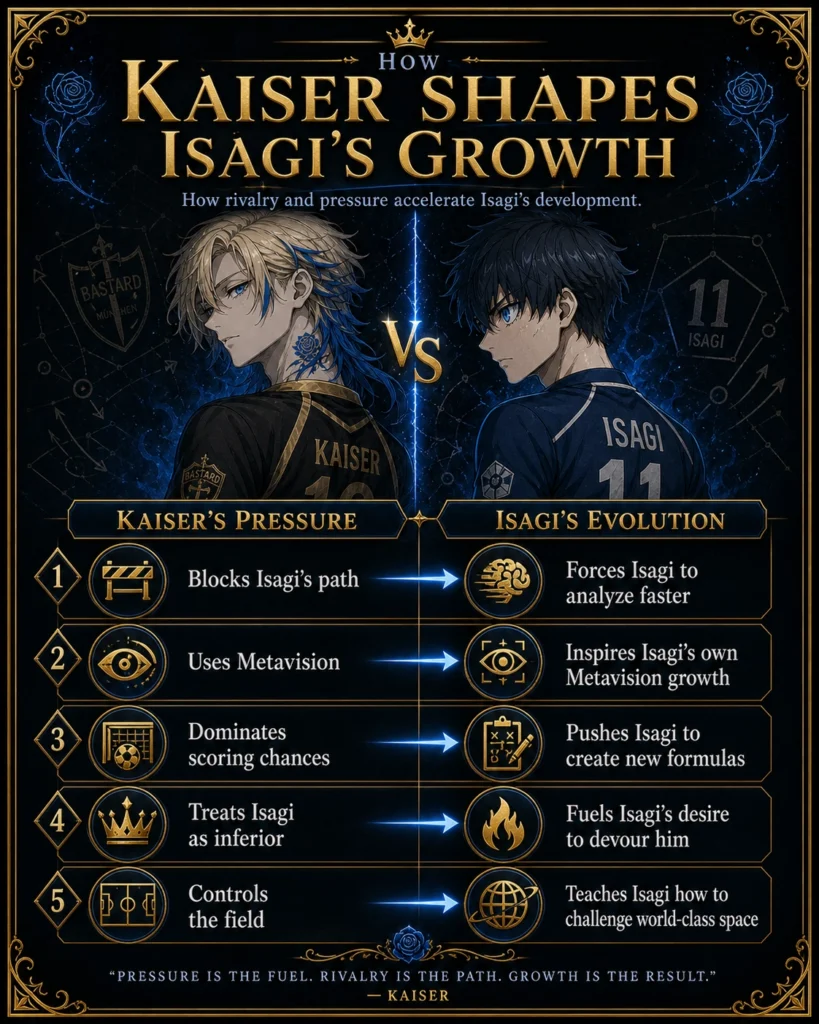
Michael Kaiser’s rivalry with Isagi Yoichi is one of the most important dynamics in the Neo Egoist League. At first, Kaiser treats Isagi like an inferior player who has entered a stage too big for him. He does not see Isagi as an equal. He sees him as someone to control, disturb, and eventually crush.
That changes once Isagi starts learning from him. Kaiser becomes the wall Isagi must break through. During Bastard München’s early matches, Isagi cannot beat Kaiser directly, which forces him to observe, adapt, and rethink his own football. Kodansha’s official description for Volume 19 even frames Isagi’s frustration around being unable to surpass Kaiser in training, showing how early Kaiser becomes a major benchmark for him.
The turning point is that Isagi does not only compete with Kaiser. He studies him. Kaiser’s use of Metavision and his finishing ability push Isagi to build his own “golden formula” by combining field vision with his Direct Shot. This is why Kaiser’s influence is so important. He does not just block Isagi’s growth. He gives Isagi the blueprint for reaching a higher level.
What makes their rivalry so compelling is the psychological tension. Kaiser wants to remain the center of the field, while Isagi keeps finding ways to enter that space and steal influence. Every time Isagi reads Kaiser’s movement or disrupts his plan, he attacks more than Kaiser’s tactics. He attacks Kaiser’s identity as the “Emperor.”
By the later Neo Egoist League matches, the rivalry becomes more layered. Kaiser is no longer just looking down on Isagi. He is forced to recognize him as a real threat. Official volume descriptions show Kaiser being driven into a corner while Isagi gains more attention, which proves how much their positions shift over time.
Kaiser and Ness: Loyalty, Control, and Dependence
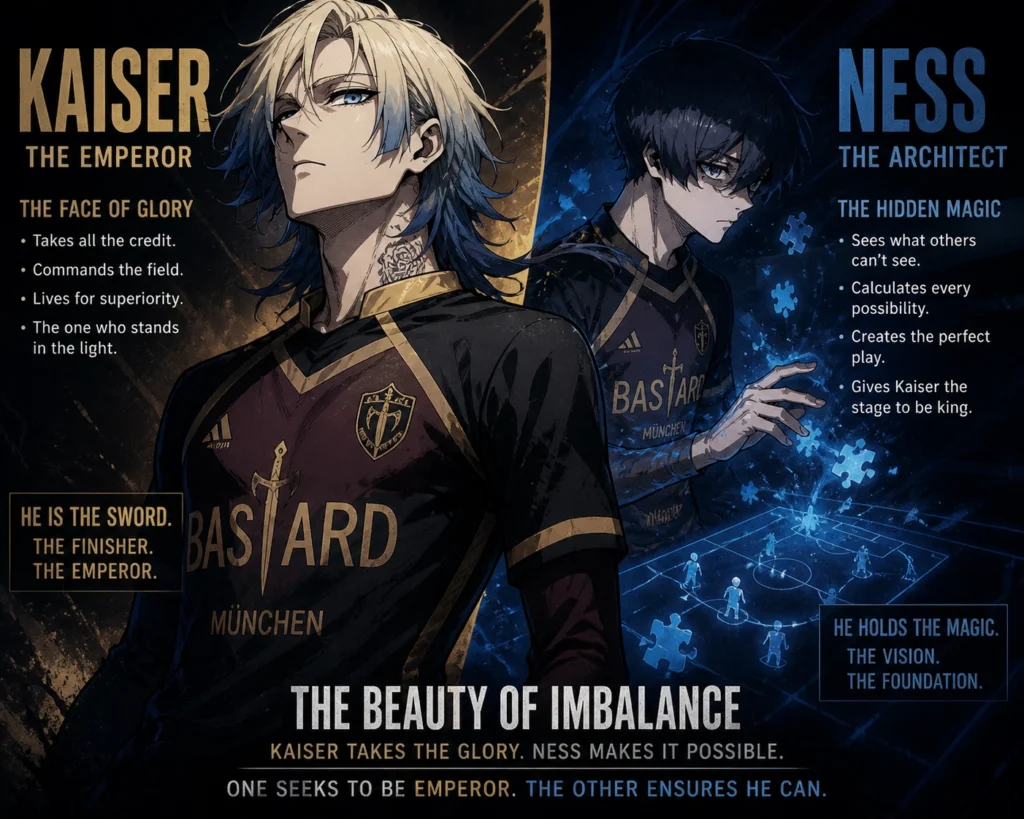
Kaiser’s relationship with Alexis Ness reveals a different side of him. With Isagi, Kaiser is competitive and threatened. With Ness, he is dominant and dismissive. Ness supports him with complete loyalty, almost treating Kaiser’s dream as his own purpose.
Their bond works tactically because Ness understands Kaiser’s movements and can deliver the kind of passes Kaiser needs. On the field, they function like a polished attacking system. Ness creates rhythm, Kaiser finishes, and the whole structure is designed to keep Kaiser at the center.
Emotionally, though, the relationship is unhealthy. Kaiser does not treat Ness as an equal partner. He treats him more like a tool that helps maintain his image. This shows Kaiser’s need for control. He wants people around him who confirm his superiority, not people who challenge it.
That is why Ness becomes important to Kaiser’s character study. Ness’s loyalty feeds Kaiser’s ego, but it also traps both of them. Ness depends on Kaiser for meaning, while Kaiser depends on Ness to preserve the illusion that he is untouchable. Later story material even shows Ness struggling as Kaiser begins moving beyond him, which makes their relationship feel less like simple teamwork and more like emotional dependency.
Kaiser and Rin: Two Forms of Dominance
Kaiser and Rin Itoshi represent two different kinds of elite ego. Rin is intense, destructive, and obsessed with total victory. Kaiser is elegant, calculated, and obsessed with control. Both are terrifying because they make other players feel powerless, but they do it in different ways.
Rin overwhelms through pressure and precision. Kaiser dominates through positioning, timing, and psychological control. Rin feels like a storm. Kaiser feels like a ruler moving pieces across a board.
This contrast matters because it shows that Blue Lock does not define greatness in one simple way. Kaiser, Rin, and Isagi all chase the same throne, but their egos are built differently. Rin wants to destroy. Isagi wants to adapt and devour. Kaiser wants to reign.
Kaiser and Kunigami: A Quiet Contrast
Kaiser’s connection to Kunigami Rensuke is less personal than his rivalry with Isagi, but it still matters. Kunigami represents physical power, directness, and a darker post-Wild Card mentality. Kaiser represents refined technique, positioning, and royal control.
In Bastard München, both are dangerous scoring options, but they carry very different meanings. Kunigami is a weapon rebuilt through hardship. Kaiser is a polished genius trying to protect his throne. Their contrast helps show how many different versions of ego exist within the same team.
Kodansha’s Volume 22 description highlights Kaiser and Kunigami scoring in the Manshine City match, while Isagi searches for a way to get revenge on Kaiser. This places Kaiser at the center of Bastard München’s internal competition, even when other powerful players are also producing results.
Impact on Blue Lock and Yoichi Isagi: A Catalyst for Evolution
Kaiser’s biggest role in the story is not simply being strong. His real purpose is to raise the standard. Before the Neo Egoist League, Isagi’s world was mostly built around Japan’s best young strikers. Kaiser expands that world. He shows what a global U-20 talent looks like and forces everyone around him to rethink what “world-class” actually means.
For Isagi, Kaiser is both an enemy and teacher. He teaches without intending to. His movements reveal what elite positioning looks like. His Metavision shows Isagi how much faster the game can be read. His Kaiser Impact proves how deadly one complete weapon can become when paired with intelligence.
This is why Kaiser works so well as a catalyst. He makes Isagi uncomfortable. He makes him angry. He makes him feel behind. But that pressure is exactly what pushes Isagi forward. Without Kaiser, Isagi may still grow, but not with the same urgency or sharpness.
Kaiser also changes the emotional rhythm of Bastard München. His presence creates tension inside the team because the players are not only fighting opponents. They are fighting for control of their own side. Isagi, Kunigami, Yukimiya, Ness, and Kaiser all want to prove their value, but Kaiser’s ego turns that competition into psychological warfare.
This is what makes him more than a rival. Kaiser alters the trajectory of the story. He forces Isagi to evolve from a clever Blue Lock striker into someone who can compete with world-level logic. He exposes weaknesses, creates pressure, and turns every match into a battle for ownership of the field.
In the end, Kaiser’s influence is simple but powerful: he makes everyone around him confront their limits. Some break under that pressure. Some become dependent on him. Isagi evolves because of it. That is why Michael Kaiser remains one of Blue Lock’s most important characters. He is not just the Emperor standing above others. He is the storm that forces the next generation to rise.
Beyond the Aura: Character Arc, Reception, and Personal Reflection
Character Development Arc: Cracks in the Armor?
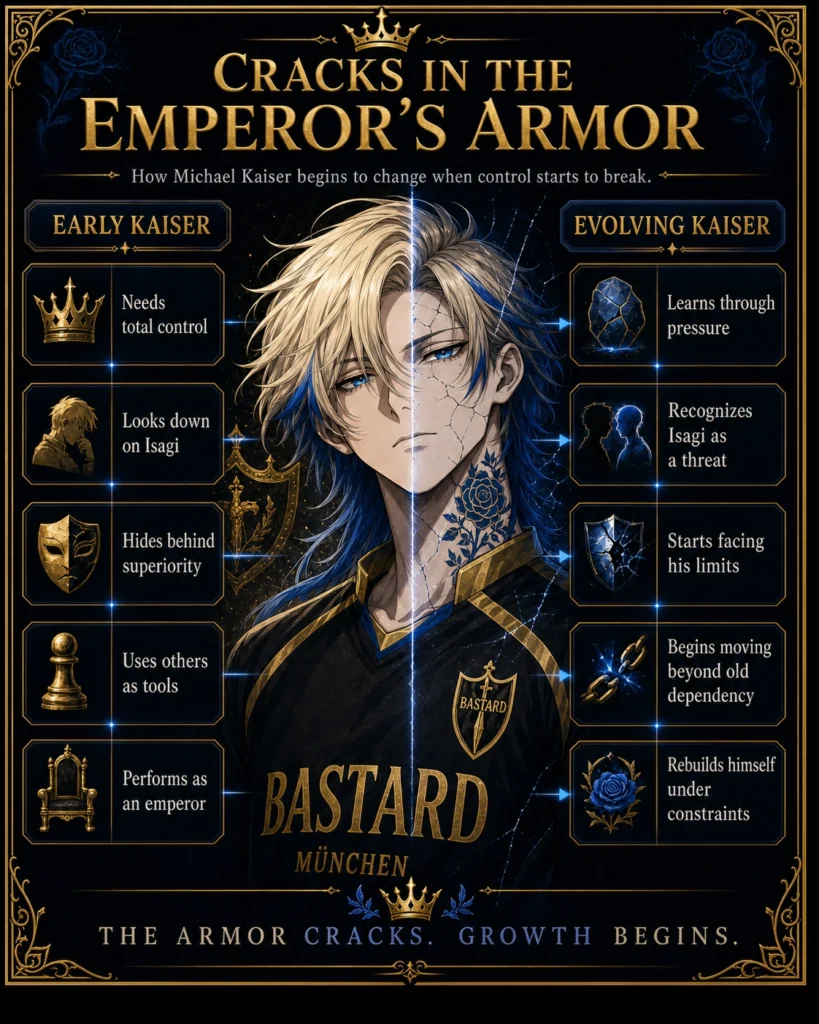
Michael Kaiser does not begin as a character who seems ready to change. When he first takes over Bastard München’s attack, he looks complete: talented, polished, arrogant, and fully convinced of his own superiority. His “Emperor” image feels almost untouchable.
But as the Neo Egoist League continues, small cracks begin to appear. Isagi’s rise forces Kaiser into uncomfortable territory. For the first time, Kaiser is not only being challenged physically or tactically. His identity is being challenged. Isagi starts reading the same field, stealing attention, and proving that Kaiser’s control is not absolute.
This is where Kaiser becomes more than a static rival. He still keeps his pride, cruelty, and royal attitude, but he slowly begins to face the limits of his old self. Kodansha’s official description for Blue Lock Volume 31 directly points to this shift, explaining that Kaiser strips away his pretense, remakes himself on the pitch, and discovers that he performs best under “constraints.” That is a major step for a character who once acted like he needed total control to survive.
His development is not a soft redemption arc. Kaiser does not suddenly become kind or humble. Instead, his growth is sharper and more fitting for Blue Lock. He learns that pressure can make him evolve. He learns that being cornered does not always mean defeat. For someone who built his identity around superiority, accepting struggle as part of growth is a powerful change.
So, is Kaiser static or dynamic? The answer is both. His core ego remains the same, but the way he understands that ego begins to shift. He is still the Emperor, but now the crown feels heavier. That makes him more interesting because his character arc is not about becoming “good.” It is about becoming more honest with the pain, hunger, and fear behind his ambition.
Fan Reception and Theories: The Community’s Kaiser
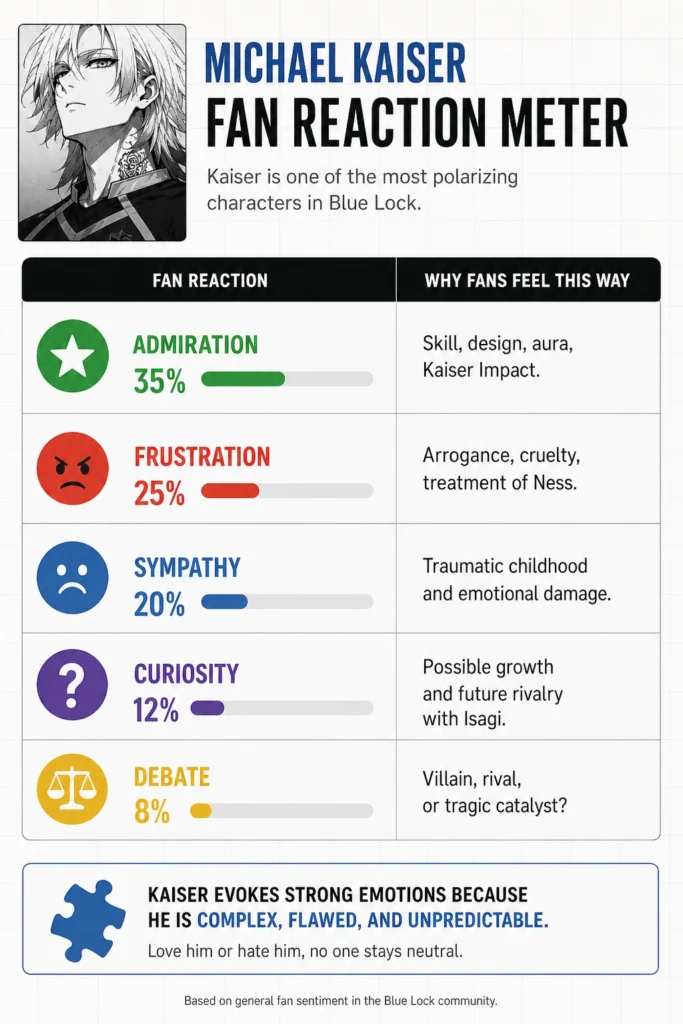
Kaiser has one of the most interesting fan receptions in Blue Lock. Many fans admire him because of his design, confidence, elite skill, and terrifying presence on the field. He has the kind of aura that instantly feels memorable. His blonde hair, blue rose tattoo, calm cruelty, and Kaiser Impact all make him stand out.
At the same time, many readers dislike him for the same reasons. He is arrogant, manipulative, and often cruel to people around him, especially Ness. He does not simply want to win. He wants to make others feel beneath him. That makes him exciting as a character, but frustrating as a person.
His backstory made the community more divided. Some fans became more sympathetic after learning about his childhood, while others felt the story made him more disturbing because it showed how deeply his idea of love and human connection had been damaged. Reddit discussions often describe Kaiser as someone shaped by trauma, malice, and a warped understanding of affection, but these are fan interpretations rather than official author statements.
A common fan theory is that Kaiser’s arc is moving toward emotional rebirth. Fans believe he may slowly grow out of the fake “Emperor” image and become a player who no longer needs control, worship, or cruelty to prove he exists. This theory fits with his later development in the Neo Egoist League, especially the idea that he evolves when placed under real pressure. Still, it should be treated as interpretation, not confirmed future direction.
Another popular discussion focuses on Ness. Some fans believe Ness must eventually break away from Kaiser to grow, while Kaiser must also learn to exist without someone constantly feeding his ego. This theory makes sense because their relationship has always felt powerful on the field but unhealthy emotionally.
There is also debate over whether Kaiser will remain Isagi’s long-term rival or become a future benchmark in the professional football world. Either way, fans agree on one thing: Kaiser is not forgettable. Whether readers love him, hate him, or feel conflicted about him, he leaves a strong impression.
My Kaiser Moment: Why He Is Hard to Forget
For me, the most unforgettable thing about Kaiser is not just Kaiser Impact. It is the moment you realize that his confidence is not as clean as it looks.
At first, I saw him as the perfect rival: stylish, cold, and almost impossible to beat. He felt like the kind of character designed to make Isagi look small. But the deeper the story went, the more Kaiser started to feel like someone trapped inside his own image.
That is what makes him memorable. His arrogance is annoying, but it is never empty. His cruelty is uncomfortable, but it has roots. His genius is exciting, but it also feels lonely. He is not simply a golden emperor standing above everyone. He is someone trying to prove, again and again, that he deserves to exist.
The moment that changed my view of him was not one single goal. It was watching Isagi slowly disturb his control. Kaiser’s reactions made it clear that Isagi was not just challenging his football. He was touching a wound Kaiser did not want anyone to see.
That is why Kaiser works so well in Blue Lock. He makes the story feel bigger, sharper, and more personal. Through him, ambition stops looking glamorous and starts looking painful. He shows that genius can be beautiful, but it can also be lonely, defensive, and desperate.
Kaiser is frustrating. Kaiser is brilliant. Kaiser is damaged. And that mix is exactly why he remains one of the most powerful characters in Blue Lock.
Conclusion: The Enduring Legacy of the Emperor
Michael Kaiser is one of Blue Lock’s most important characters because he is more than a talented rival. He is a symbol of world-class pressure. His presence raises the standard of the story, forcing Isagi and the other Blue Lock players to face a level of football where ego alone is not enough. To stand against Kaiser, they must evolve their vision, sharpen their weapons, and prove they can survive on a global stage.
His impact on Isagi is especially powerful. Kaiser challenges Isagi’s intelligence, confidence, and identity as a striker. He becomes both an obstacle and a blueprint. By studying Kaiser’s movement, Metavision, and finishing formula, Isagi finds new ways to grow. In that sense, Kaiser does not simply oppose Isagi. He helps create the version of Isagi who can eventually challenge the world.
But Kaiser’s legacy is not built only on skill. His backstory, emotional wounds, and need for control make him one of the series’ most layered figures. He shows the darker side of ambition, where the desire to be the best can become tangled with fear, loneliness, and the need to be validated. His “Emperor” image is powerful, but it is also fragile.
Looking ahead, Kaiser still has many unresolved conflicts. His rivalry with Isagi is far from simple. His bond with Ness remains emotionally complicated. His own ego is still being tested. The biggest question is whether Kaiser will keep hiding behind the crown, or whether he will learn to evolve without needing to dominate everyone around him.
Whatever direction his story takes, Michael Kaiser has already left a permanent mark on Blue Lock. He changed the scale of the series, exposed the gap between national talent and world-class genius, and pushed Isagi into one of his most important stages of growth. Kaiser may be called the Emperor, but his real legacy is the chaos he creates: the kind that destroys comfort, forces evolution, and makes every player ask whether their ego is truly strong enough to survive.