Ryusei Shidou Character Analysis: Blue Lock's Most Misunderstood Egoist
Spoiler warning: This article discusses Blue Lock manga and anime events, including the U-20 match.
Most fans describe Shidou in three words: crazy, chaotic, monster striker.
Those words are not wrong. But they are too small for what Blue Lock is actually doing with him.
Shidou is not interesting just because he is wild. He is interesting because he may be the most honest egoist in the entire series. He does not break football down through analysis like Isagi. He does not try to control the field like Rin. His ego is simpler and more direct than both. He wants to score because scoring is the purest way he can express himself.
This article will prove exactly that. Starting with who he really is, what his biggest moments reveal, and why fans keep reading him wrong.
Who Is Ryusei Shidou?
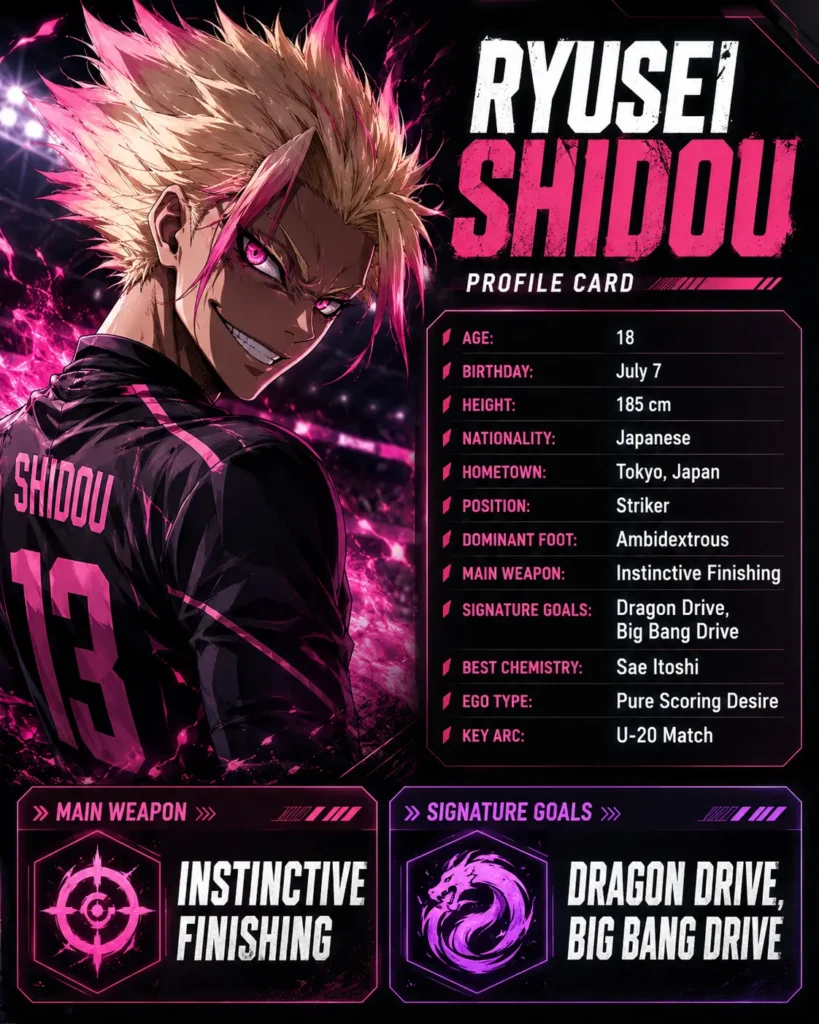
Ryusei Shidou is an 18 year old striker from Tokyo, standing 185 cm tall, and ranked second best among all Blue Lock players before the U-20 match. Despite that ranking, Ego Jinpachi could not include him in the Blue Lock Eleven’s starting lineup because Shidou had zero chemistry with every player in the facility. He attacked Rin during training and could not work within any structured system.
That detail matters. Shidou’s ego was so extreme that even a program built around ego could not contain him.
His football is built on three core weapons: extreme spatial awareness inside the penalty area, acrobatic finishing ability, and explosive reflexes that let him turn broken plays into goals before defenders can react. Unlike most players whose spatial awareness accounts for positions and teammates, Shidou’s is locked onto the goal at all times, allowing him to feel exactly where it is even without physically facing it.
That is not a minor detail. That is the foundation of his character.
| Age | 18 |
| Position | Striker |
| Team | Japan U-20 |
| Key abilities | Spatial awareness, acrobatic finishing, Drive Shot, Big Bang Drive |
| Known as | The Monster Striker |
| Ego type | Pure scoring instinct |
The Goal That Explains Everything: Dragon Drive and Big Bang Drive
If you want to understand Shidou in one section, this is it.
During the U-20 match, Shidou sits on the bench in the first half while Japan struggles. He enters the game in the second half, and things change quickly.
Sae Itoshi personally requested Shidou for the U-20 team and reportedly threatened not to play without him. When Shidou enters, he and Sae connect almost immediately, overwhelming not only the Blue Lock Eleven but their own U-20 teammates in the process. One fellow U-20 player even comments that the two seem like a match made in heaven.
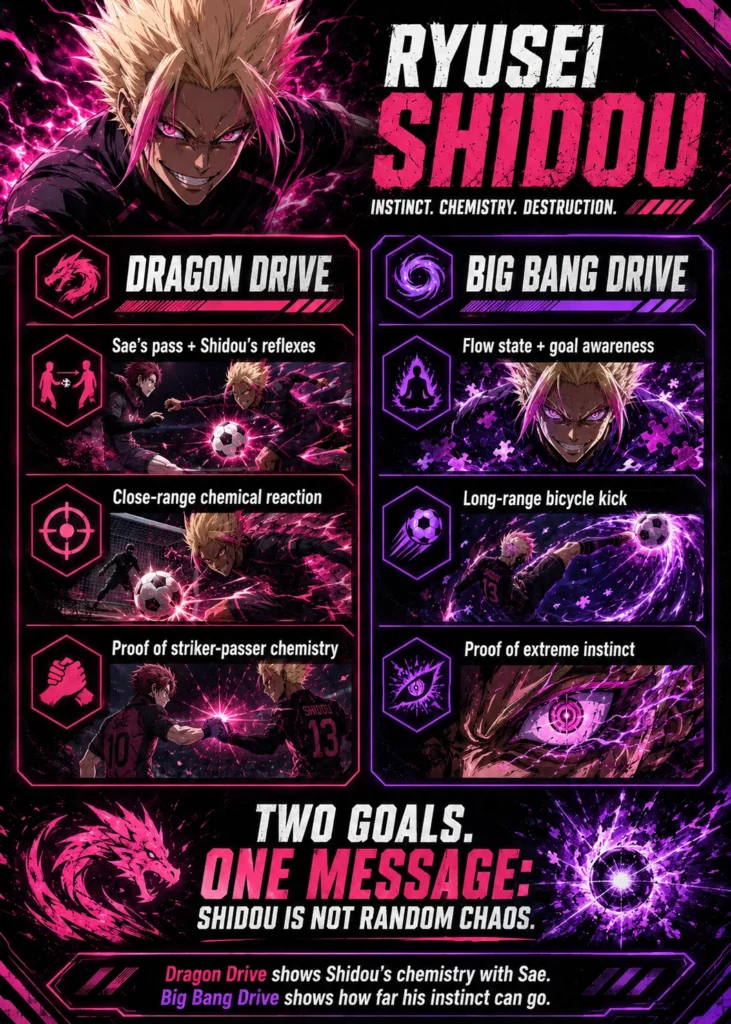
The Dragon Drive is the first proof of what that partnership looks like in real time. It is a shot made possible specifically by combining Shidou’s reflexes with the kind of pass only Sae can deliver. The pass arrives at a moment and angle where most players would either hesitate or mishit. Shidou does not hesitate. The goal happens because his body was already moving before his mind could overthink it.
Then comes the Big Bang Drive, which operates on a completely different scale.
When Shidou enters Flow during the U-20 match, he pushes his spatial awareness past its normal limit, feeling the location of the goal even from outside the penalty area, and produces a long range bicycle kick off a clearance without even resetting his positioning.
Read that again. A bicycle kicks from outside the box, off a clearance, without time to reset. The move reportedly stunned viewers and anime reviewers alike when it aired, with some describing it as the standout animated sequence of the season.
These two goals are not random chaos. They are the clearest expression of everything Shidou’s character stands for. Instinct that does not need time. Finishing does not need perfect conditions. A goal built entirely from desire and body intelligence.
Why Fans Misunderstand Shidou
Fans misunderstand Shidou because his personality is louder than his football.
He fights. He provokes. He says extreme things. He does not behave like a disciplined athlete. So fans file him under “the crazy one” and move on.
The problem is that this misses the actual football argument Blue Lock is making through him.
Shidou does not appear to aspire to be the world’s best striker. Based on what the story shows, he plays football because of a deep instinct, treating it almost like a biological need. His primary goal is to score, which he seems to equate with leaving his mark on the world in the most direct way he knows.
That is not chaos for the sake of chaos. That is someone with a completely different and arguably purer relationship to football than most other players in the series.
Blue Lock uses exaggerated personalities to show different forms of ego. Isagi’s ego comes through adaptation. Rin’s ego comes through destruction and control. Shidou’s ego comes through instinctive creation. When his football is restricted, he becomes restless. When his instincts are freed, he becomes a different player entirely. Sae understood this dynamic well enough to build a tactical partnership around it.
Fans see the aggression. They miss the reason behind it.
What “I Devour” Actually Means for Shidou
In Blue Lock, devouring means taking something from the game and turning it into your own weapon.
For Isagi, devouring is mental. He studies a player’s strength, absorbs it, and rebuilds his own game around it.
For Shidou, devouring is physical and immediate. The Dragon Drive is a clear example. Sae’s pass arrives in a position most players cannot use cleanly. Shidou devours it before anyone else processes the moment. The Big Bang Drive takes that further. A clearance becomes a bicycle kick goal because Shidou’s body is always ready to consume a chance, even when the situation makes no logical sense on paper.
His spatial awareness reportedly allows him to zero in on the goal’s location even with his back turned, finishing from angles that would seem impossible for most players, using body control to strike from positions that catch defenders and goalkeepers off guard.
That is what devouring looks like when it comes from instinct instead of analysis. Not a plan. A reaction. Not a calculation. A release.
Why Sae Chose Shidou
Sae Itoshi is cold, technical, and brutally honest about football. He does not choose players based on effort or potential alone. He chooses based on what they can do for his game right now.
Their first real interaction sets the tone. Sae tells Shidou that Blue Lock is too small a cage for him and instructs him to go wild for Sae’s sake. That is not how you talk to a player you see as unpredictable baggage. That is how you talk to someone whose weapon you understand and plan to use at full power.
The Japan U-20 had structure and experience. What it lacked was a striker who could respond to Sae’s creativity without slowing it down. Sae creates passes at a level most strikers cannot process quickly enough. Shidou’s instinct means he does not need processing time. He reacts.
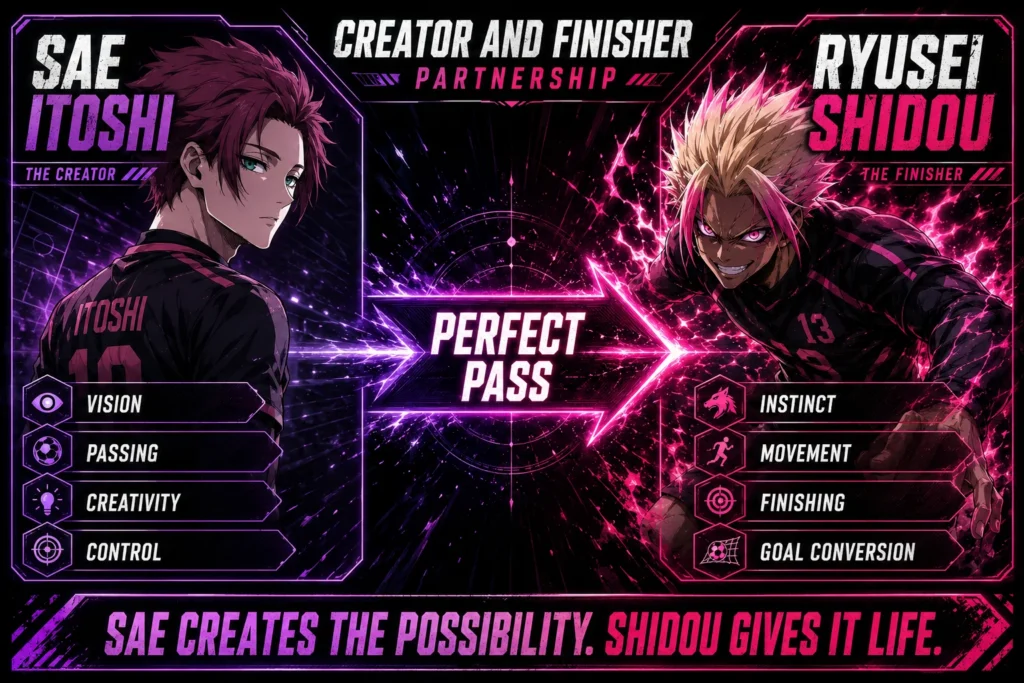
The Dragon Drive proves this. Sae delivers a pass that requires immediate action. Shidou gives it immediate action. The goal exists because Shidou’s body was already committed before anyone else had a chance to respond.
Shidou is widely considered one of the most dangerous players in Blue Lock inside the penalty area, with a natural ability to detect and attack defensive gaps that other strikers overlook entirely. Sae’s vision combined with that finishing ability creates a partnership where creativity and execution arrive at the same moment.
That is what makes them difficult to stop together.
Shidou vs Isagi vs Rin
The comparison between these three shows why Shidou’s weapon is distinct from the others.
Isagi is a thinker. He reads patterns, rebuilds his game, and uses analysis to arrive at the best scoring position. His ego grows through learning and adaptation.
Rin is a controller. He uses superior technique and vision to dominate matches. His football is precise, cold, and built around personal superiority. His ego grows through destruction.
Shidou is different from both. While Rin’s spatial awareness is strong and covers the whole field, Shidou’s appears to be specifically tuned toward the goal rather than overall field control. That single difference explains a lot. Rin reads the entire match. Shidou reads only the moment before a goal. For a complete player like Rin, that can look one dimensional. But in the final seconds before a shot, that narrow focus becomes one of the more dangerous weapons on the pitch.
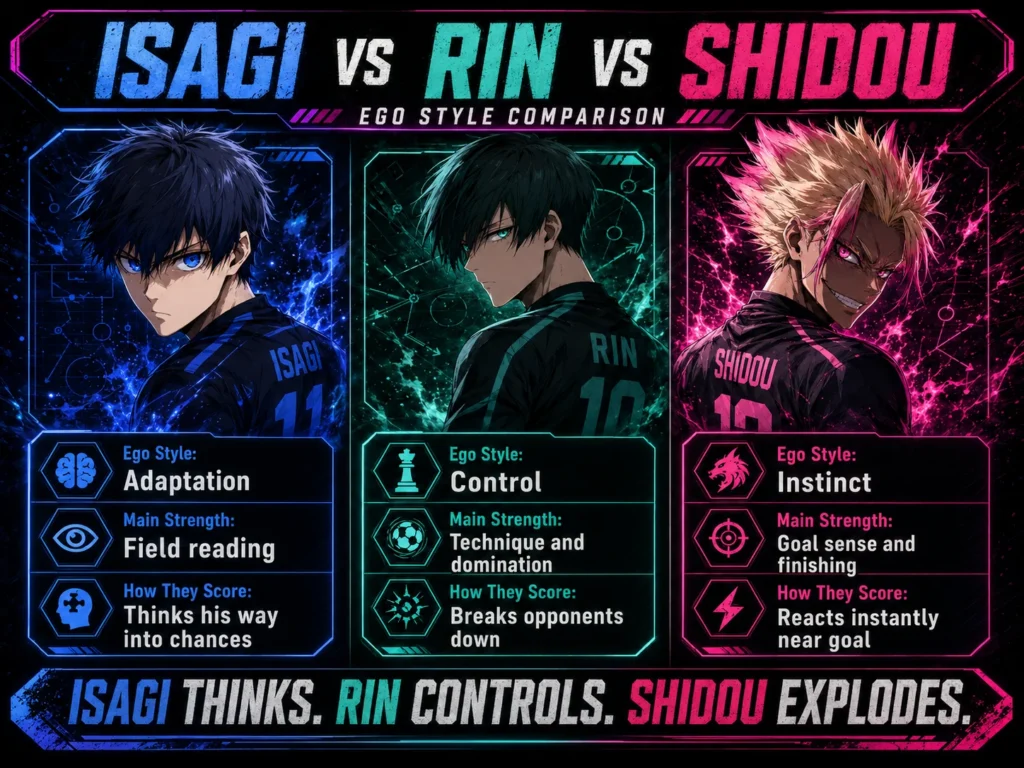
Isagi can understand and analyze Shidou’s movement patterns. But understanding them is not the same as having Shidou’s body, confidence, and finishing instinct. In one of the U-20 match’s key moments, Shidou comes within reach of scoring the winning goal for Japan, and only a sharp, last-second read from Isagi cuts him off. The fact that stopping Shidou required one of Isagi’s strongest analytical moments in the match says a lot about the kind of threat Shidou poses.
The Truth About Shidou’s Instinct
Calling Shidou instinctive does not mean he is lucky. It means his instinct is a skill, and likely his highest one.
His main scoring method is the Drive Shot, executed with power and precision from a range of positions. In Flow, he can produce a bicycle kick from outside the penalty area that still finds the net, a type of finish that puts him in rare company as a striker.
The Big Bang Drive is the clearest proof. A bicycle kick off a clearance without resetting his body, from well outside the box, that still lands in the goal. That is not fortune. That is body intelligence expressing itself under pressure.
During the U-20 match, one of Shidou’s acrobatic goals reportedly drew a reaction from commentators describing him as something close to a monster in the penalty box, with the implication that what he produced did not look like a normal human finish.
That reaction matters. It is not confusion at randomness. It is shock at something physically extraordinary that still works.
Shidou’s instinct does have limits worth noting. He becomes significantly more dangerous with a creative passer who can unlock his weapon properly. Without that kind of service, he can look harder to fit into a team. But when the right environment is there, his ceiling is difficult to measure.
Why Blue Lock Needs a Character Like Shidou
Blue Lock’s central argument is that Japanese football needs a striker with enough ego to change the sport.
Different characters show different answers to that idea. Isagi shows the ego of adaptation. Rin shows the ego of superiority. Barou shows the ego of dominance. Shidou shows the ego of pure scoring desire.
After the U-20 match, Shidou ranks among the top players in the entire program. His self-sufficient scoring approach, getting past defenders independently and finishing without assistance, is pointed to as an example of the kind of productive egoism that Ego Jinpachi set out to build.
He is not there to be comfortable or manageable. He is there to show that football sometimes needs players who are dangerous, selfish, and hard to contain because they create goals nobody else can.
That is why the U-20 arc works so well with him in it. Shidou does not just give Blue Lock Eleven a powerful opponent. He gives them a different version of what they are all trying to become.
Is Shidou a Villain?
No. He acts as an antagonist at certain points, but Blue Lock is not a simple good versus evil story.
Shidou’s behavior is more extreme than most characters, but his role is not simply to be disliked. His role is to test the limits of everyone around him. Against Blue Lock Eleven, he proves one striker can change the feeling of an entire match. With Sae, he proves that the right creative partnership can make even an extreme player look like a complete one.
He is messy, aggressive, and difficult. But he is written to show one of the most intense forms of striker ego in the series, and that is a different thing entirely from being written as a villain.
Can Shidou Grow as a Player?
Shidou’s growth does not mean becoming calm or easy to manage. That would likely make him less interesting as a character.
The better path is control without losing instinct. Early signs of this are already present. During the U-20 arc, he begins to understand that managing his aggression long enough to stay on the pitch gives him access to better football. That is a form of growth that does not compromise his weapon.
If he can develop his link up play and generate more of his own chances rather than depending heavily on elite service like Sae’s, his ceiling could rise further still. The strongest strikers pull the game toward themselves. Shidou already does this inside the box. The next step may be doing it from further out.
Not less ego. A sharper one.
Conclusion: Shidou Is More Than Blue Lock’s Crazy Striker
Yes, he is chaotic. Yes, he is violent and strange. But stopping there misses the point entirely.
The Dragon Drive shows he is not random. The Big Bang Drive shows his instinct can operate at a level most players cannot reach even with full preparation. His partnership with Sae shows he is not just wild energy but a specific kind of weapon that needs the right environment to reach its peak. His near-winner against Blue Lock Eleven shows he is a genuine match-deciding threat.
Fans see the madness first.
But underneath that madness is one of the purest scoring egos in Blue Lock.
And that is what makes Ryusei Shidou unforgettable.
FAQs About Ryusei Shidou
Why does Shidou say “I devour”?
For Shidou, devouring means turning a scoring chance into a goal through pure instinct. The Dragon Drive and Big Bang Drive both show this. He consumes a pass or a loose ball before anyone else processes the moment.
Is Shidou stronger than Rin?
Both are among the strongest players in Blue Lock, but in different ways. Rin is more complete and controlled across the full pitch. Shidou may be the more dangerous finisher inside the penalty area, with spatial awareness specifically tuned toward scoring. Arguing one is simply better than the other misses how different their weapons actually are.
Why did Sae choose Shidou?
Sae needed a striker who could respond to his creative passes without hesitation or adjustment time. Shidou’s instinct makes him one of the few players who can fully complete what Sae’s passing creates, which is why their Dragon Drive chemical reaction works on a level other pairings in the match could not replicate.
What makes Shidou different from Isagi?
Isagi thinks his way into scoring positions through analysis and field reading. Shidou reacts to scoring chances almost instantly using spatial awareness locked onto the goal. Isagi devours through the mind. Shidou devours through the body.
Is Shidou evil?
No. He acts as an antagonist in some arcs, but his role is to show an extreme version of striker ego rather than function as a traditional villain.
Does Shidou have a confirmed backstory?
As of now, Blue Lock has revealed very little about Shidou’s personal history. Any serious analysis should focus on what the manga clearly shows through his actions, goals, and partnerships.