BLUE LOCK CHAPTER 56: PROOF I'VE WAGERED MY LIFE
BLUE LOCK CHAPTER 56 – A DETAILED BREAKDOWN:
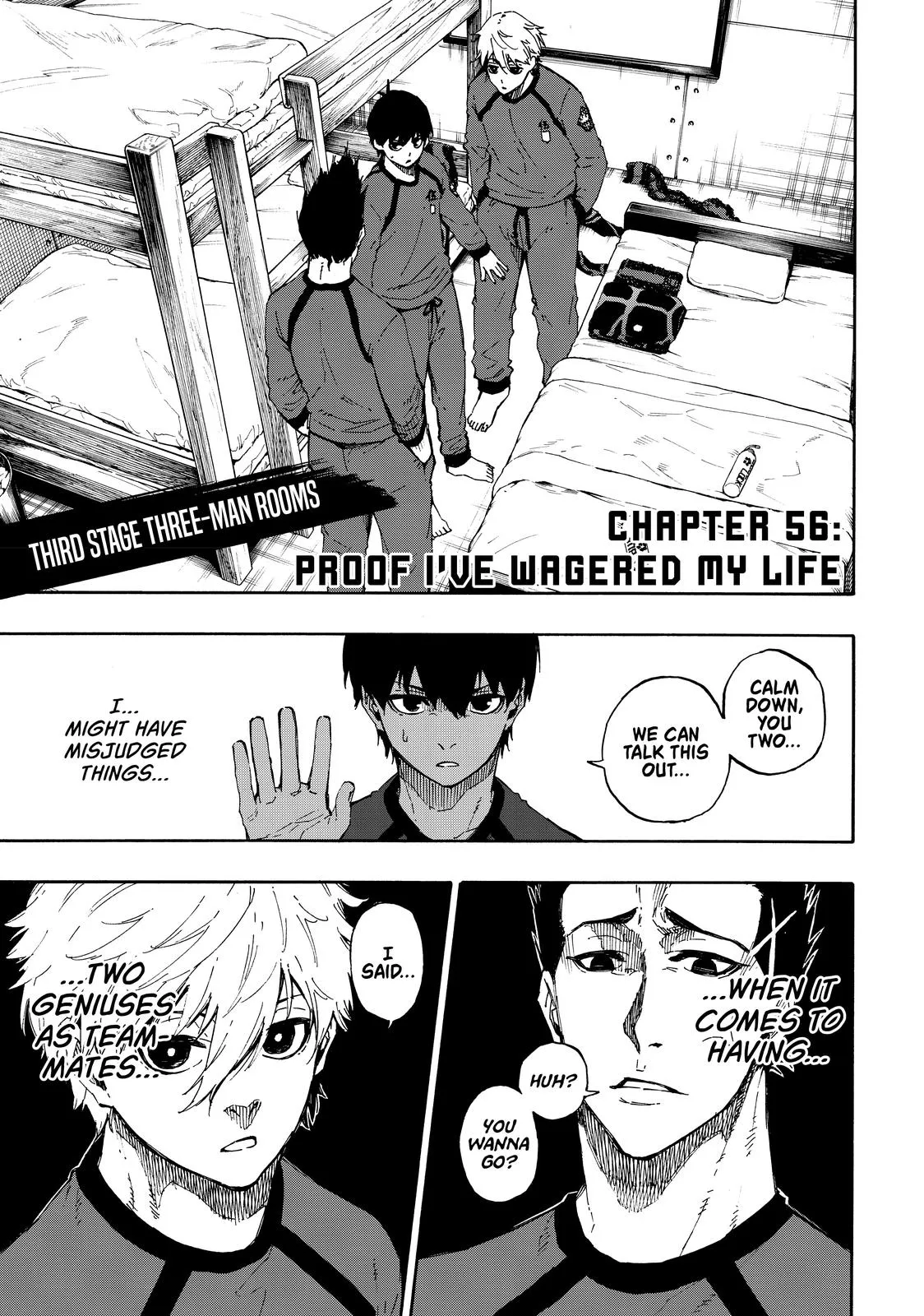
PROOF I’VE WAGERED MY LIFE
Chapter 56 shifts the story after Isagi and Nagi’s victory.
They have now taken Barou into their team, but instead of instant chemistry, the chapter begins with chaos.
Three strong egos are now trapped in one room.
Isagi quickly realizes something:
“I… might have misjudged things…”
This chapter matters because winning the match was only the first step.
Now Isagi, Nagi, and Barou must learn how to exist together before they can create a real chemical reaction on the field.
Three Players, One Room, Zero Peace
The chapter opens inside the Third Stage Three-Man Rooms.
Isagi is already trying to calm things down.
“We can talk this out…
Calm down, you two…”
But Nagi and Barou are not exactly easy teammates.
Nagi sees the situation as two geniuses on one team.
Barou, however, is still moving by his own rules.
The problem is not strategy.
It is something much smaller.
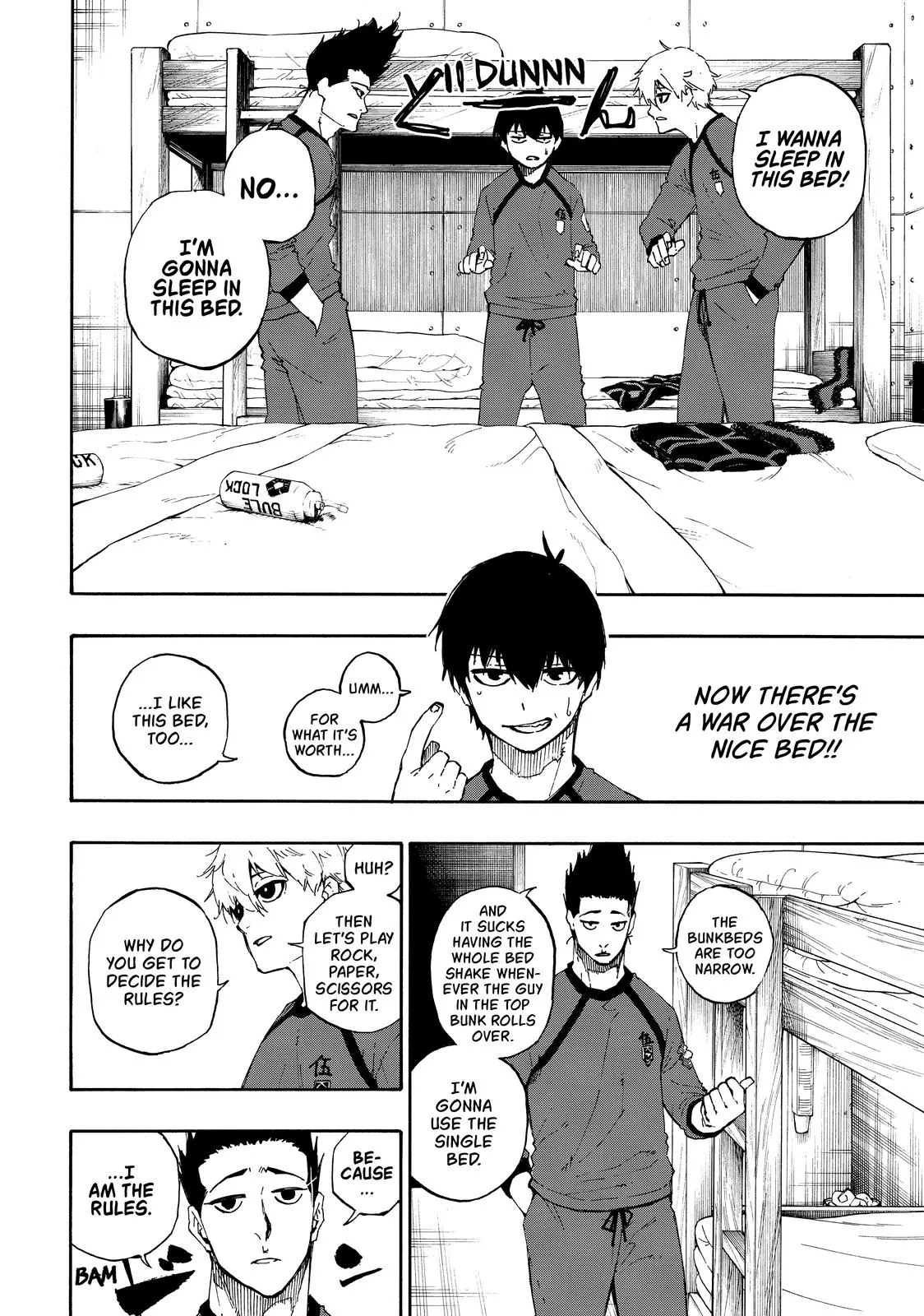
A bed.
“I’m gonna sleep in this bed.”
Nagi refuses immediately.
“No…
I wanna sleep in this bed!”
This moment matters because it shows the real challenge of this new team.
Their biggest enemy right now is not another team — it is their own selfishness.
The War Over the Nice Bed
The room turns into a battlefield over who gets the single bed.
Isagi tries to join the conversation carefully.
“For what it’s worth…
I like this bed, too…”
His solution is simple and fair.
“Then let’s play rock, paper, scissors for it.”
But Barou does not care about fairness.
He explains that the bunk beds are too narrow and annoying.
He does not want the bed shaking when someone above him moves.
So he declares the single bed as his.
“Because…
I am the rules.”
This moment matters because Barou’s personality becomes clear outside the field too.
He does not follow rules. He believes he is the rule.
Barou’s Absolute Ego Causes Trouble
Nagi snaps back.
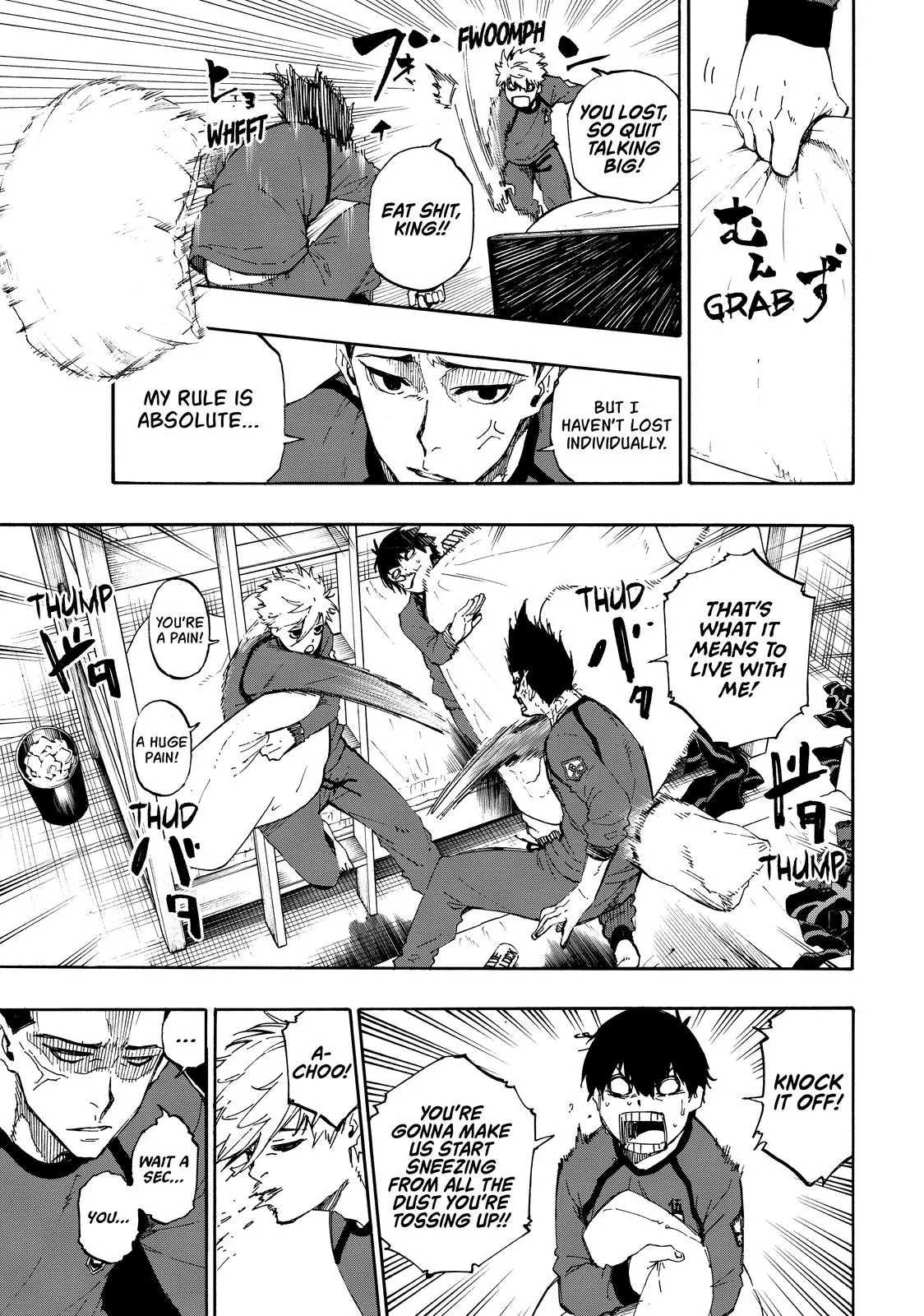
“Eat shit, King!!”
Barou grabs him and refuses to back down.
“You lost, so quit talking big!”
But then he adds something important.
“My rule is absolute…
But I haven’t lost individually.”
This matters because Barou still separates team defeat from personal defeat.
Even though his team lost, his ego remains untouched.
To him, he did not truly lose as a player.
Nagi calls him a pain.
Isagi agrees.
“A huge pain!”
Barou accepts it like a lifestyle.
“That’s what it means to live with me!”
The King Becomes Maid Barou
The room fight kicks up dust, and Isagi tells them to stop.
“You’re gonna make us start sneezing from all the dust you’re tossing up!!”
Then Barou suddenly notices the mess.
His attitude changes.
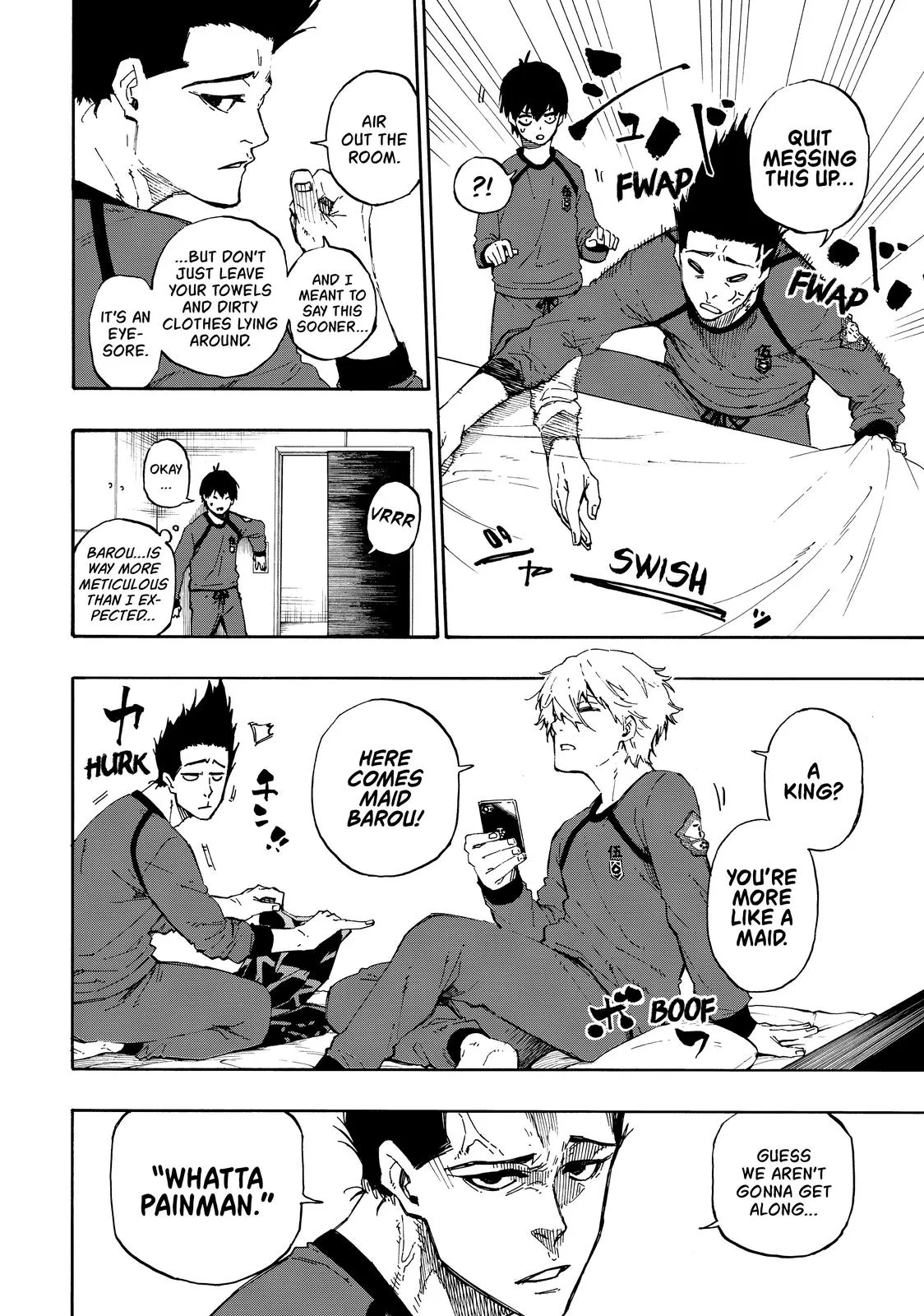
“Quit messing this up…”
He starts cleaning.
He tells them to air out the room and not leave towels or dirty clothes lying around.
“It’s an eyesore.”
This moment matters because it reveals a surprising side of Barou.
He is not only arrogant and aggressive.
He is also extremely meticulous.
Isagi is shocked.
“Barou… is way more meticulous than I expected…”
Nagi jokes on his phone.
“Here comes Maid Barou!”
The joke cuts deep into the scene because Barou, the so-called king, is cleaning like a strict housekeeper.
Barou’s Rules Reveal His Way of Life
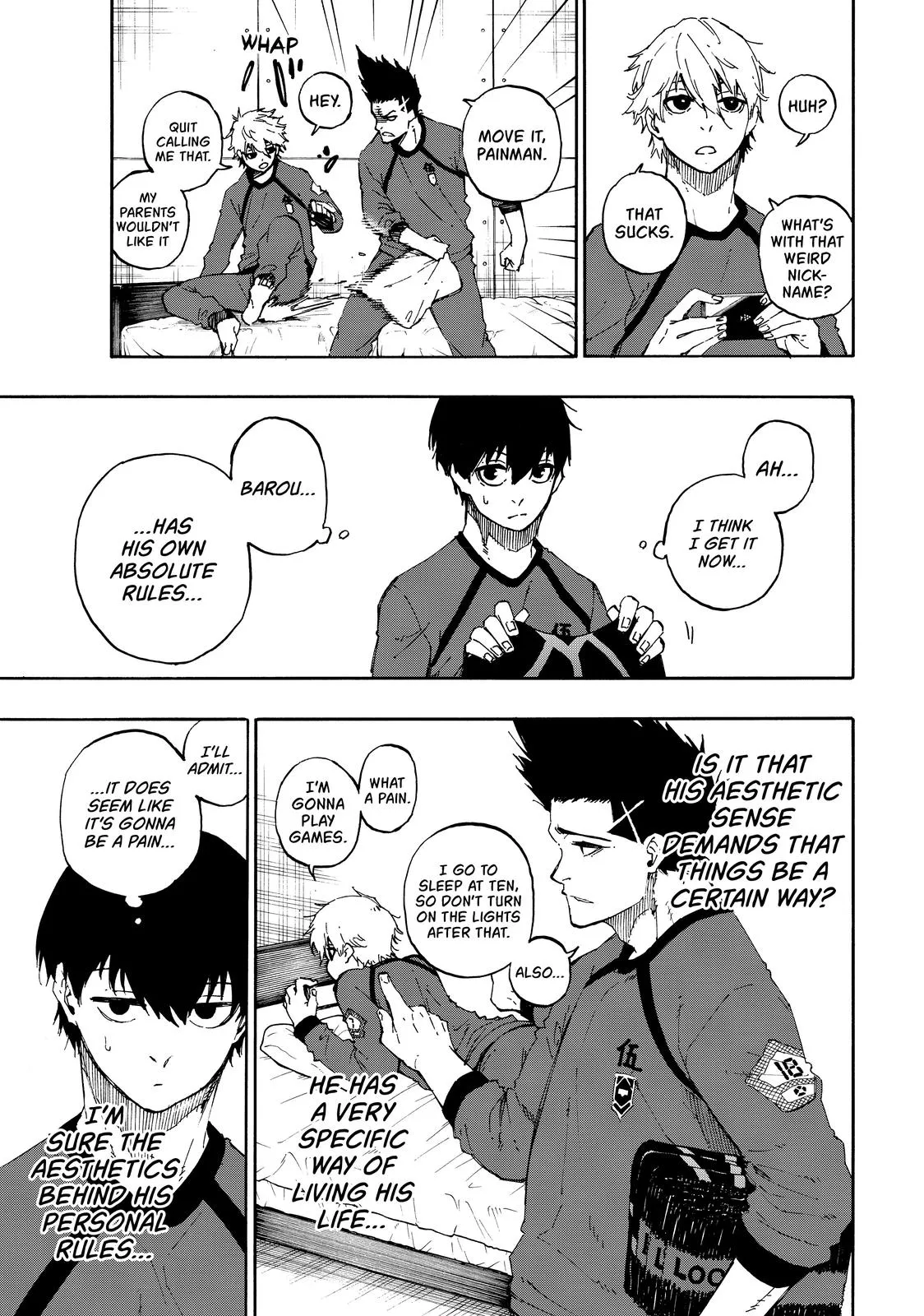
Barou gives Nagi a nickname.
“Move it, Painman.”
Nagi complains.
“Quit calling me that.
My parents wouldn’t like it.”
Isagi thinks the nickname is terrible.
“That sucks.”
But Isagi also starts to understand something deeper.
Barou has absolute rules.
He has a very specific way of living.
“I think I get it now…”
Barou even has a sleep rule.
“I go to sleep at ten, so don’t turn on the lights after that.”
This moment matters because Isagi begins to see Barou’s lifestyle as part of his strength.
His rules are not random.
They may be connected to the way he creates his overwhelming presence on the field.
Isagi Wants to Understand Barou’s Genius
Isagi starts thinking about Barou’s personal rules.
He wonders if Barou’s aesthetic sense demands that everything be a certain way.
“He has a very specific way of living his life…”
Then Isagi reaches an important conclusion.
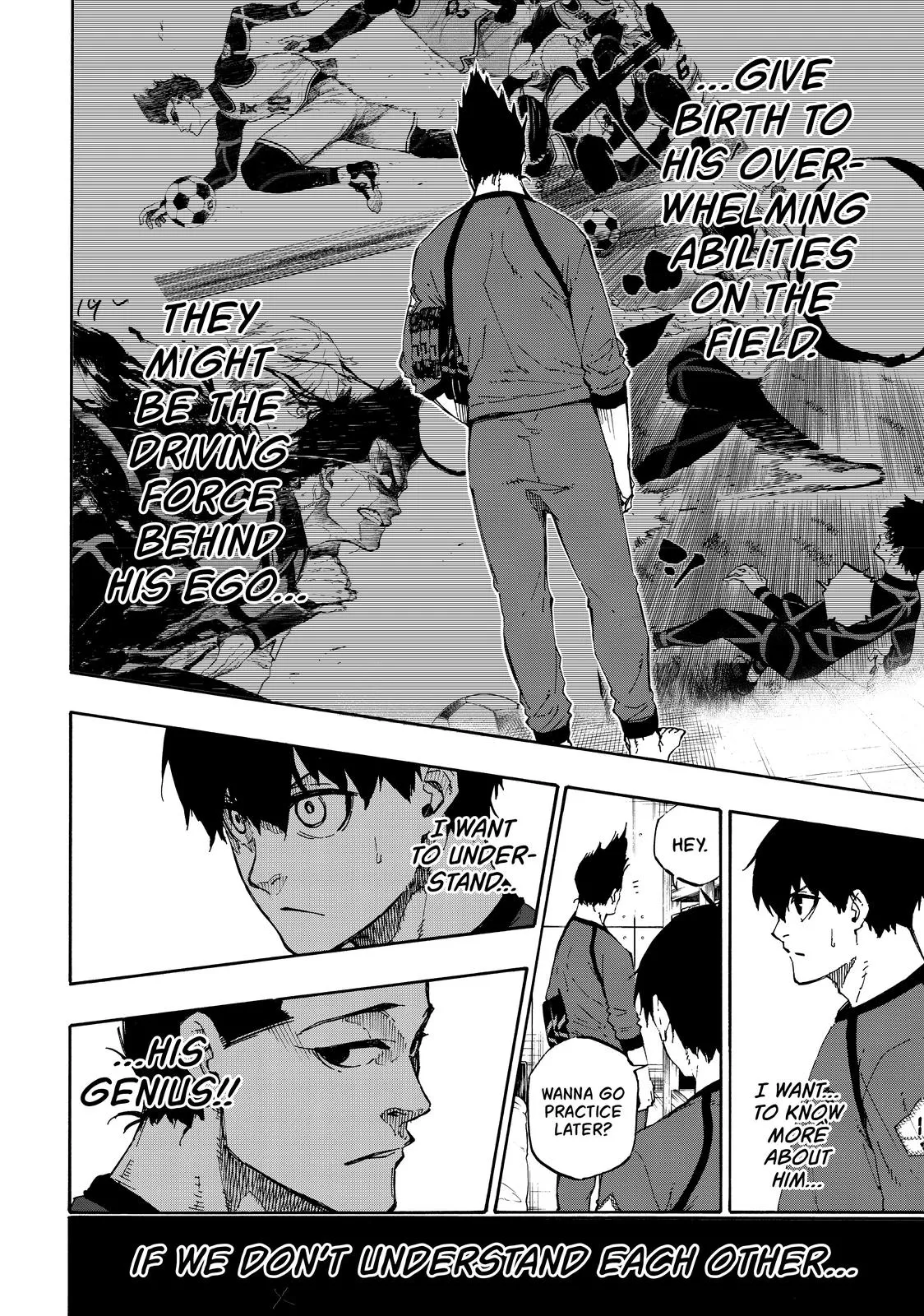
Those rules may give birth to Barou’s abilities on the field.
“They might be the driving force behind his ego…”
This matters because Isagi does not only want Barou as a teammate.
He wants to understand him.
“I want to understand…
his genius!!”
He wants to know more about Barou because without understanding, they cannot connect.
Then Barou suddenly asks:
“Hey.
Wanna go practice later?”
This matters because despite all the conflict, the team’s next step begins here.
Chemical Reaction Requires Understanding
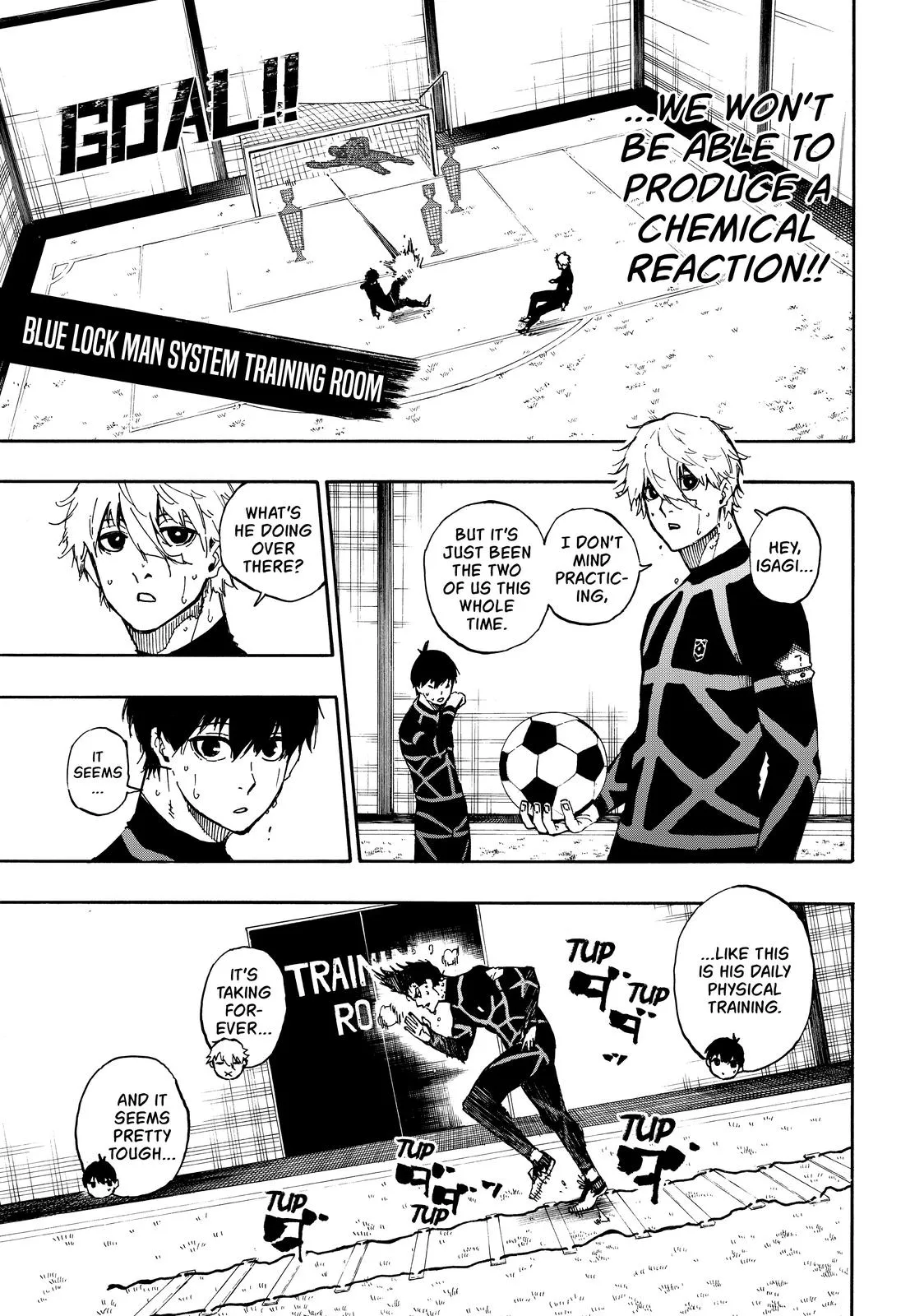
The chapter moves to the Blue Lock Man System Training Room.
The message is clear:
“If we don’t understand each other…
we won’t be able to produce a chemical reaction!!”
This moment matters because Isagi knows talent alone is not enough.
Nagi, Isagi, and Barou are all strong in different ways.
But if they cannot understand each other, their strengths will never combine.
Nagi notices something strange.
“It’s just been the two of us this whole time.”
Barou is not practicing combos yet.
He is doing his daily physical training.
“It seems…
like this is his daily physical training.”
This matters because Barou’s power is not accidental.
It is built through routine, discipline, and repetition.
Barou’s Training Shows His Stoicism
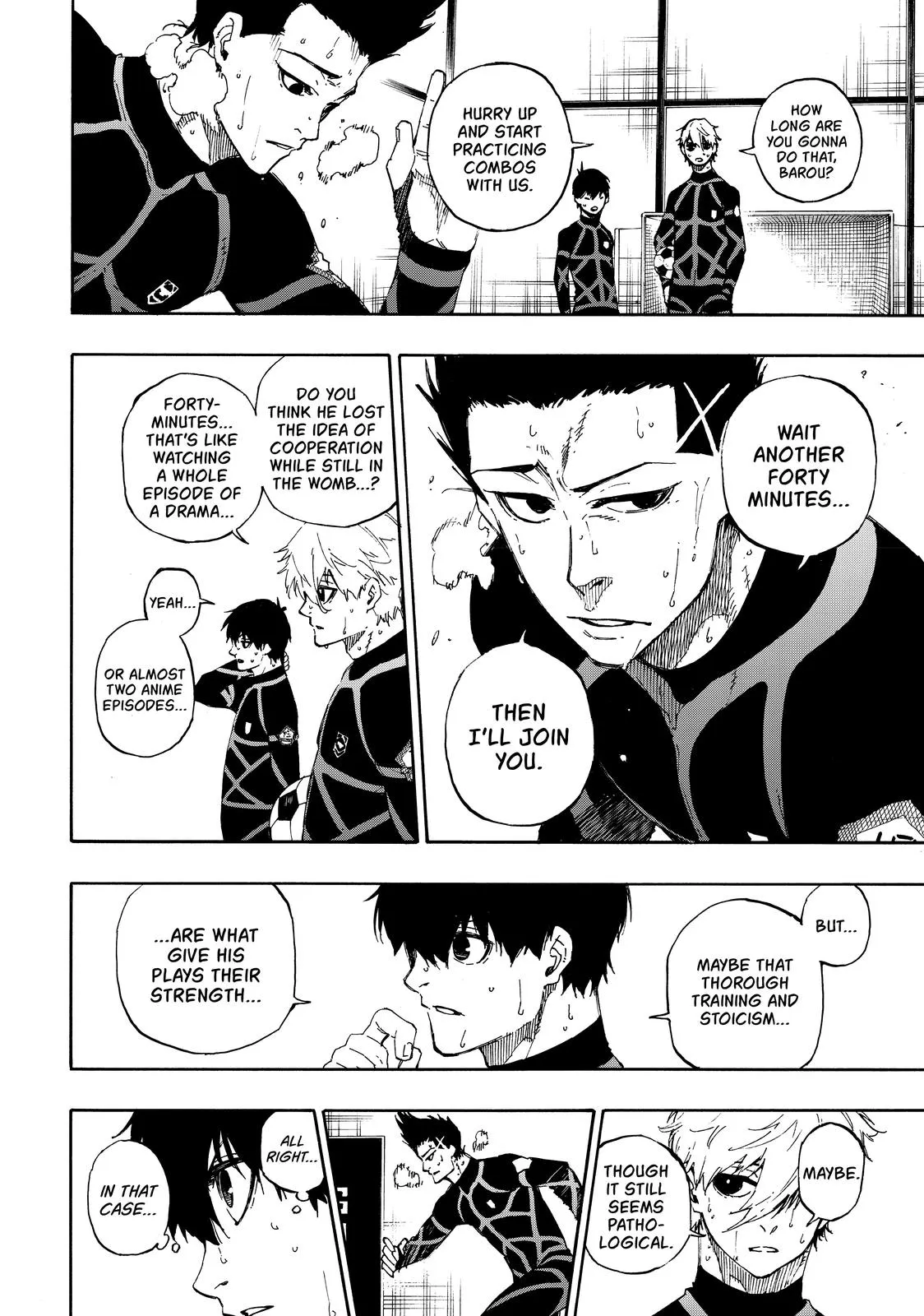
Nagi asks how long Barou will keep training.
“How long are you gonna do that, Barou?”
Barou tells them to hurry up and start practicing combos, but Isagi explains they need to wait.
“Wait another forty minutes…”
Nagi compares the wait to watching a drama episode.
“Forty minutes…
that’s like watching a whole episode of a drama…”
Isagi adds:
“Or almost two anime episodes…”
This moment gives humor, but it also matters because Barou’s seriousness stands out.
His training is intense and strict.
Isagi sees it clearly.
“Maybe that thorough training and stoicism…
are what give his plays their strength…”
Barou’s ego is not empty arrogance.
It is supported by hard routine.
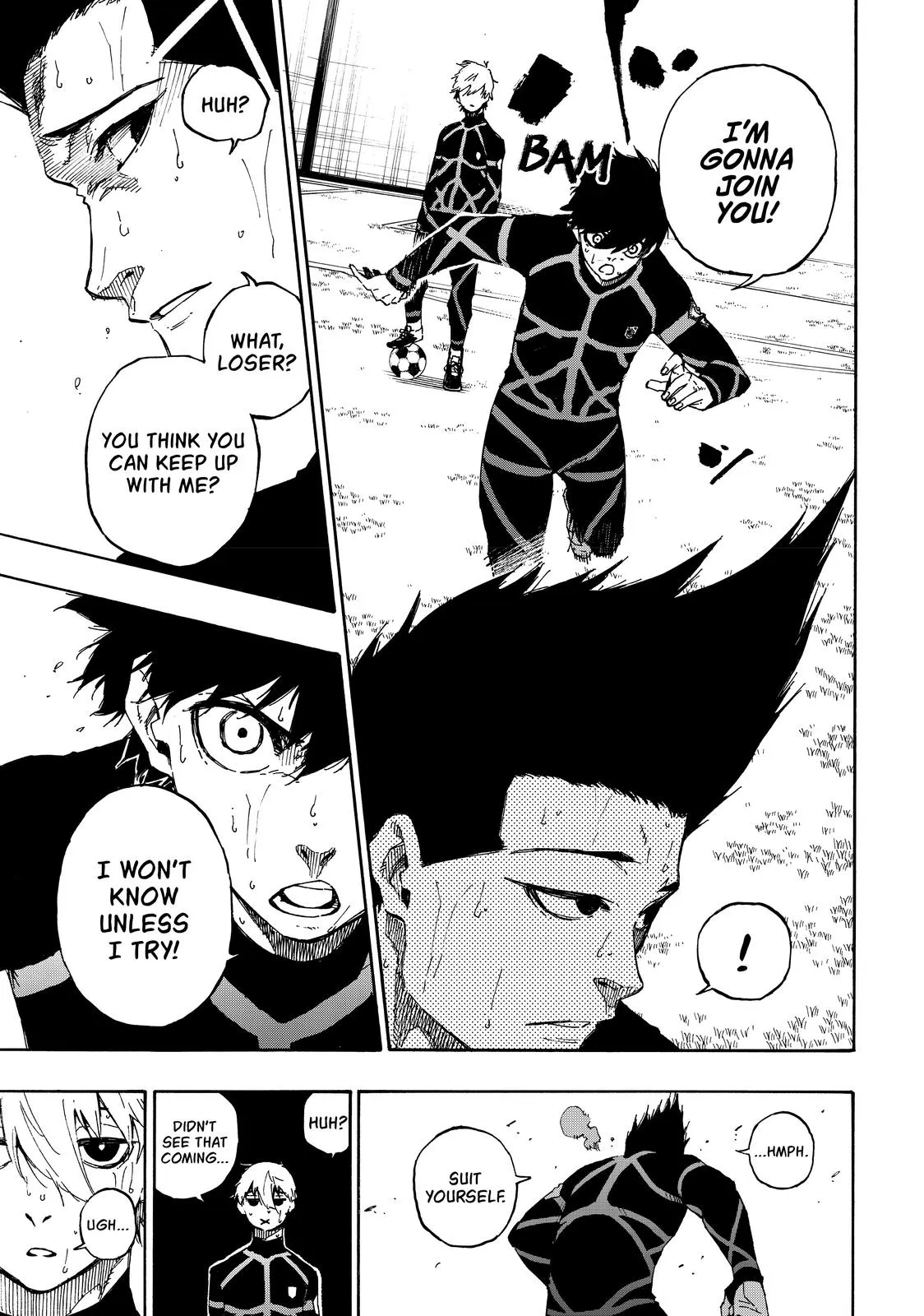
Isagi Chooses to Join Barou’s Training
Then Isagi makes a decision.
“I’m gonna join you!”
Barou challenges him immediately.
“What, loser?
You think you can keep up with me?”
Isagi does not pretend to know.
“I won’t know unless I try!”
This moment matters because Isagi is not just observing Barou anymore.
He is stepping into Barou’s world to understand him through action.
Barou allows it.
“Hmph.
Suit yourself.”
Nagi is surprised.
“Didn’t see that coming…”
This is important because Isagi’s strength is again shown through adaptability.
He is willing to change his habits if it helps him grow.
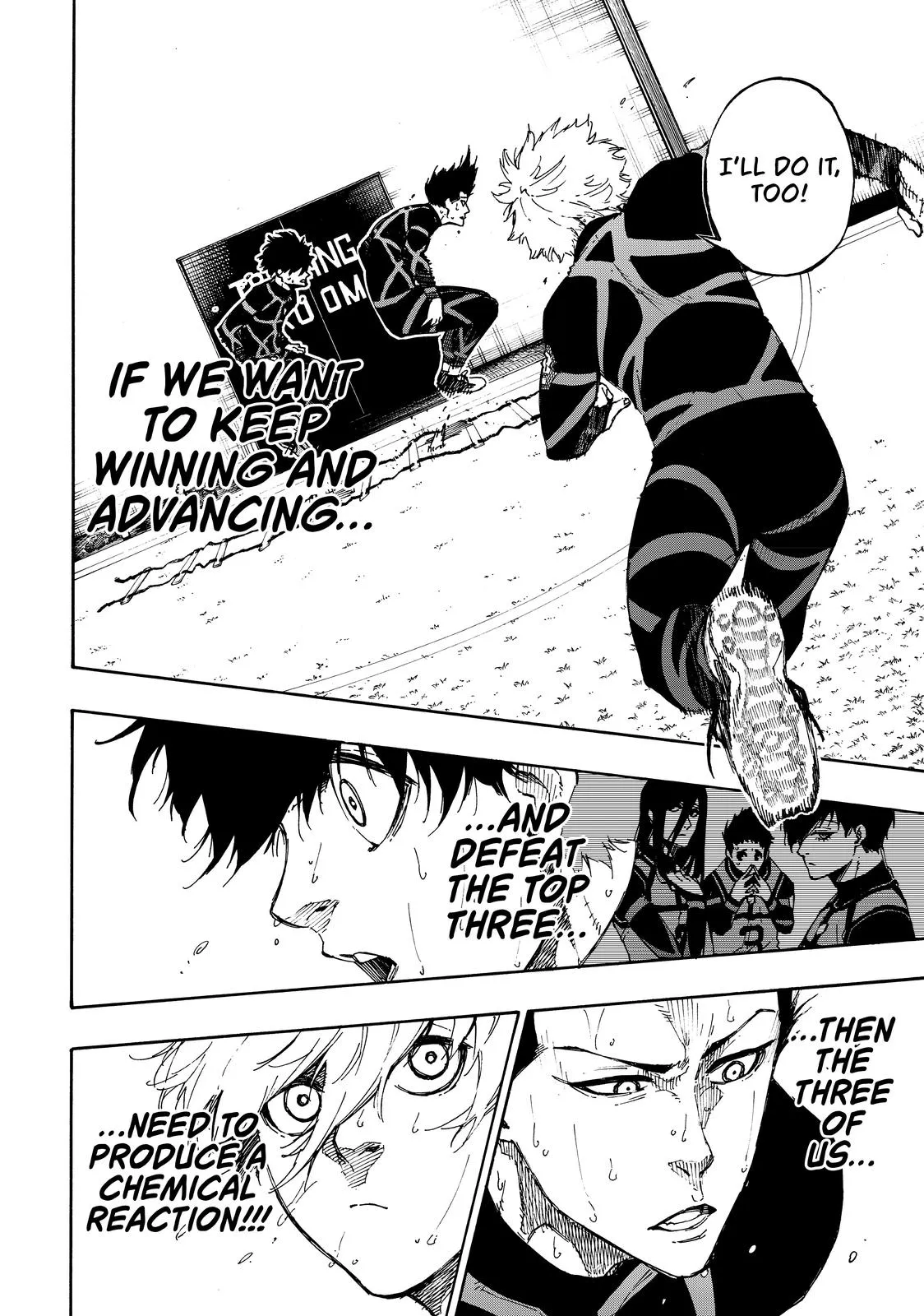
Nagi Joins Too
Nagi decides to join as well.
“I’ll do it, too!”
This moment matters because the three-man team finally begins moving in the same direction.
They are still selfish.
They are still difficult.
But now they are training together.
The chapter explains the reason:
“If we want to keep winning and advancing…
and defeat the top three…”
Then they need something more.
“The three of us…
need to produce a chemical reaction!!!”
This matters because their next goal is not just survival.
They must become a team strong enough to defeat the top three.
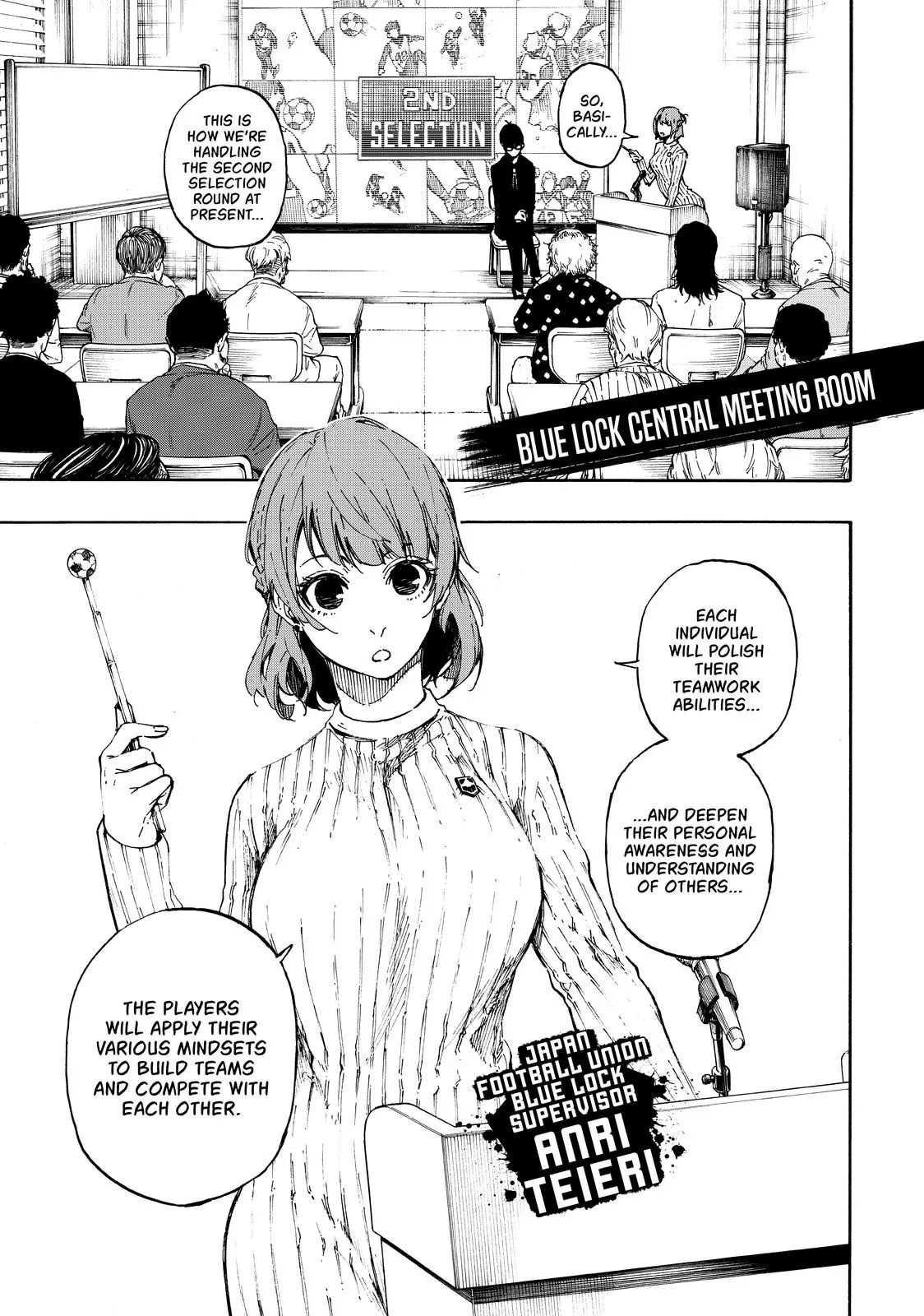
The Purpose of the Second Selection
The chapter then shifts to the Blue Lock Central Meeting Room.
Anri Teieri explains the current second selection system.
“Each individual will polish their teamwork abilities…
and deepen their personal awareness and understanding of others…”
This matters because the training is not only about scoring goals.
It is about players learning themselves and learning each other.
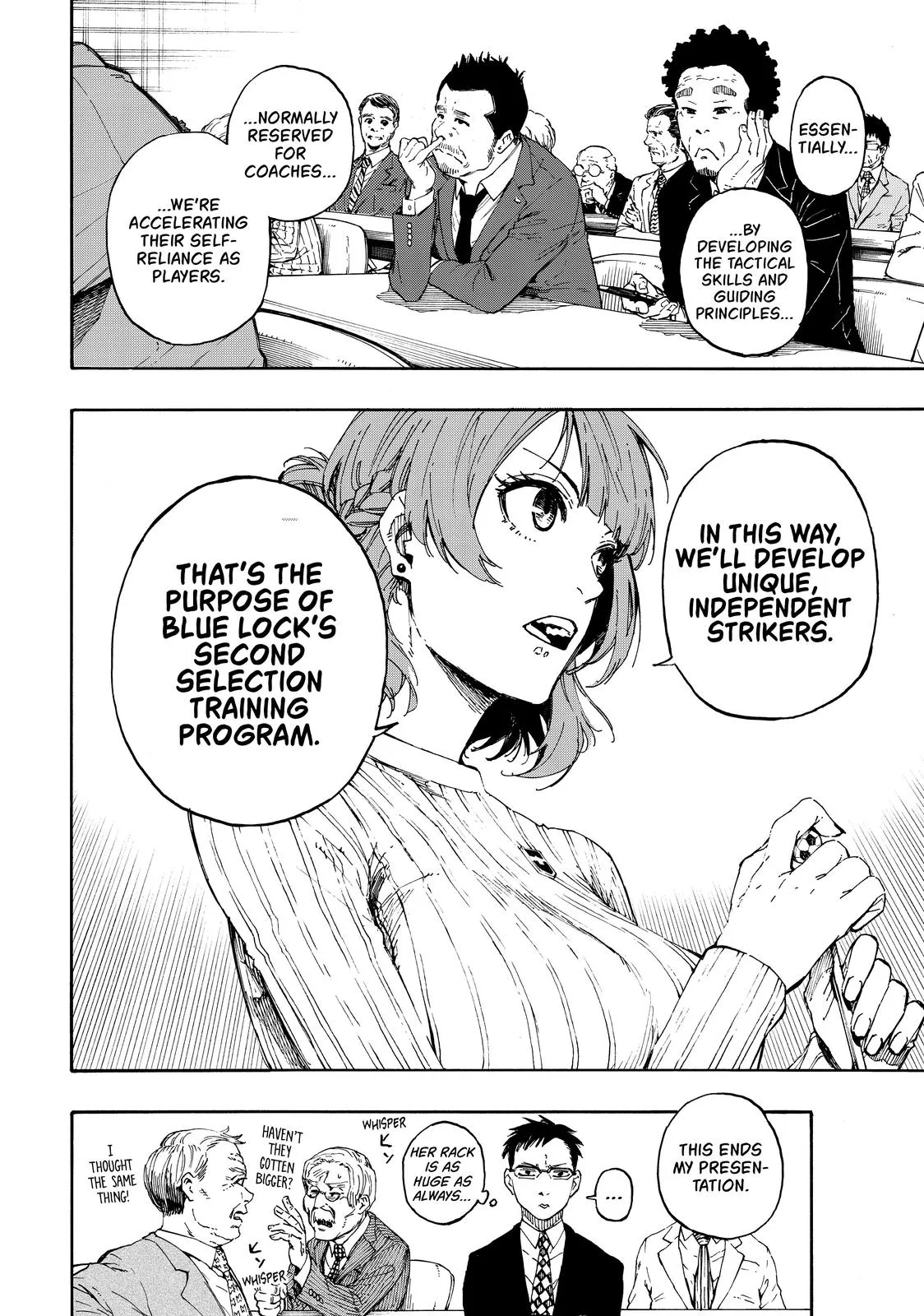
Teieri explains that the players build teams and compete using their different mindsets.
The goal is to develop self-reliant strikers.
“We’ll develop unique, independent strikers.”
This moment matters because it connects directly to Isagi’s situation.
He must understand Barou and Nagi while also strengthening himself.
Blue Lock Wants Independent Strikers
The officials explain that the second selection develops tactical skills and guiding principles usually reserved for coaches.
“We’re accelerating their self-reliance as players.”
This matters because Blue Lock is not creating players who wait for orders.
It is creating players who can think, decide, and act for themselves.
That is exactly what Isagi is learning.
He is not just playing inside a system.
He is learning how to build one.
Teieri ends her presentation, but the room’s focus is not entirely serious.
Some old men whisper inappropriate comments, while others discuss the program’s value.
This matters because it shows the contrast between Blue Lock’s serious purpose and the shallow attitudes around it.
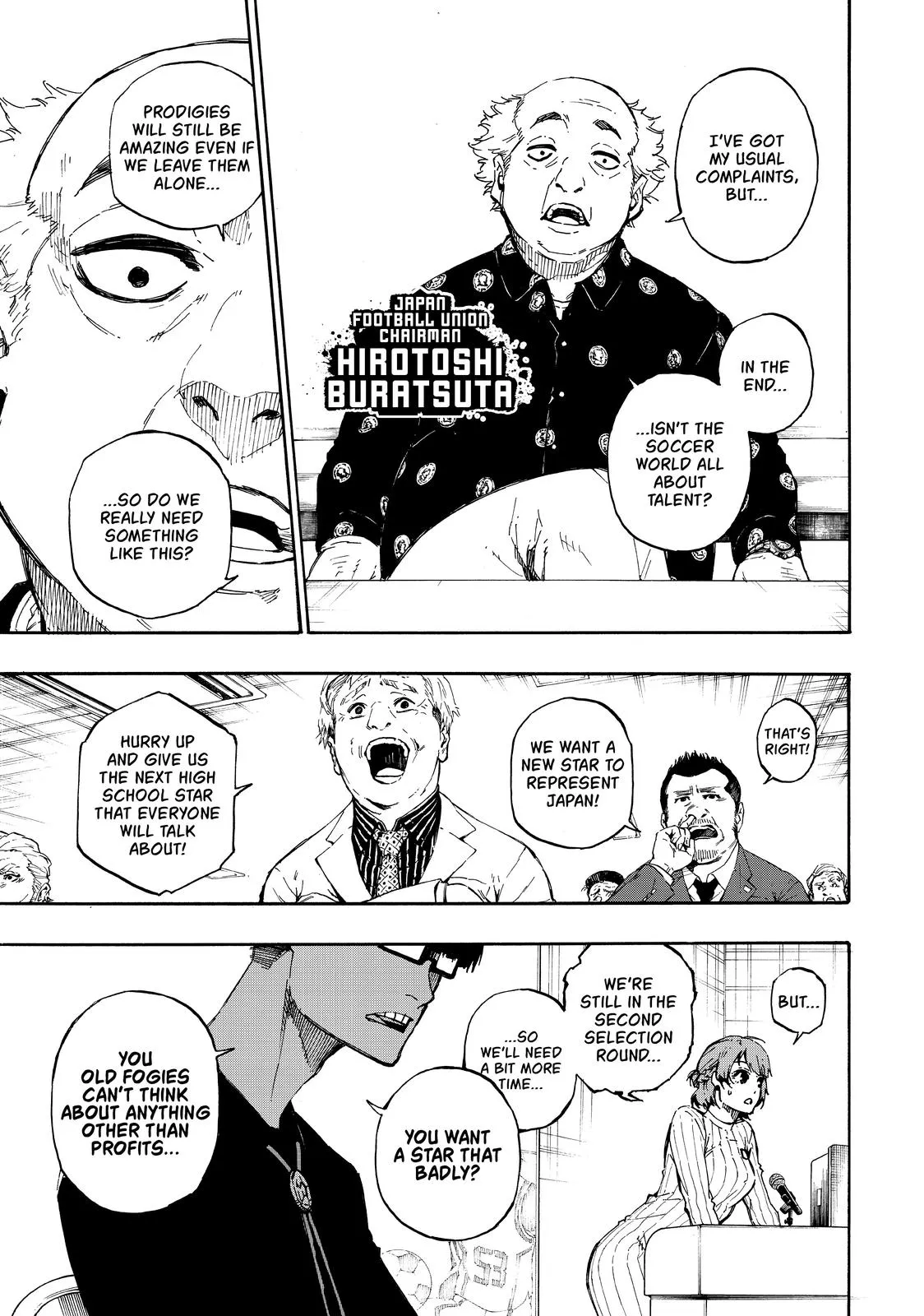
The Chairman Questions Blue Lock
Hirotoshi Buratsuta, the Japan Football Union Chairman, questions whether Blue Lock is even necessary.
“Isn’t the soccer world all about talent?”
He believes prodigies will still be amazing even if left alone.
“Prodigies will still be amazing even if we leave them alone…”
Others want a new star quickly.
“We want a new star to represent Japan!”
This moment matters because it shows a different mindset from Blue Lock.
The officials want marketable stars.
They want someone people will talk about.
But Ego sees a deeper problem.
Ego Challenges the Meaning of Talent
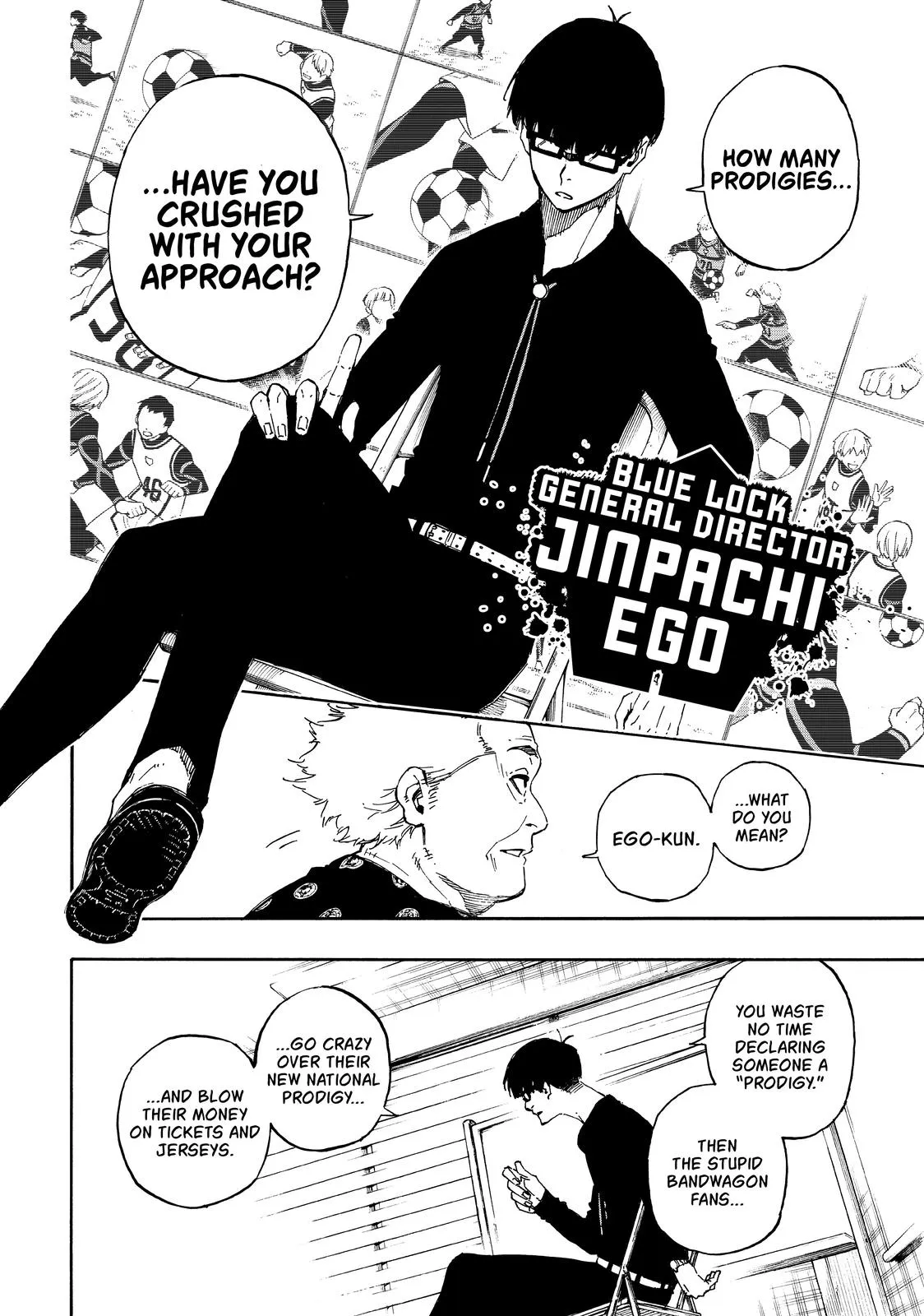
Jinpachi Ego cuts through the room.
“How many prodigies…
have you crushed with your approach?”
This moment matters because Ego attacks the system itself.
He says people are quick to label someone a prodigy.
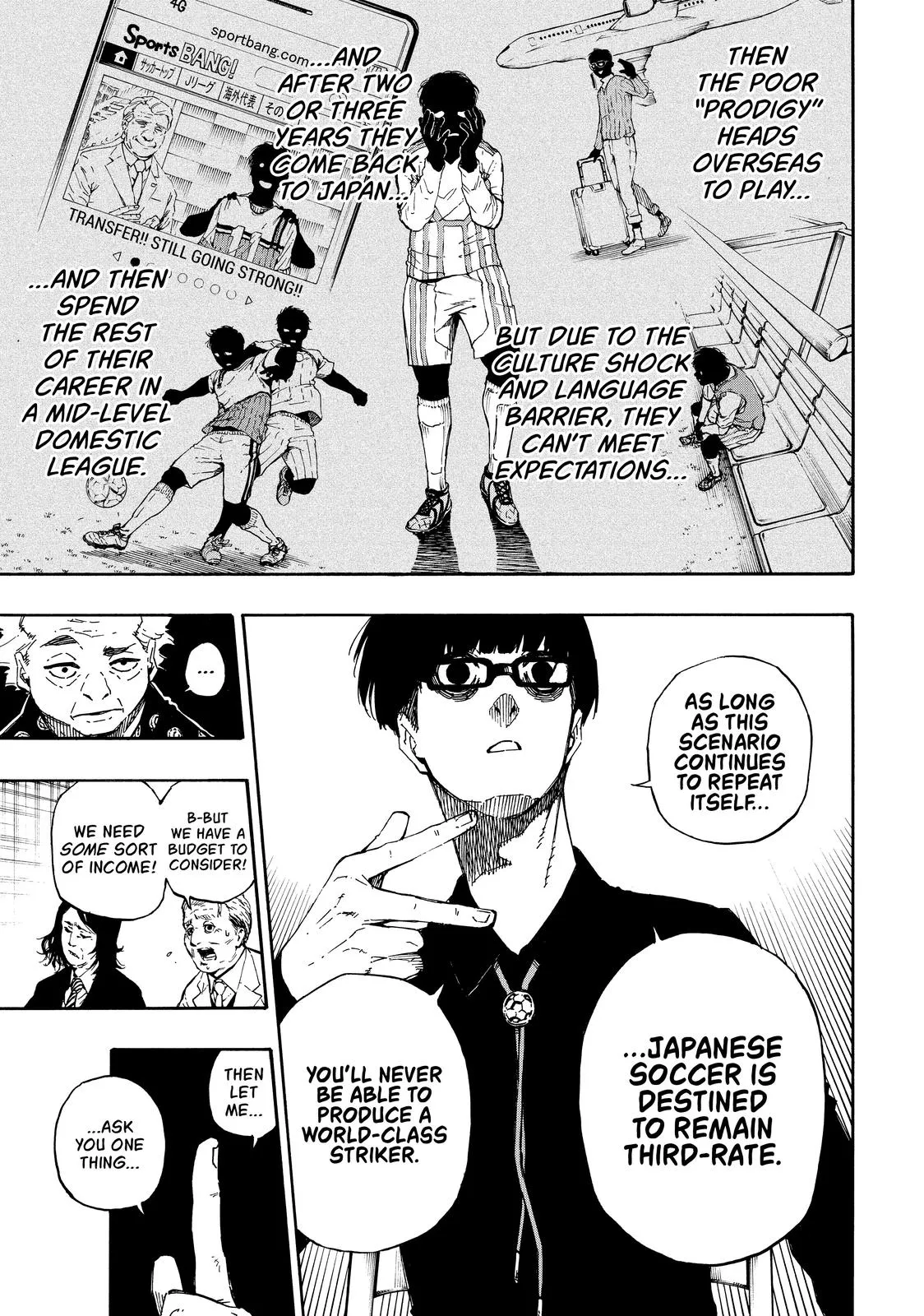
Fans jump on the bandwagon, buy tickets and jerseys, and turn that player into a symbol.
But then the “prodigy” goes overseas.
“Due to the culture shock and language barrier, they can’t meet expectations…”
After a few years, they return and spend the rest of their career in a mid-level domestic league.
Ego says that if this keeps happening:
“Japanese soccer is destined to remain third-rate.”
This matters because Ego is not satisfied with shallow talent.
He wants something stronger.
Ego Defines Talent
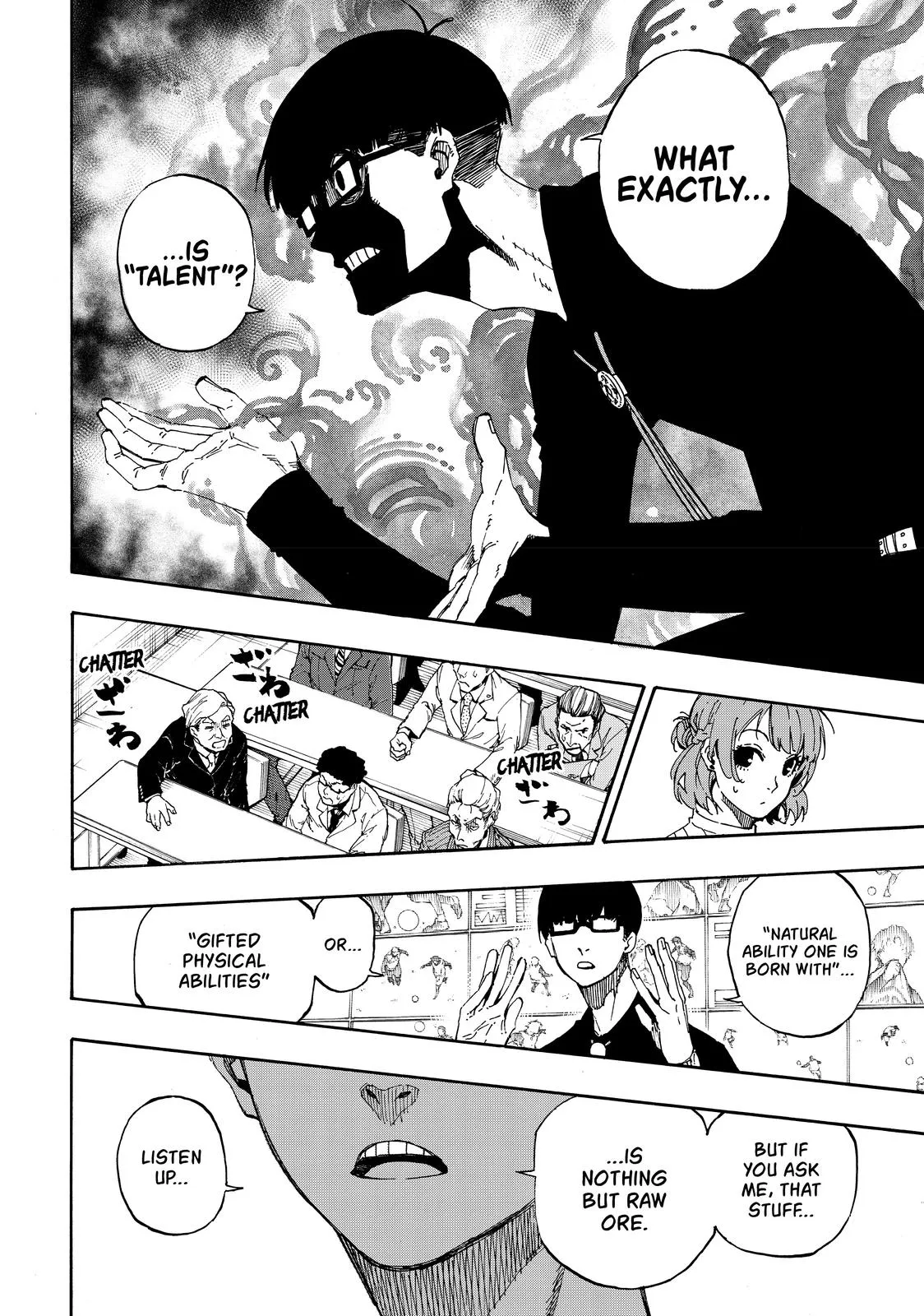
Ego asks the central question of the chapter.
“What exactly…
is talent?”
The common answers appear:
“Natural ability one is born with…”
“Gifted physical abilities”
But Ego rejects those as the full meaning.
“That stuff…
is nothing but raw ore.”
This moment matters because it connects back to the chapter title.
Talent is not simply being born special.
Raw ability must be proven.
It must be shaped.
It must be shown to the world.
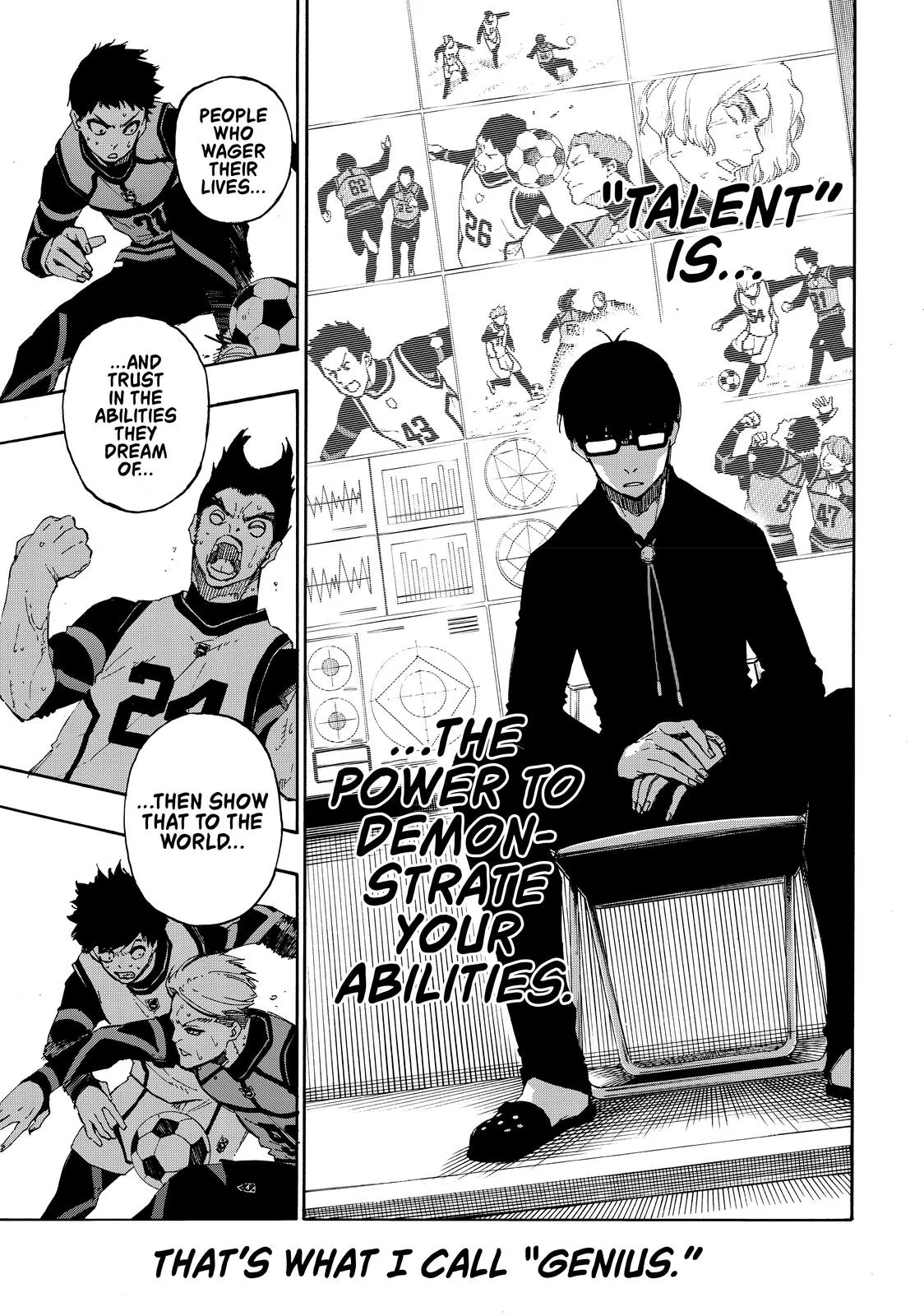
Talent Is the Power to Demonstrate Ability
Ego gives his definition.
“Talent is…
the power to demonstrate your abilities.”
This matters because it reframes everything happening in Blue Lock.
A genius is not just someone with gifts.
A genius is someone who wagers their life on those gifts and proves them.
The chapter says:
“People who wager their lives…
and trust in the abilities they dream of…
then show that to the world…”
That is what Ego calls genius.
“That’s what I call ‘genius.’”
This moment matters because it directly explains the chapter’s title.
A real genius proves their life’s wager through performance.
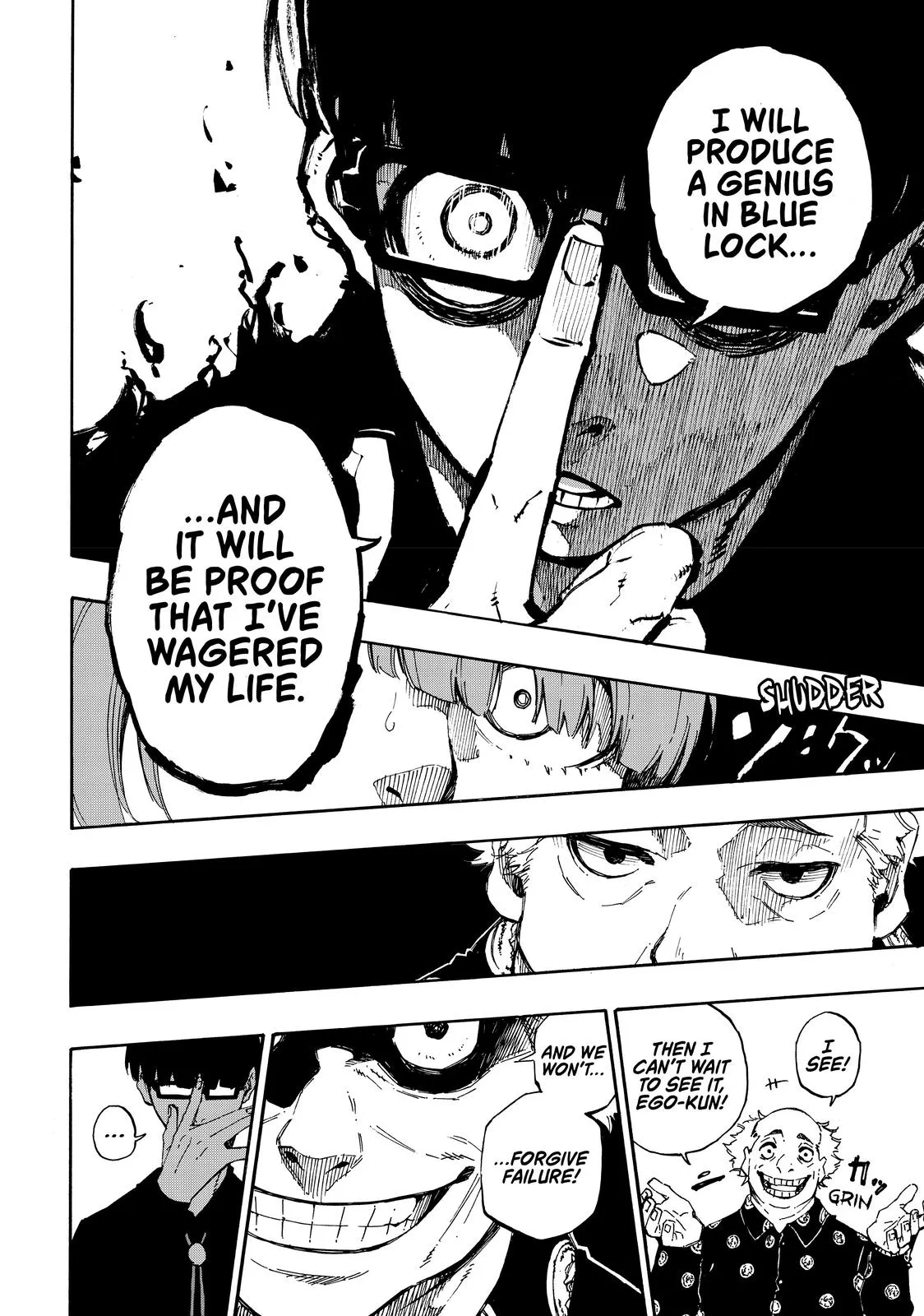
Ego’s Own Wager
Ego then declares his own purpose.
“I will produce a genius in Blue Lock…”
And he adds:
“It will be proof that I’ve wagered my life.”
This moment matters because Ego is not only testing the players.
He is also staking his own life’s work on Blue Lock.
Buratsuta smiles and gives a warning.
“We won’t…
forgive failure!”
The pressure around Blue Lock becomes clear.
The players are fighting for survival, but Ego is also fighting to prove his vision.
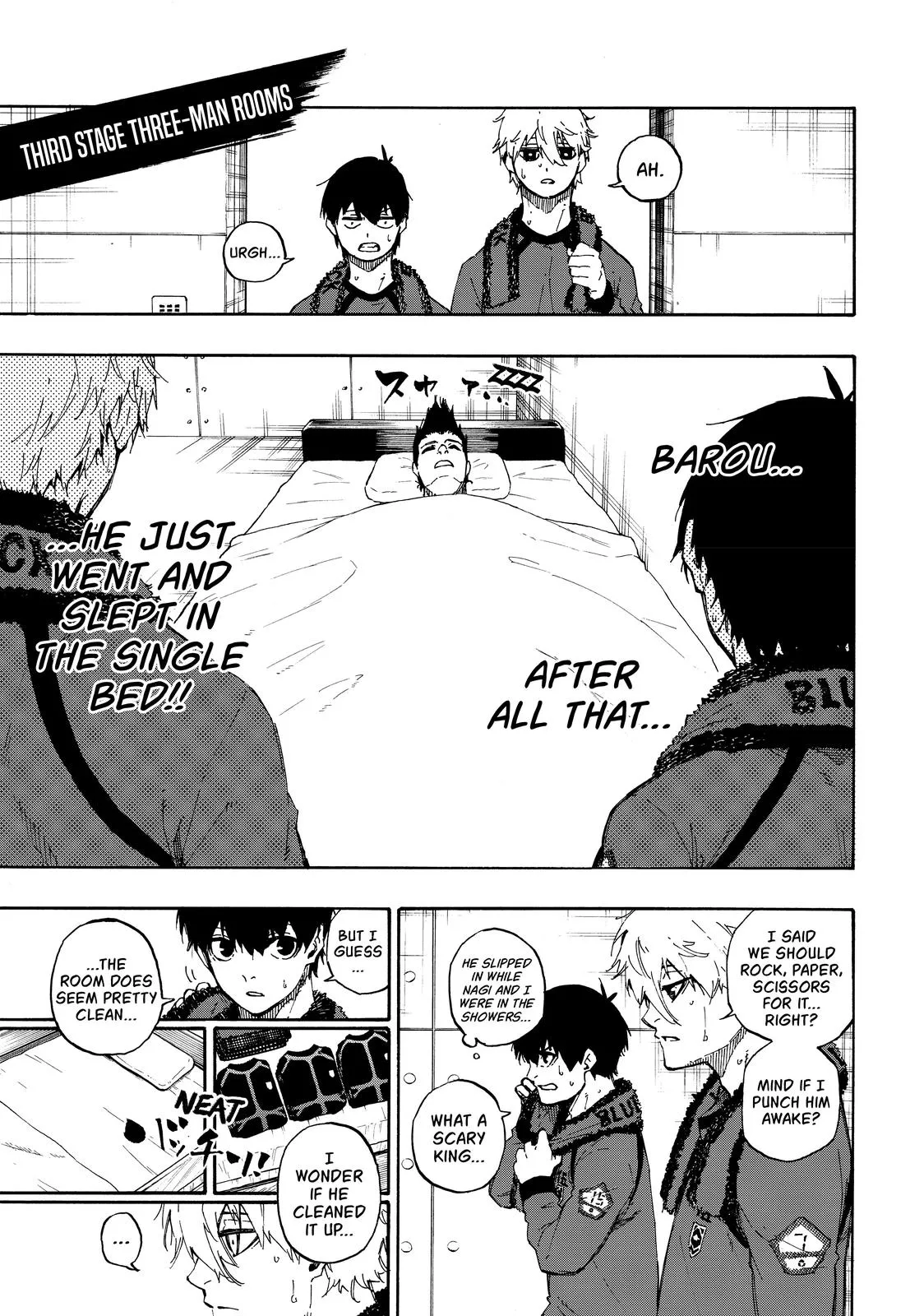
Back in the Room: Barou Wins the Bed Anyway
The chapter returns to the Third Stage Three-Man Room.
Isagi is exhausted.
“Urgh…”
After all the arguing, Barou has simply taken the single bed.
“After all that…
he just went and slept in the single bed!!”
The room is now clean, and Isagi wonders if Barou cleaned it.
“I wonder if he cleaned it up…”
This matters because Barou’s contradictions continue.
He is selfish enough to steal the bed, but disciplined enough to clean the room.
Nagi says Barou slipped in while they were in the showers.
“Mind if I punch him awake?”
Isagi can only react to the terrifying selfishness of the king.
“What a scary king…”
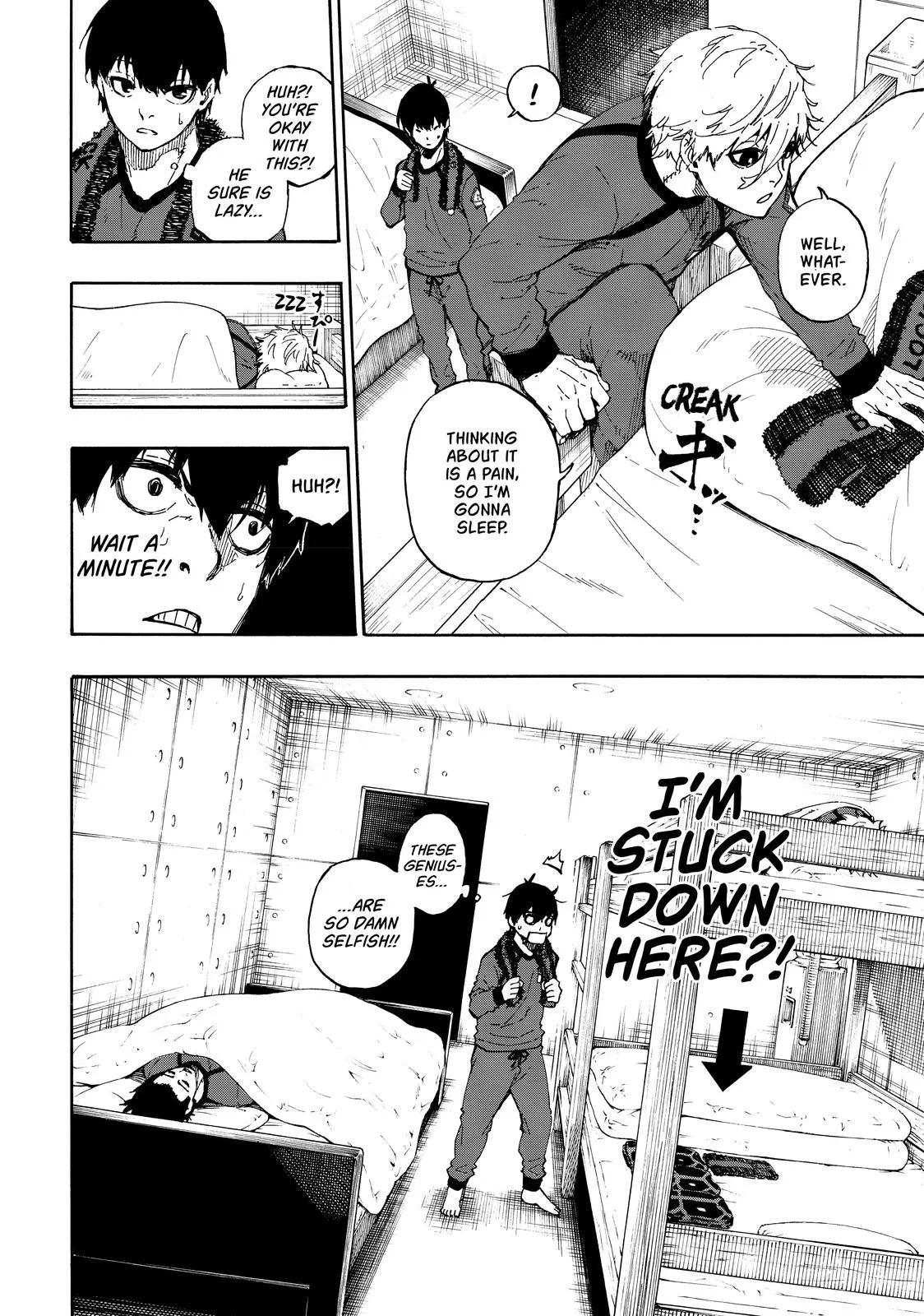
Isagi Gets Stuck With the Bunk Bed
Nagi gives up quickly.
“Thinking about it is a pain, so I’m gonna sleep.”
Then Isagi realizes what has happened.
“Wait a minute!!”
He is stuck below.
“I’m stuck down here?!”
The chapter ends with Isagi’s frustration.
“These geniuses…
are so damn selfish!!”
This moment matters because it captures the new team perfectly.
They are powerful, talented, and full of potential.
But they are also difficult, selfish, and chaotic.
For Isagi, surviving with them may be its own kind of training.
Final Thoughts
Blue Lock Chapter 56: is a transition chapter, but it carries major meaning.
Isagi, Nagi, and Barou are now teammates.
But their chemistry is far from complete.
Barou’s strict rules, Nagi’s laziness, and Isagi’s desire to understand them create a strange new team dynamic.
“If we don’t understand each other…
we won’t be able to produce a chemical reaction!!”
At the same time, Ego explains what talent truly means.
“Talent is…
the power to demonstrate your abilities.”
That definition matters because it connects every player’s struggle.
Being called a genius is not enough.
A real genius must prove it.
And in Blue Lock, that proof comes from wagering your life on your ability and showing it to the world.
“I will produce a genius in Blue Lock…
and it will be proof that I’ve wagered my life.”
Continue to Chapter 57 →