BLUE LOCK CHAPTER 31: AWAKENING


BLUE LOCK CHAPTER 31 – A DETAILED BREAKDOWN:
AWAKENING
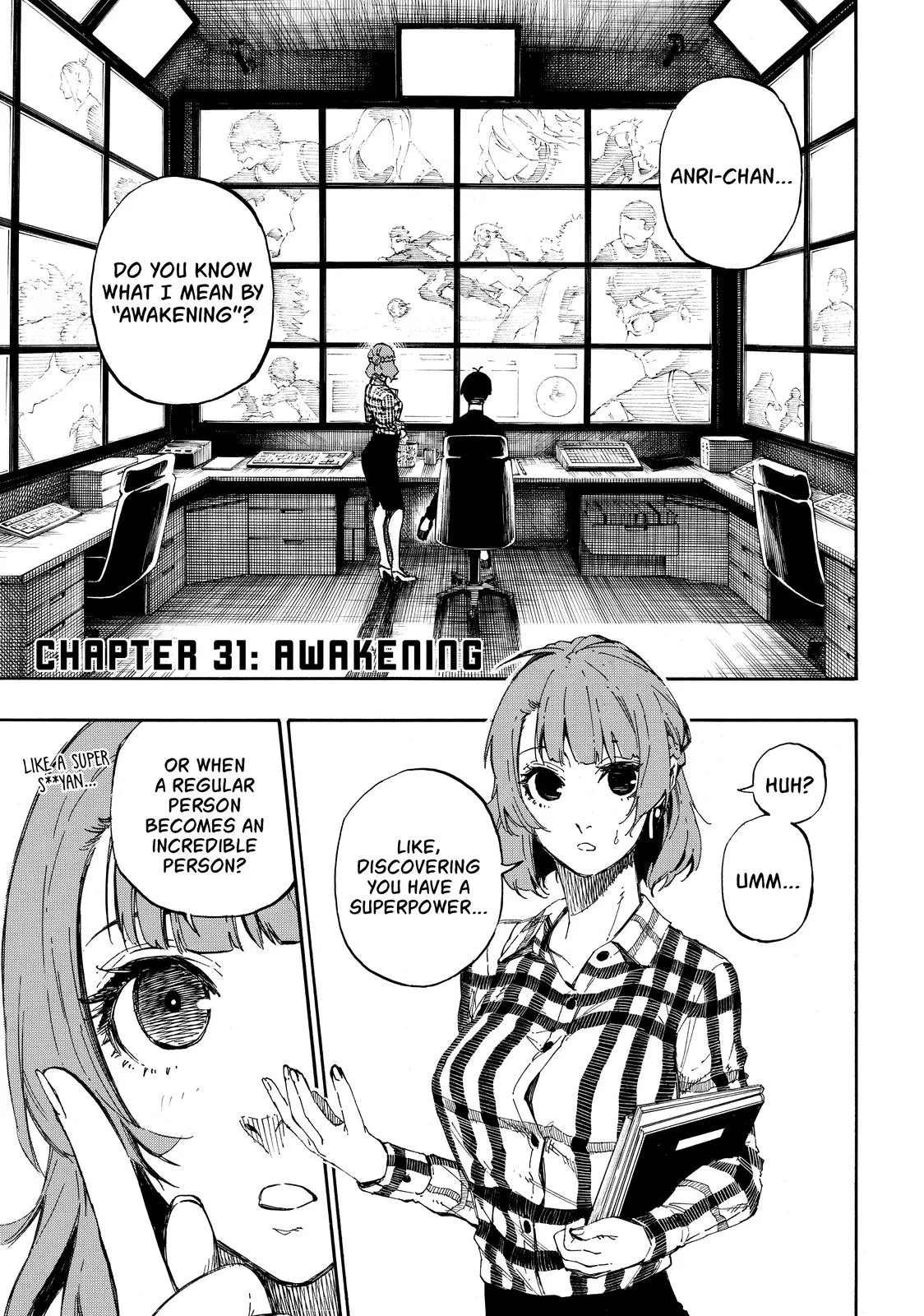
The Question That Opens the Chapter
This chapter opens in the control room, but it does not feel calm for even a second. It starts with a question that sounds simple on the surface:
“Anri-chan…
Do you know what I mean by ‘Awakening’?”
And the first answer completely misses the point.
Anri’s reply is almost playful, almost childish. She talks about it like it is some fantasy switch getting flipped.
“Like, discovering you have a superpower…”
“Or when a regular person becomes an incredible person?”
“Like a super s**yan…”
That is exactly the kind of idea the chapter wants to crush.
Because what follows is not soft, and it is definitely not romantic.
The Brutal Definition of “Awakening”
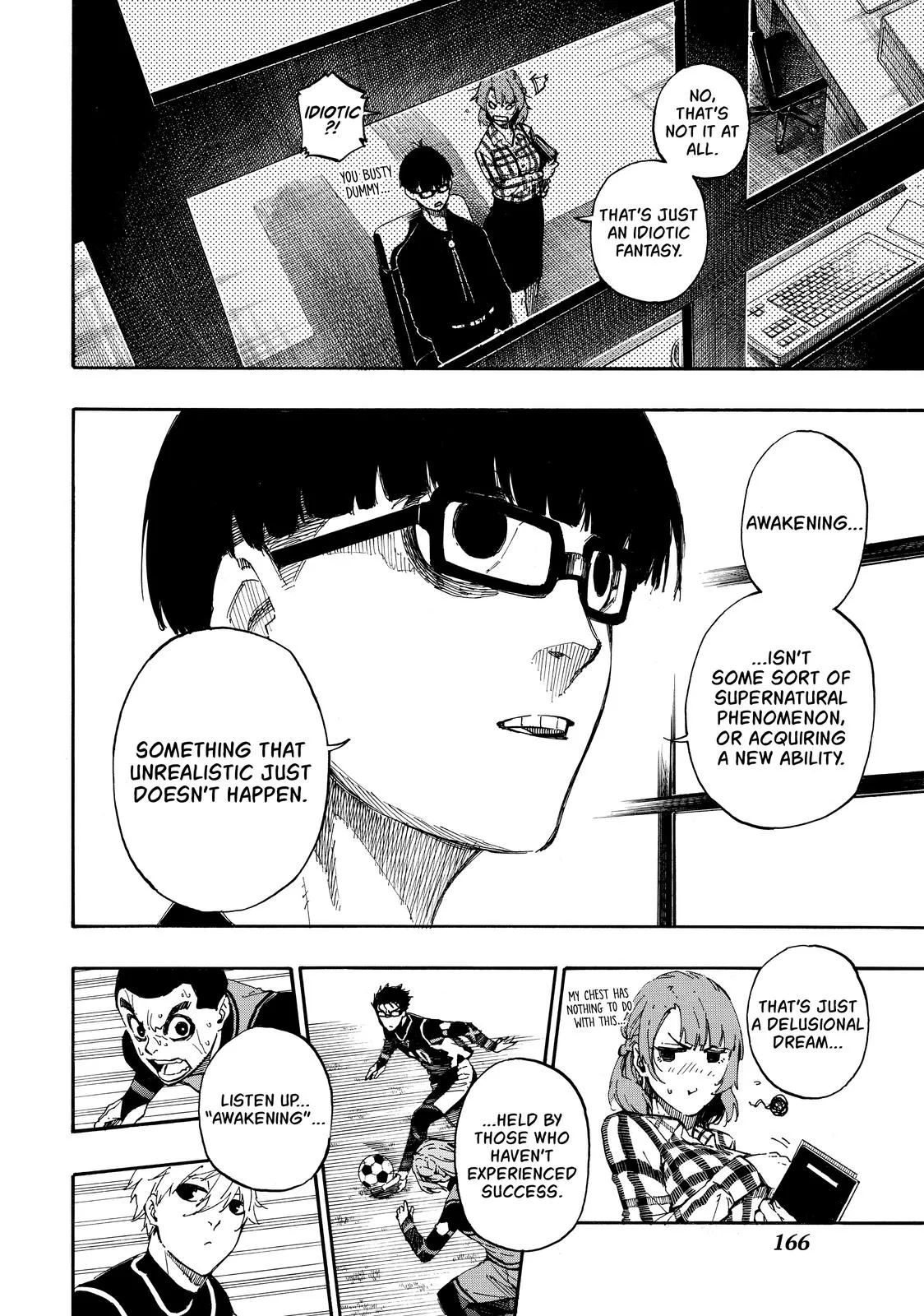
Ego’s response comes down hard:
“No, that’s not it at all.”
“That’s just an idiotic fantasy.”
That line sets the whole chapter’s mood. No magic. No miracle. No random hidden power appearing out of nowhere.
Then the explanation gets sharper.
“Awakening…”
“…isn’t some sort of supernatural phenomenon, or acquiring a new ability.”
“Something that unrealistic just doesn’t happen.”
The chapter is making a very direct point here. People who talk about “awakening” like it is some magical transformation are fooling themselves.
Then it goes even further:
“Listen up… ‘Awakening’…”
“…held by those who haven’t experienced success.”
“That’s just a delusional dream…”
That is harsh on purpose. This chapter does not want the word “awakening” to sound cool in a fake way. It wants it stripped down to what it really is.
And then, finally, it gives the real answer.
What Awakening Actually Means
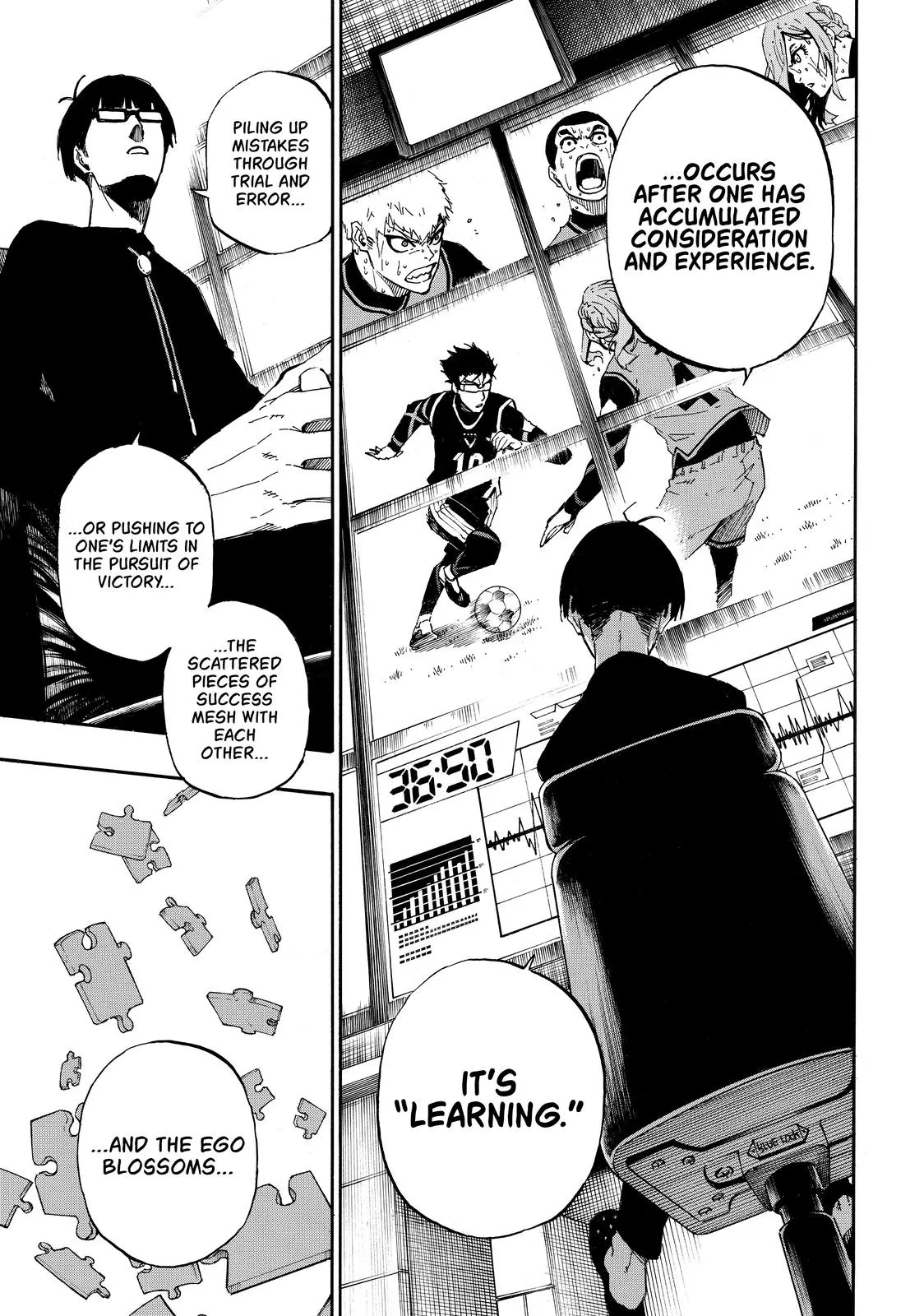
The explanation on page 3 is probably the core of the whole chapter:
“Piling up mistakes through trial and error…”
“…or pushing to one’s limits in the pursuit of victory…”
“…the scattered pieces of success mesh with each other…”
“…and the ego blossoms…”
That is not fantasy. That is accumulation. Failure. Pressure. Experience. Tiny fragments finally connecting.
And then the chapter says it in the simplest possible way:
“…occurs after one has accumulated consideration and experience.”
“It’s ‘learning.’”
That is the real definition.
Not becoming someone else.
Not getting a new weapon from nowhere.
Just learning so deeply, under so much pressure, that the truth of your game reveals itself.
Then the chapter lands the most important line:
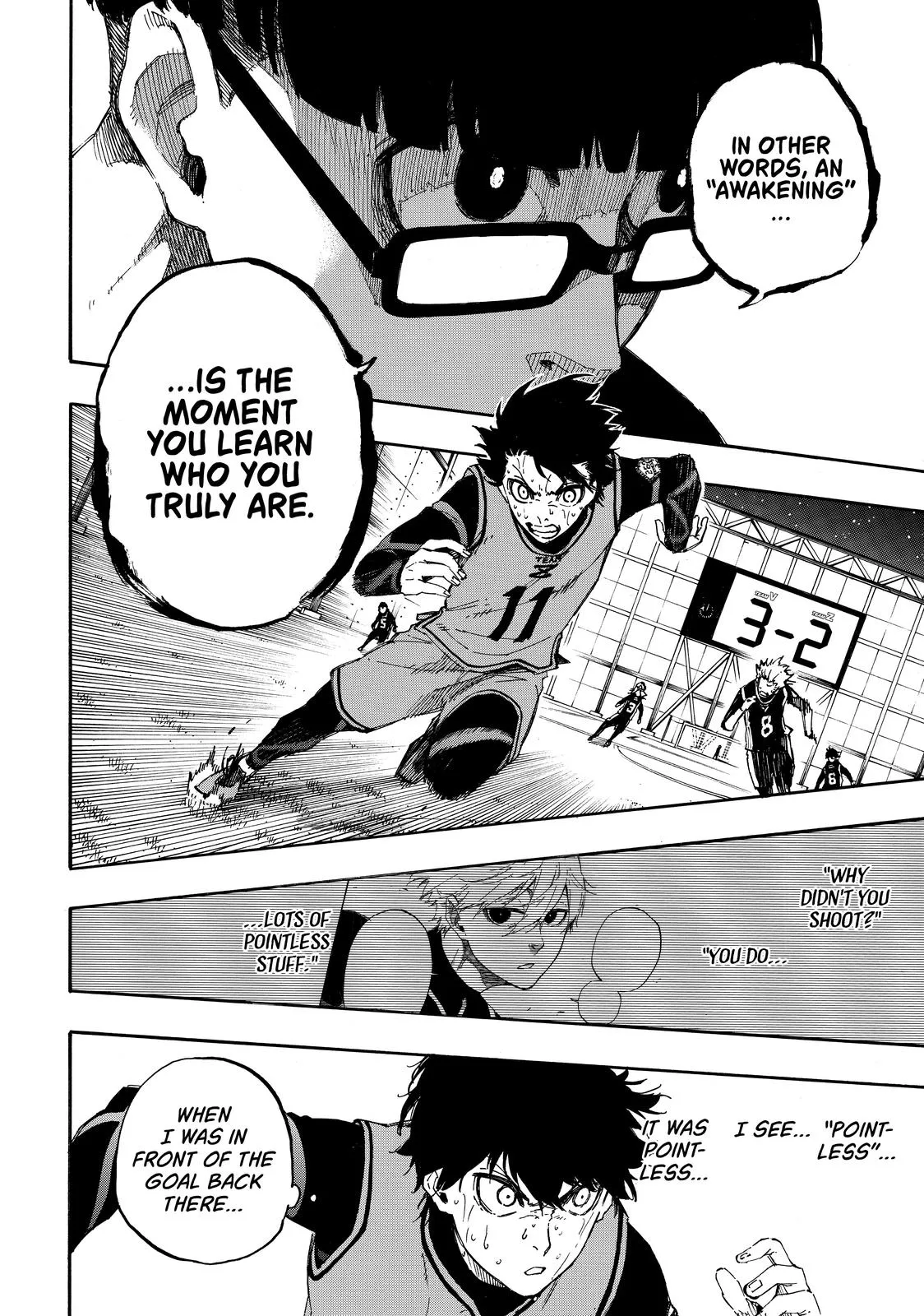
“In other words, an ‘Awakening’…”
“…is the moment you learn who you truly are.”
That line hangs over everything that comes next.
Because from here on, the chapter stops explaining and starts proving it.
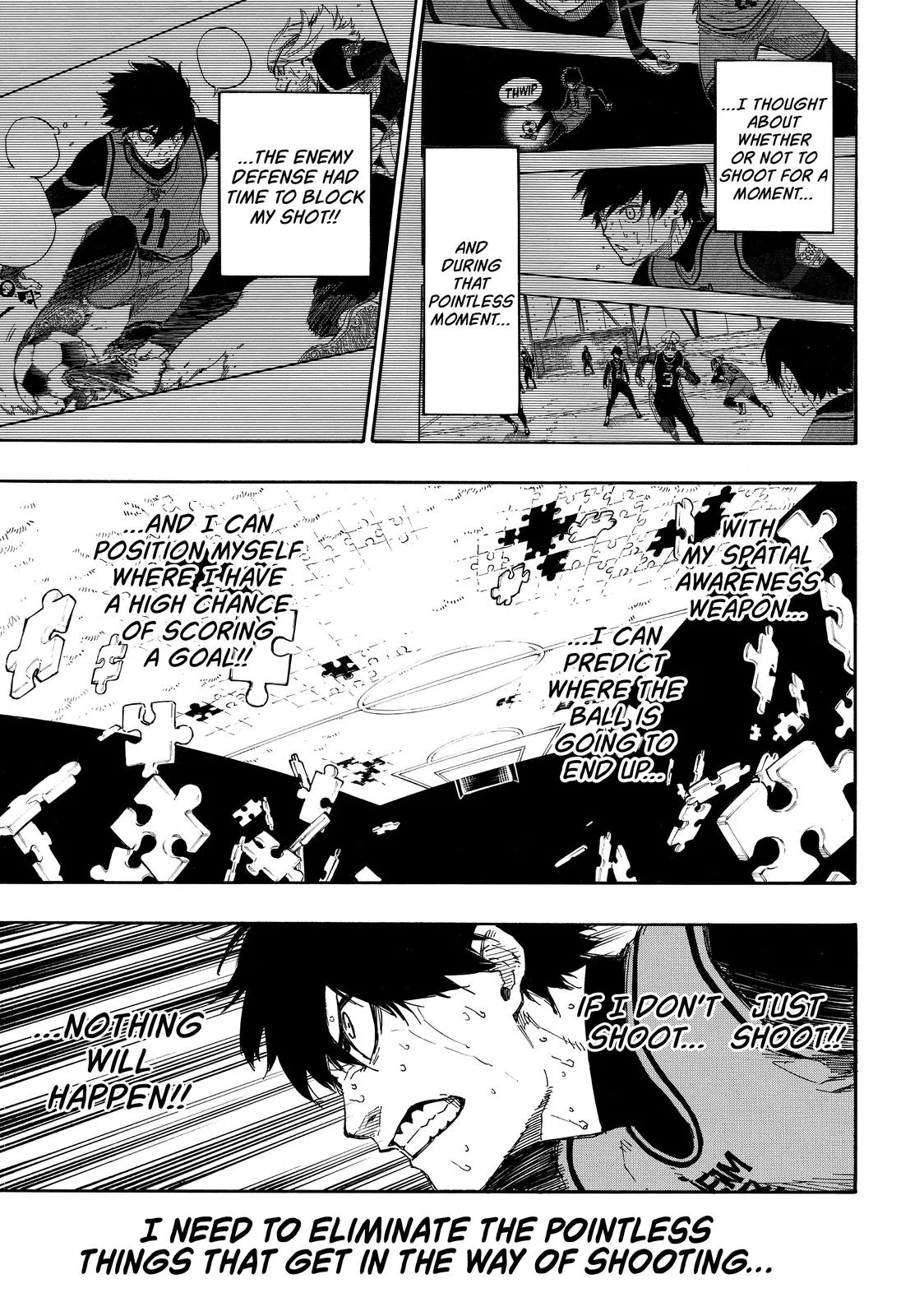
The Pointless Moment in Front of Goal
The first on-field realization is not flashy. It is painfully small.
Isagi thinks back to a moment in front of goal and suddenly understands what ruined it.
“When I was in front of the goal back there…”
“It was pointless…”
“I see… ‘Pointless’…”
That word becomes the trigger.
Then the full mistake gets exposed:
“…I thought about whether or not to shoot for a moment…”
“…the enemy defense had time to block my shot!!”
That is the whole problem right there. Not lack of talent. Not lack of instinct. Just one useless pause.
One hesitation.
And in a match like this, one hesitation is enough to kill everything.
Then the Isagi realizes what his weapon really does:
“With my spatial awareness weapon…”
“…I can predict where the ball is going to end up…!”
“…and I can position myself where I have a high chance of scoring a goal!!”
This is what the chapter means by awakening. The weapon was already there. The ability was already there. What was missing was clarity.
Then comes the decision:
“If I don’t shoot… Just shoot!!”
“…nothing will happen!!”
“I need to eliminate the pointless things that get in the way of shooting…”
That is not a power-up. That is self-recognition.
A player seeing the useless clutter in his own thinking and deciding to cut it out.
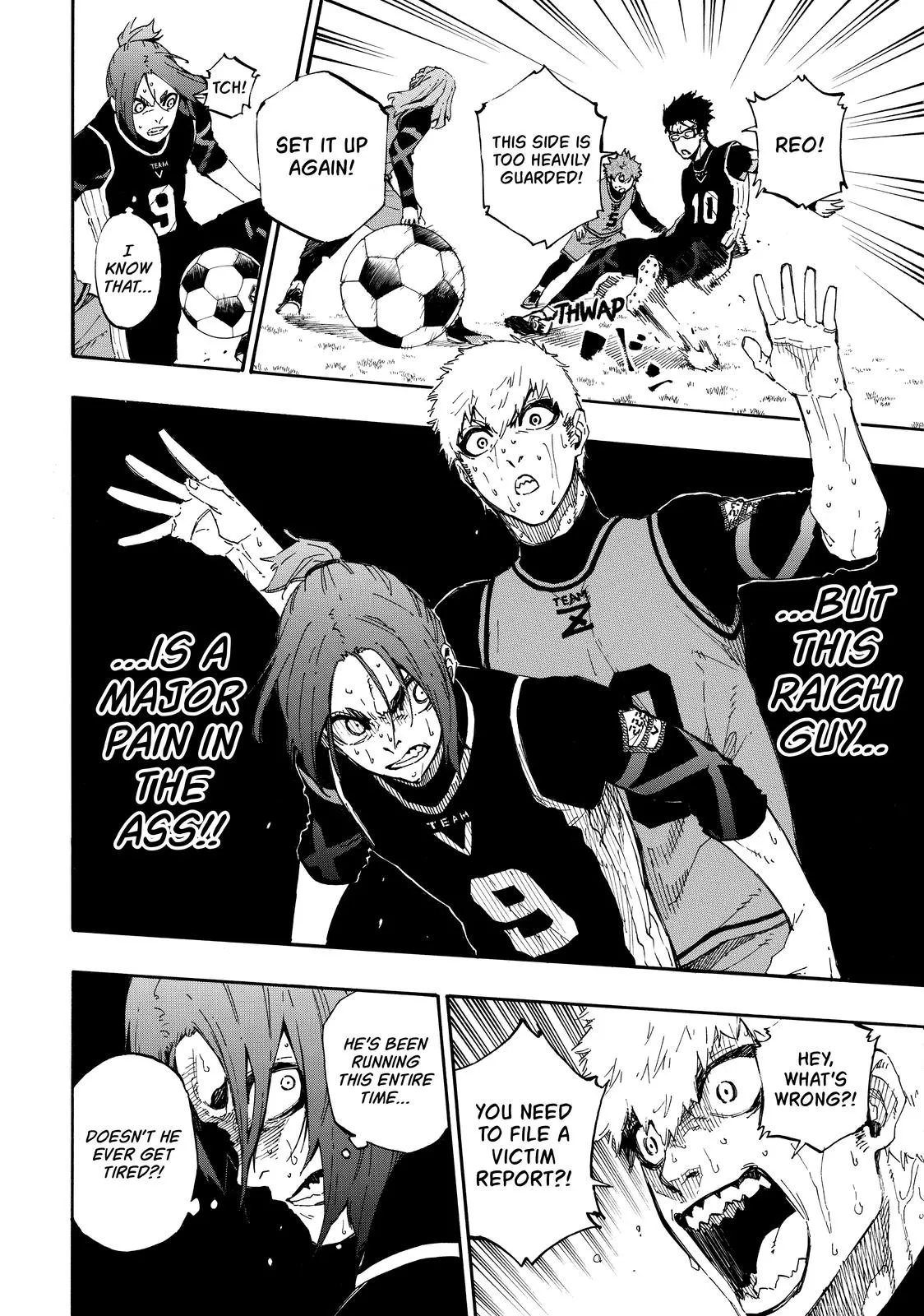
Team V Starts Feeling the Pressure
The match moves fast after that, and the tone changes immediately.
Team V is no longer flowing comfortably. There is irritation in their voices now.
“This side is too heavily guarded!”
“REO!”
“Set it up again!”
But the rhythm is already getting disrupted.
Then one complaint says everything:
“…but this Raichi guy…”
“…is a major pain in the ass!!”
And honestly, that is the perfect way to describe what Raichi becomes in this chapter. He is not elegant. He is not graceful. He is just relentless.
He keeps pressing, keeps running, keeps sticking himself to the problem until the other side starts getting annoyed.
“Hey, what’s wrong?!”
“You need to file a victim report?!”
“He’s been running this entire time…”
“Doesn’t he ever get tired?!”
This part matters because the chapter is showing another kind of value. Not brilliance. Not genius. Just refusal to stop.
And that refusal starts cracking Team V’s rhythm.
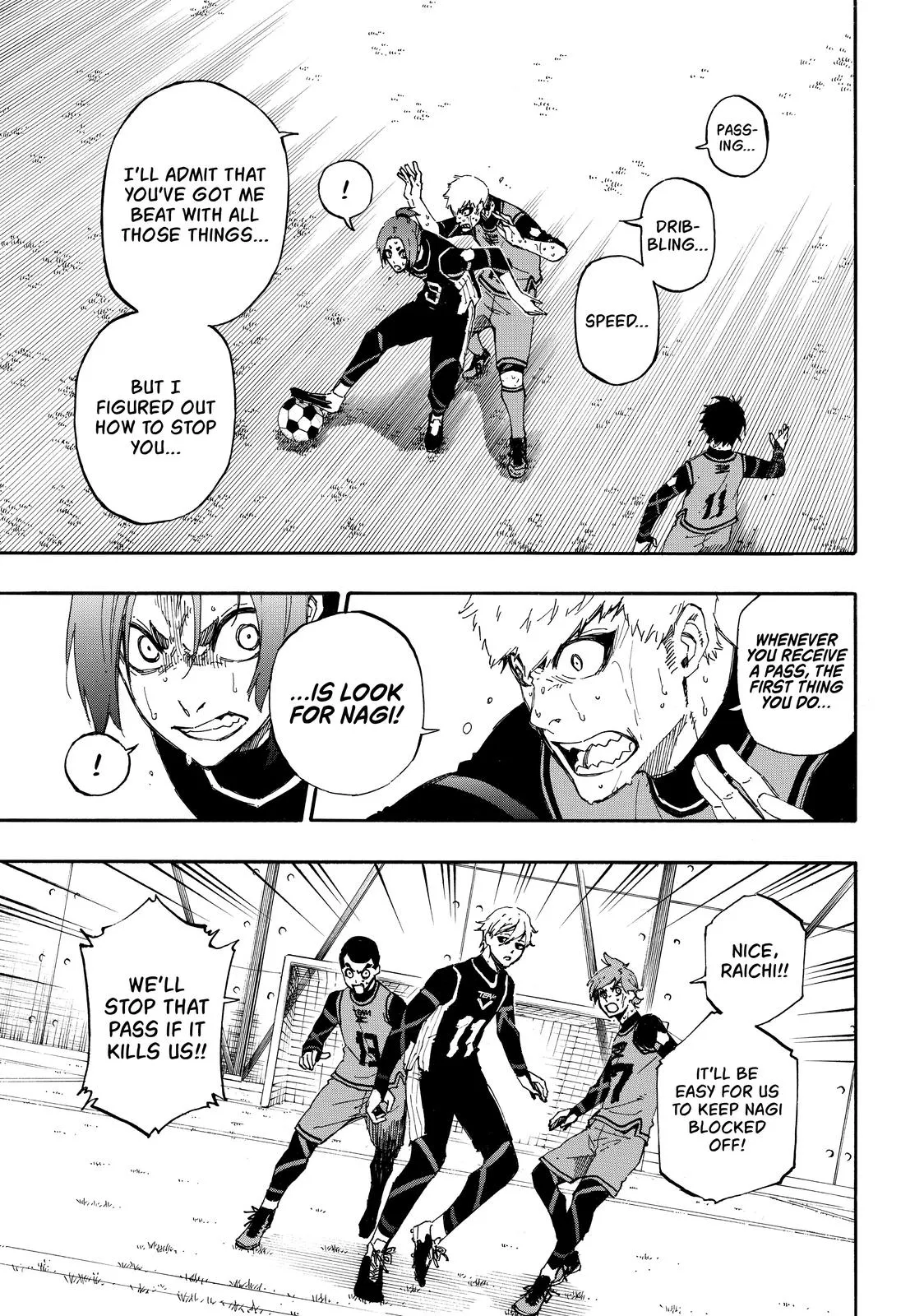
Raichi Figures Out the Pattern
Then Raichi does something huge. He stops trying to beat everything and starts targeting the habit.
He admits what the other player has over him:
“Passing…”
“Dribbling…”
“Speed…”
“I’ll admit that you’ve got me beat with all those things…”
That honesty matters. He is not delusional.
But then he follows it with the important part:
“But I figured out how to stop you…”
And then comes the read:
“Whenever you receive a pass, the first thing you do…”
“…is look for Nagi!”
That is the opening.
He is not trying to erase all of the opponent’s strengths. He just found the dependency hiding underneath them.
And once he sees it, Team Z starts reacting together:
“Nice, Raichi!!”
“We’ll stop that pass if it kills us!!”
“It’ll be easy for us to keep Nagi blocked off!”
That is a small tactical shift, but it changes the emotional balance of the match. Team V is suddenly being read instead of just admired.
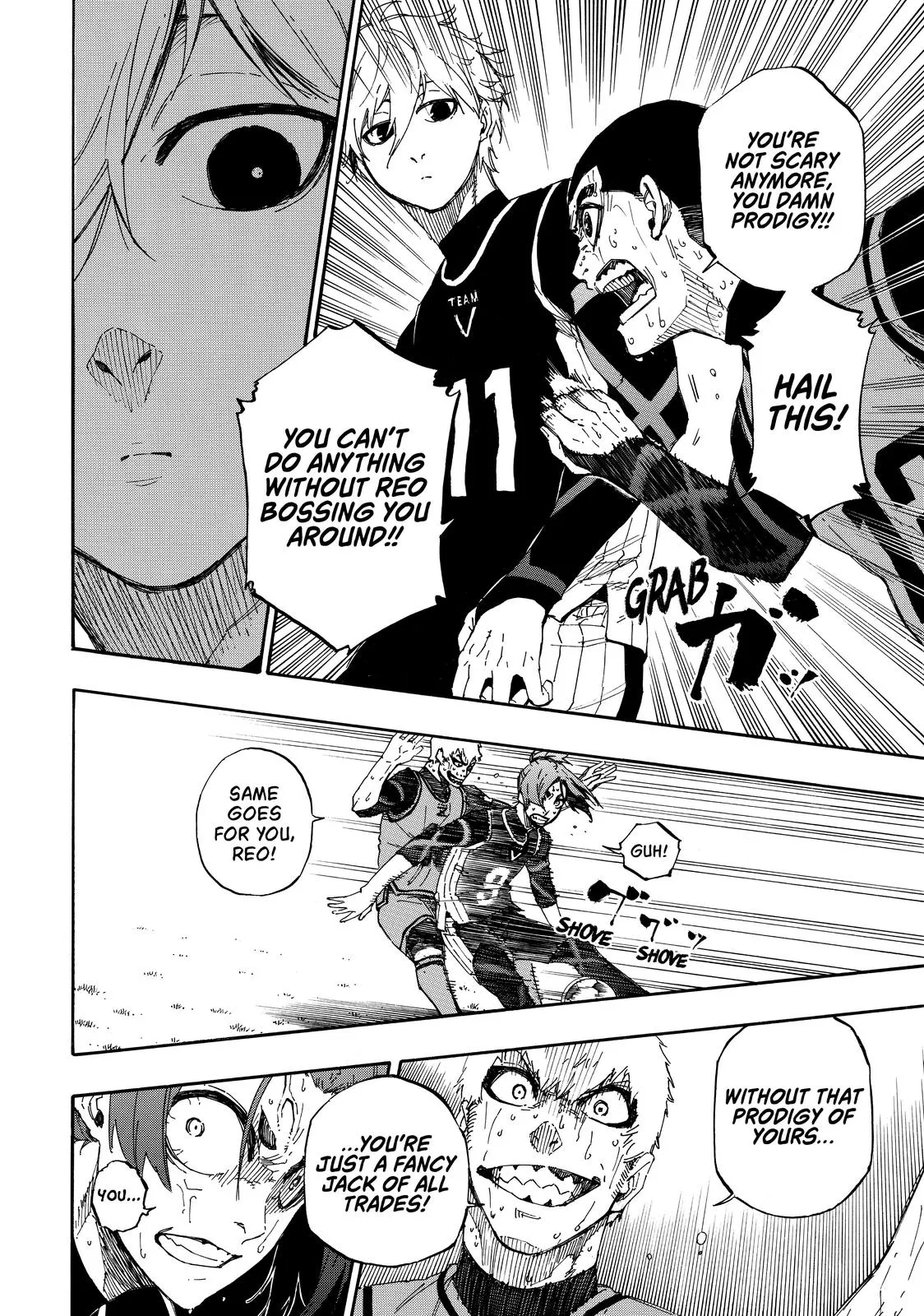
The Trash Talk Hits Exactly Where It Should
Then the chapter gets mean.
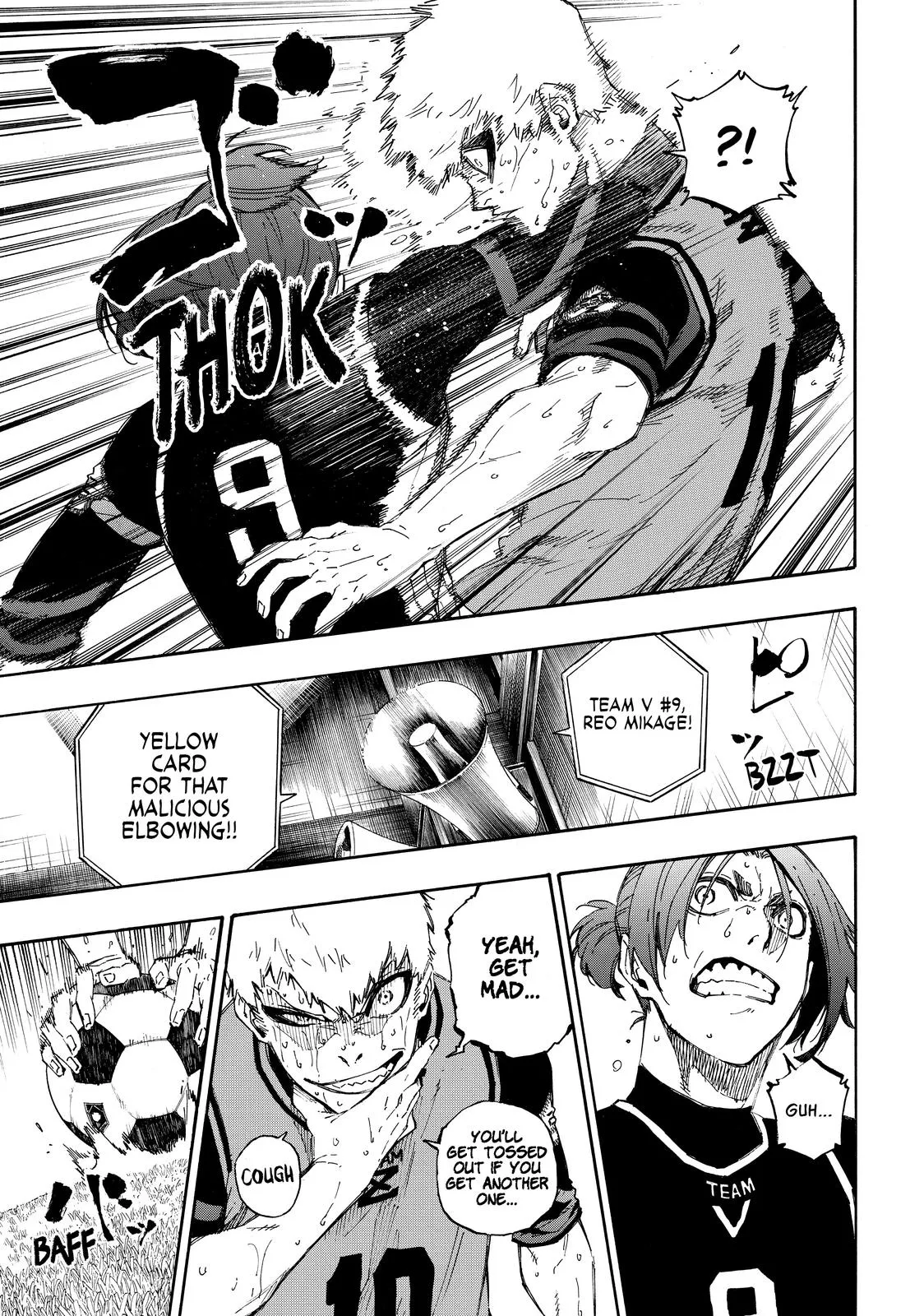
Raichi starts talking, but it is not random yelling. He attacks the exact weak point in the connection between the two players.
To the prodigy:
“You’re not scary anymore, you damn prodigy!!”
“You can’t do anything without Reo bossing you around!!”
To Reo:
“Without that prodigy of yours…”
“…you’re just a fancy jack of all trades!”
That second line especially is nasty because it is aimed straight at identity.
Not “you’re weak.”
Not “you’re trash.”
But “without him, you’re incomplete.”
And it works.
Reo snaps.
“THOK”
“Team V #9, Reo Mikage!”
“Yellow card for that malicious elbowing!!”
That yellow card is more than a foul call. It is proof that Team Z has started getting inside Team V’s head.
Then Raichi pushes it even further:
“Yeah, get mad…”
“You’ll get tossed out if you get another one…”
So now the match is not just physical or tactical. It is psychological too.
“I’m No Princess”
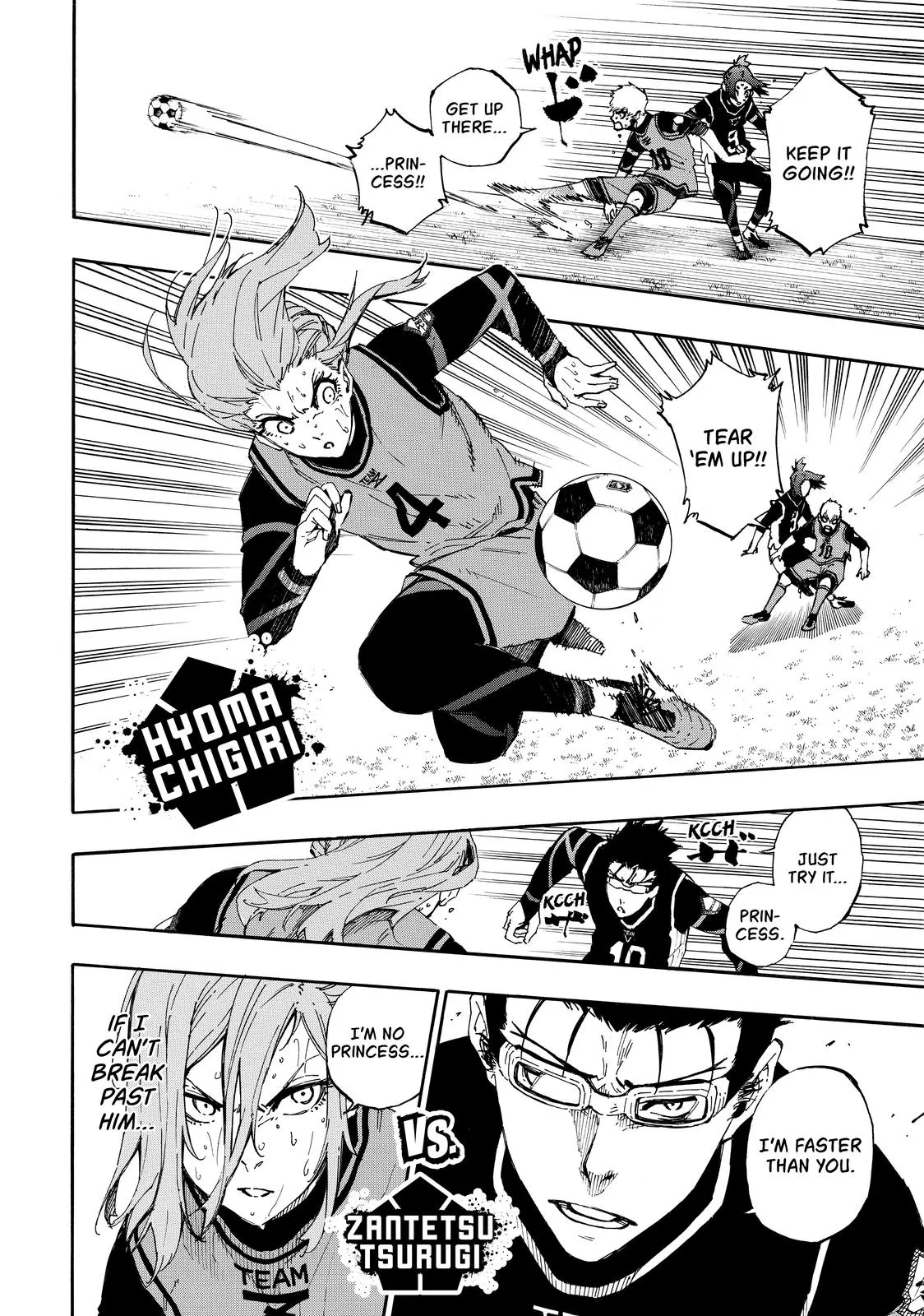
Then the chapter shifts to Hyoma Chigiri, and the whole energy changes again.
The ball gets sent up.
“Get up there… Princess!!”
“Keep it going!!”
“Tear ’em up!!”
And Chigiri answers with one of the cleanest little lines in the chapter:
“I’m no princess…”
That matters because this chapter keeps circling the same theme. Awakening is the moment you learn who you truly are.
Chigiri’s section is exactly that.
He is not accepting the label thrown at him. He is stepping into a direct confrontation.
“I’m faster than you.”
“VS. ZANTETSU TSURUGI”
Now the chapter turns into a speed duel, but it does not stay simple for long.
Why Chigiri Keeps Losing at First
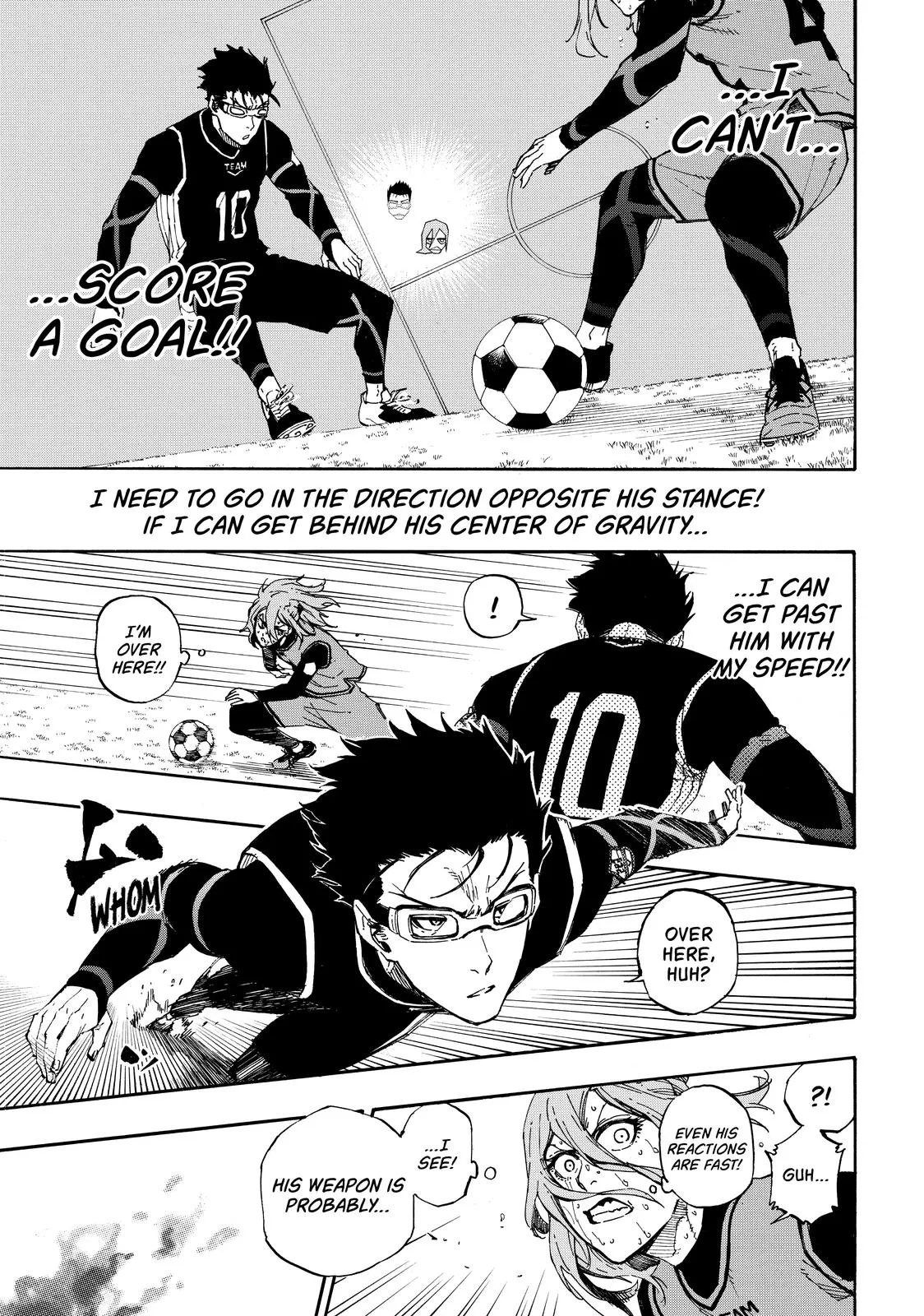
At first, Chigiri tries to beat him in a close-range reaction battle.
You can feel him thinking through the mechanics:
“I need to go in the direction opposite his stance! If I can get behind his center of gravity…”
“…I can get past him with my speed!!”
But that does not work.
The opponent reacts too quickly.
“Over here, huh?”
“Even his reactions are fast!”
Then the real analysis begins:
“His weapon is probably…”
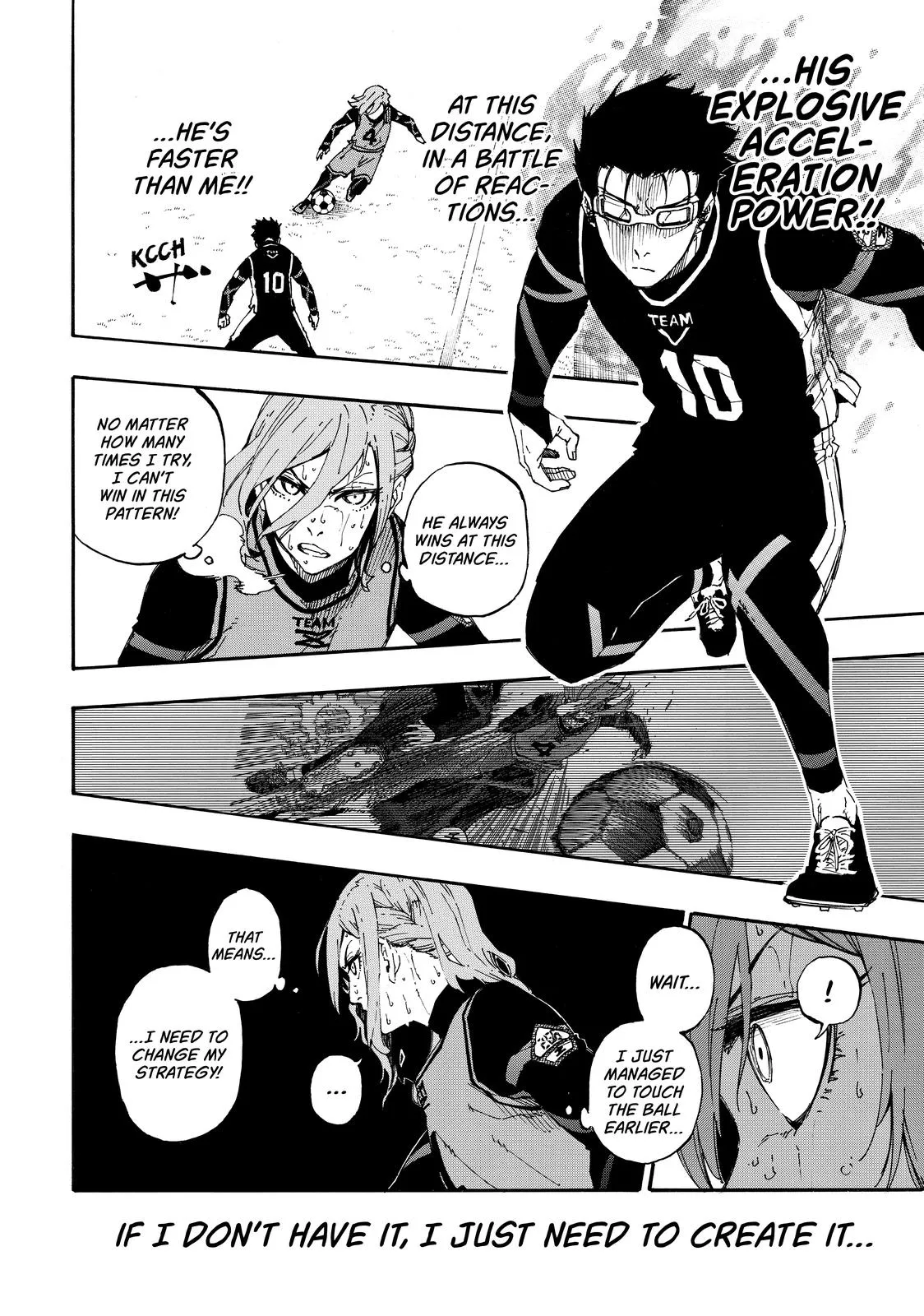
“…His explosive acceleration power!!”
That is the first major realization.
And then Chigiri understands the consequence of it:
“At this distance, in a battle of reactions…”
“…he’s faster than me!!”
This is where the chapter gets good. Because instead of lying to himself, he accepts the truth immediately.
Then he says the real problem out loud:
“He always wins at this distance…”
“No matter how many times I try, I can’t win in this pattern!”
That line is everything.
He is not failing because he lacks speed.
He is failing because he keeps entering the same losing pattern.
And the moment he realizes that, the awakening starts.
Changing the Pattern Instead of Forcing It
Then Chigiri reaches the answer:
“That means…”
“…I need to change my strategy!”
That is the chapter’s philosophy in action.
Not “try harder.”
Not “charge in again.”
Not “believe more.”
Change the situation.
Then comes one of the coldest lines in the whole transcript:
“If I don’t have it, I just need to create it…”
That is the move.
He cannot win in the kind of duel the opponent wants. So he creates a different duel.
The chapter says it clearly:
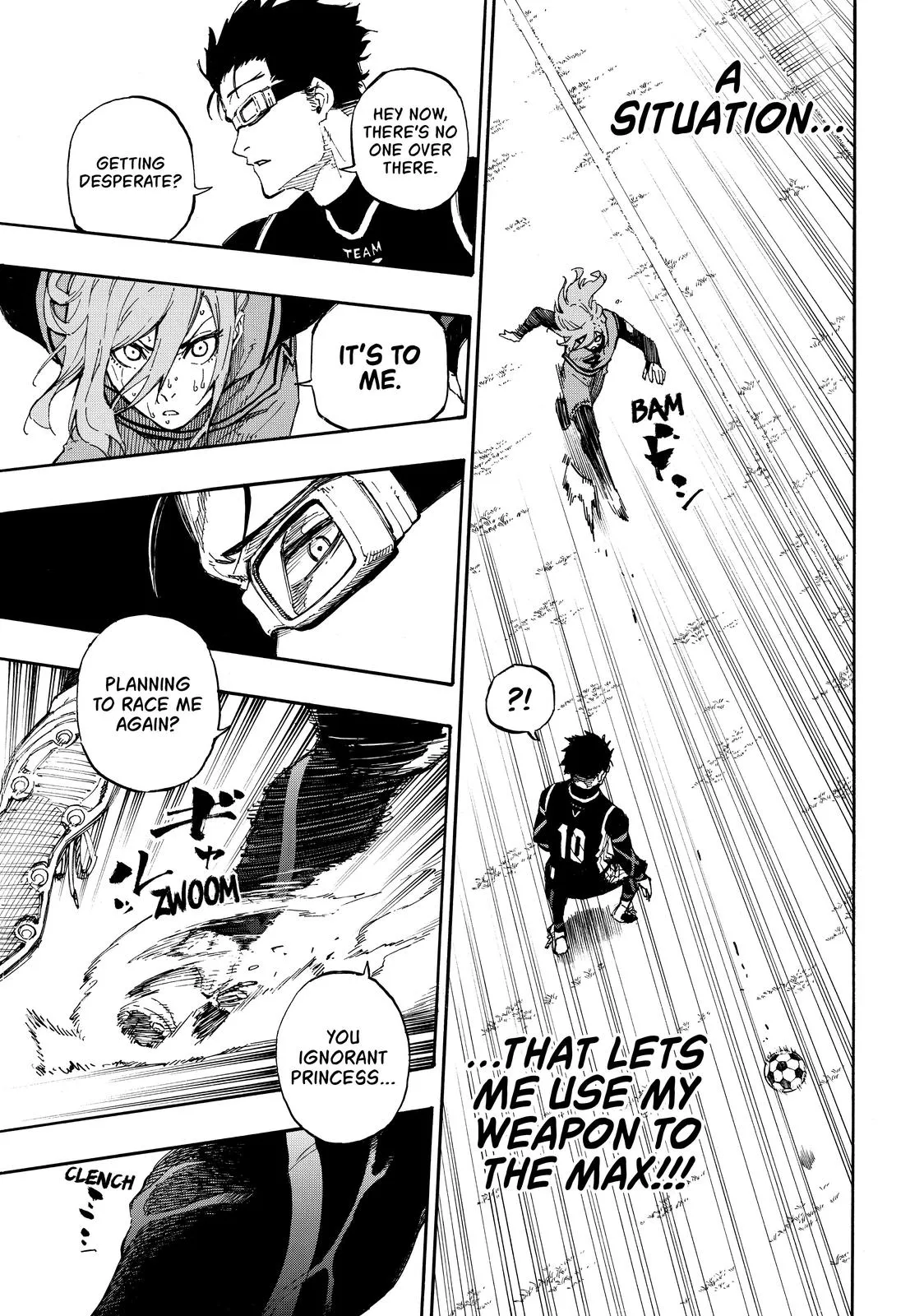
“A situation…”
“…that lets me use my weapon to the max!!!”
That is awakening right there.
Not discovering a new self.
Building the condition where the real self can finally appear.
Acceleration vs Top Speed
Zantetsu says:
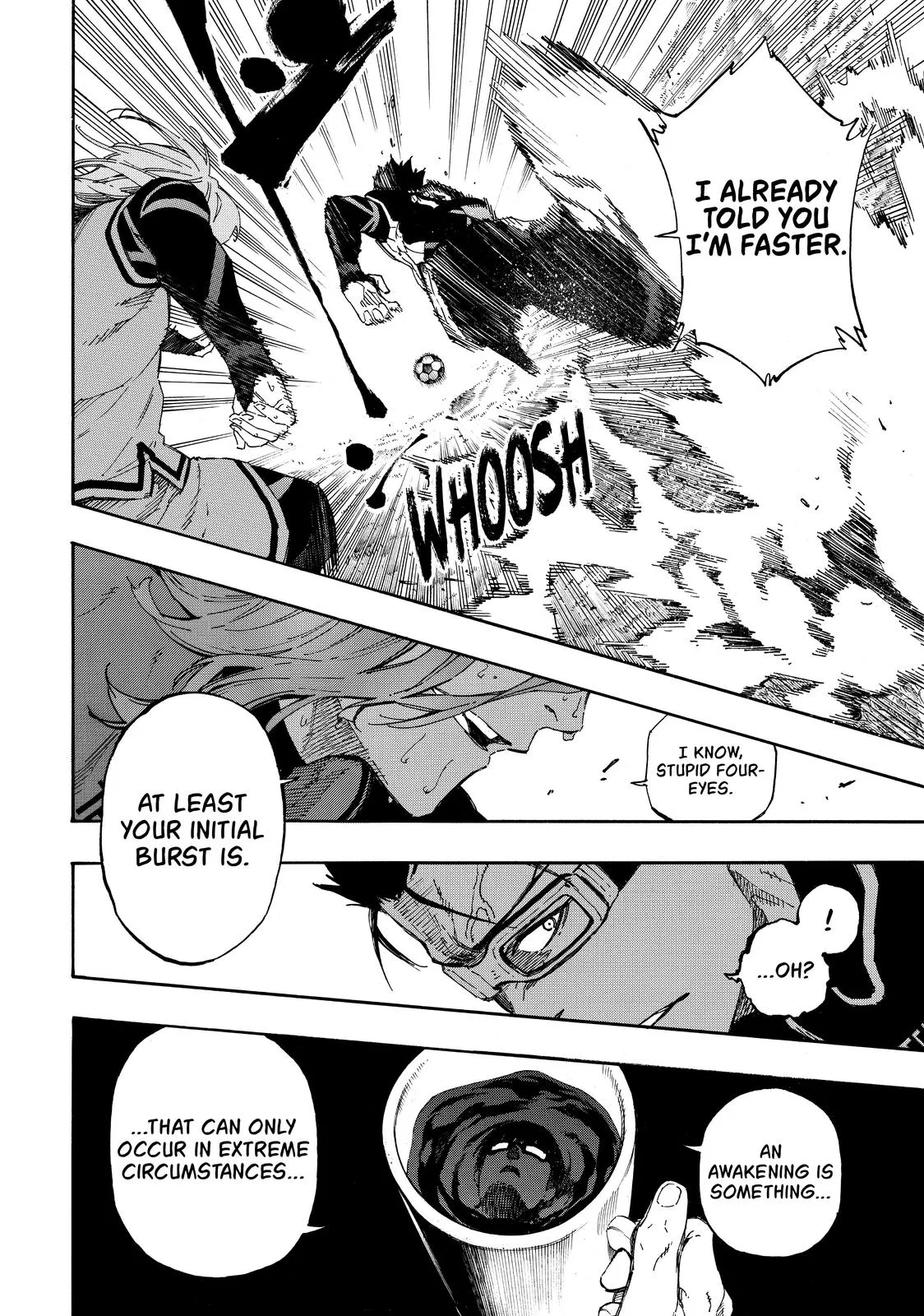
“I already told you I’m faster.”
And Chigiri answers in the most direct way possible:
“I know, stupid four-eyes.”
“At least your initial burst is.”
That one correction changes the whole battle.
The Zantetsu owns the start.
Chigiri owns the distance.
And the chapter connects that back to the earlier definition:
“An awakening is something…”
“…that can only occur in extreme circumstances…”
Then it explains why:
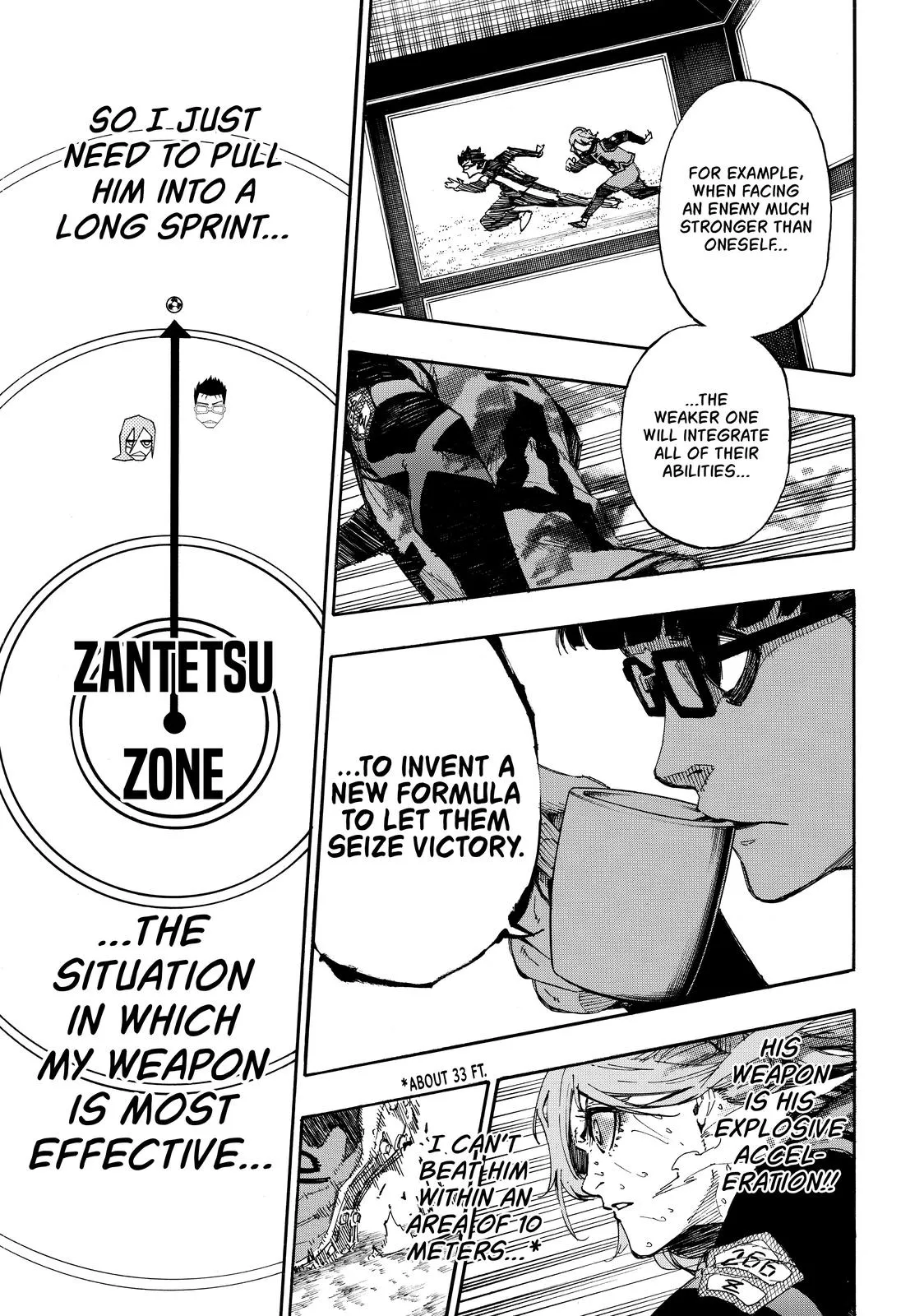
“For example, when facing an enemy much stronger than oneself…”
“…the weaker one will integrate all of their abilities…”
“…to invent a new formula to let them seize victory.”
That is exactly what Chigiri is doing now.
He is inventing a formula.
Then he states it with total clarity:
“So I just need to pull him into a long sprint…”
“…the situation in which my weapon is most effective…”
“I can’t beat him within an area of 10 meters…”
That is such a strong moment because it is brutally honest. He knows exactly where he loses. So he builds the race somewhere else.
No ego pretending.
No fake confidence.
Just precision.
The Long Sprint Where Everything Clicks
Then the chapter cashes it all in.
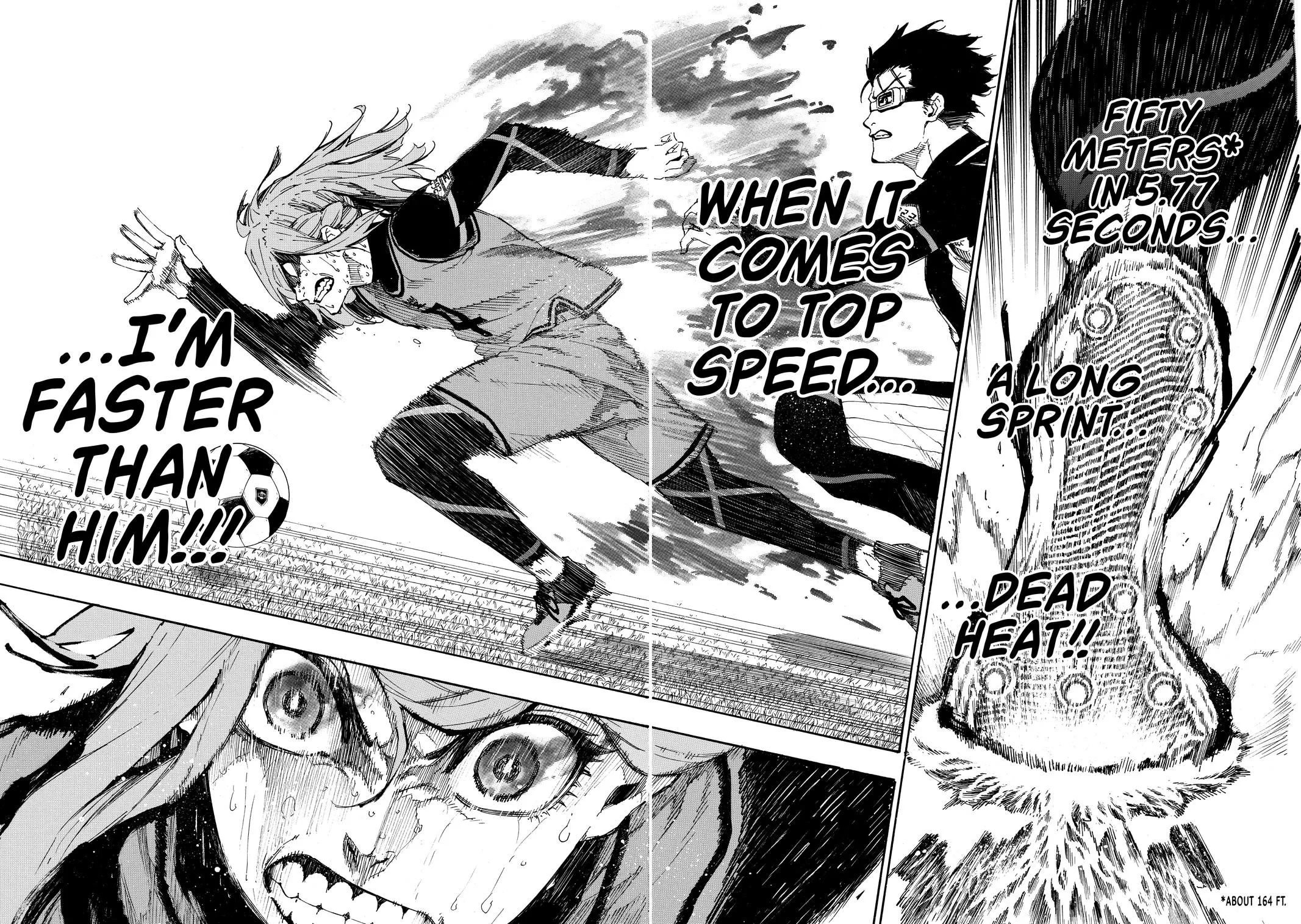
“FIFTY METERS IN 5.77 SECONDS…”
“A long sprint…”
“Dead heat!!”
At first, it is even.
But that is only the beginning.
Then comes the line that defines the entire sequence:
“When it comes to top speed…”
“…I’m faster than him!!!”
That is the awakening.
Not because Chigiri becomes someone new.
Because he finally understands the shape of his own strength.
And once he understands it, the play opens up.
The sprint sequence explodes forward, and the chapter’s momentum completely shifts.
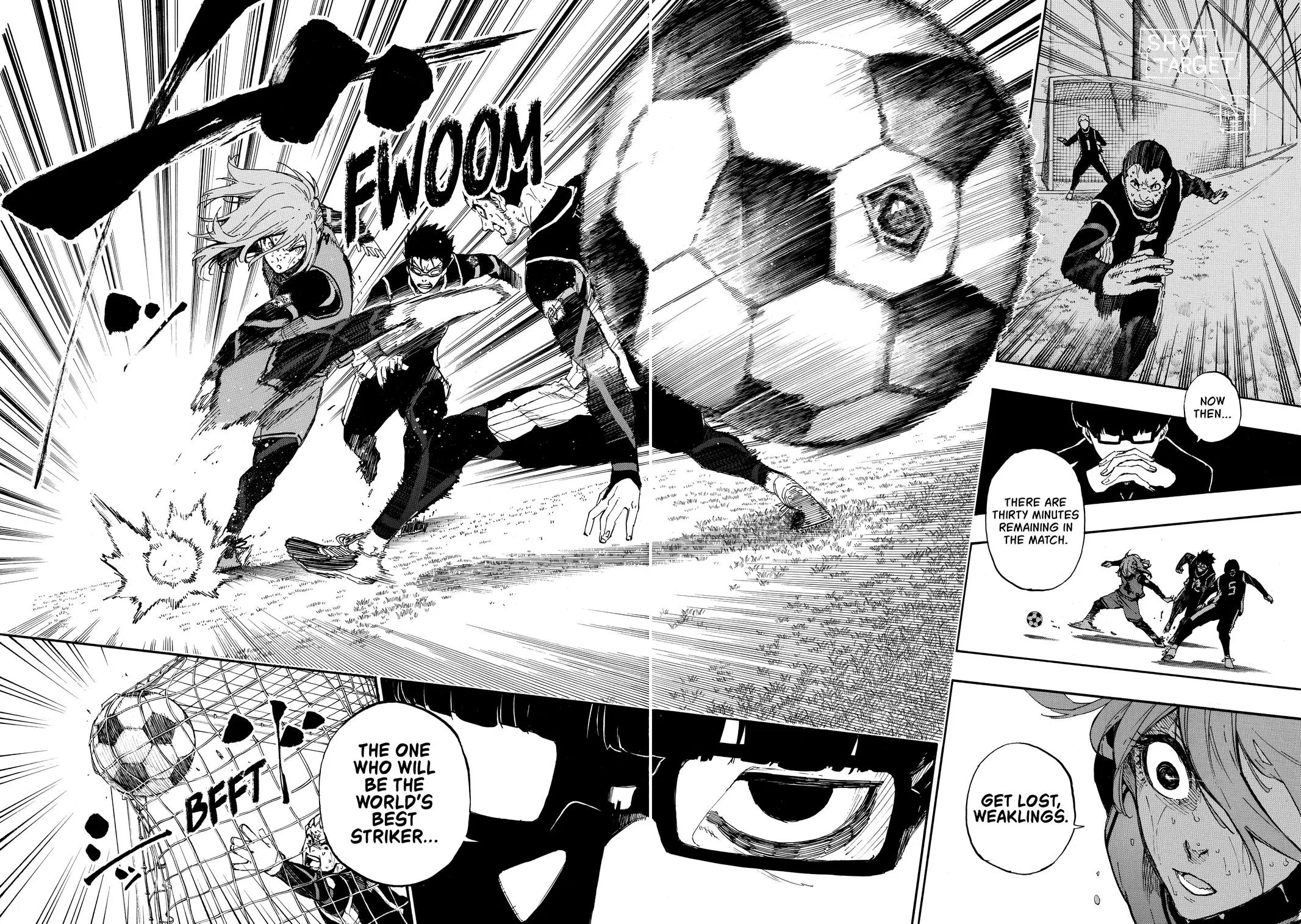
“Get Lost, Weaklings”
The final stretch of the chapter feels almost arrogant in the best way.
“The one who will be the world’s best striker…”
Then:
“Now then…”
“There are thirty minutes remaining in the match.”
“Get lost, weaklings.”
That line hits hard because it sounds like the exact kind of ego the chapter was building toward from page 3.
“…the ego blossoms…”
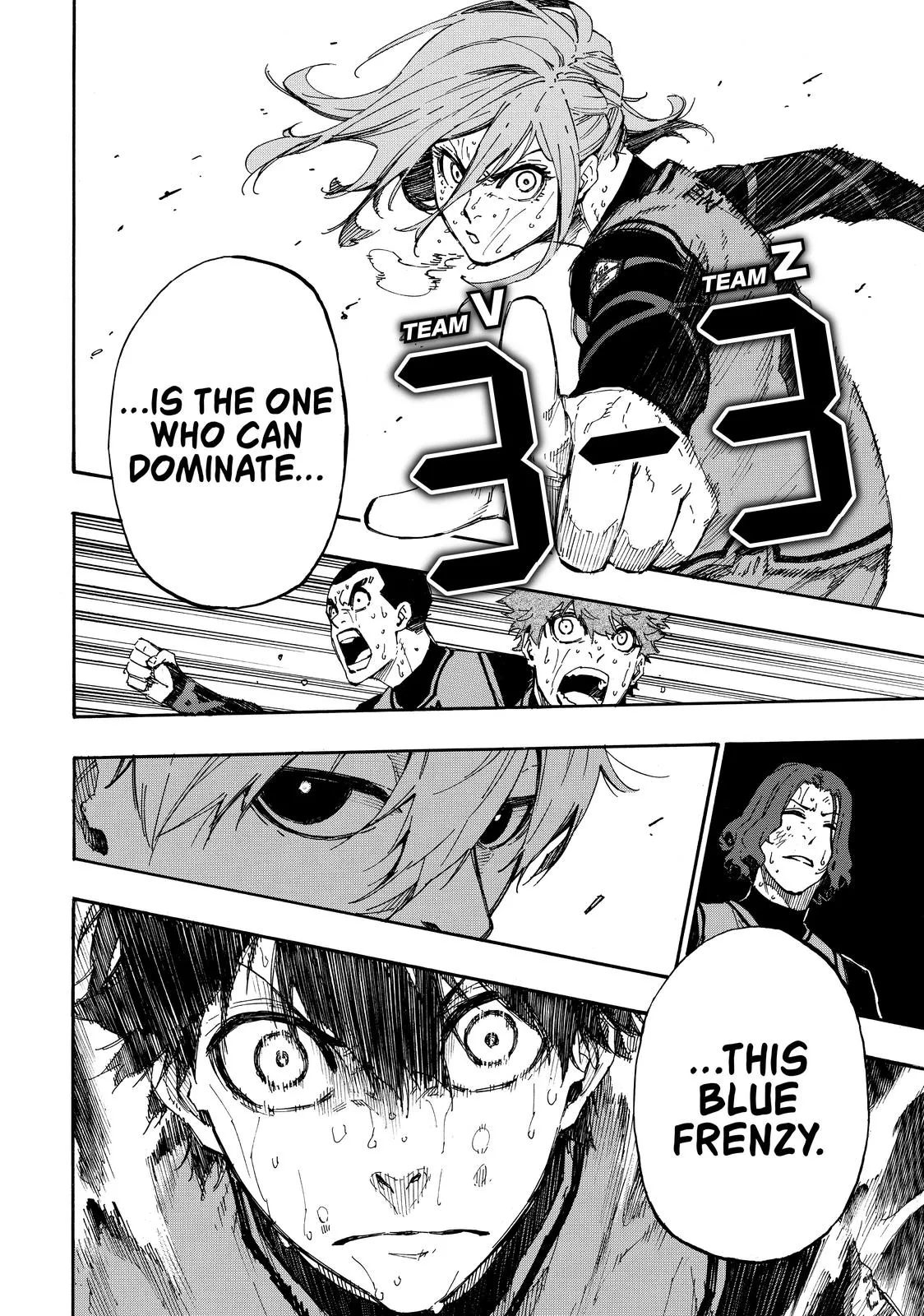
Then the scoreboard updates:
“TEAM V 3 — TEAM Z 3”
That equalizer is not just a score change. It is the visible proof that the awakenings in this chapter are real.
Not theoretical.
Not speeches.
Not empty monologues.
Realizations turned into results.
Then the last line lands:
“…is the one who can dominate…”
“…this Blue Frenzy.”
And that is where the chapter leaves you.
At 3–3.
With the pace broken open.
With Team Z no longer just surviving, but dragging the whole match into a different kind of chaos.
What This Chapter Is Really About
Chapter 31 is about stripping away fake ideas of growth and replacing them with something harsher and more real.
It says awakening is not fantasy.
It is not a miracle.
It is not sudden talent from nowhere.
It is:
realizing what is pointless
understanding what your real weapon actually does
seeing the pattern where you keep losing
changing the situation so your true strength can finally work
That happens in the explanation at the start.
It happens in the realization in front of goal.
It happens in Raichi’s read.
And it happens most clearly in Chigiri’s sprint.
This whole chapter is basically one message repeated in different forms:
“It’s ‘learning.’”
And more than that:
“…is the moment you learn who you truly are.”
That is the chapter.
Not magic.
Not luck.
Just brutal clarity under pressure.
And once that clarity arrives, everything starts moving differently.
Best Lines in the Chapter
These are the lines that carry the whole chapter on their back:
“That’s just an idiotic fantasy.”
“It’s ‘learning.’”
“…is the moment you learn who you truly are.”
“I need to eliminate the pointless things that get in the way of shooting…”
“If I don’t have it, I just need to create it…”
“When it comes to top speed…”
“…I’m faster than him!!!”
Those are not just cool lines. They are the chapter’s structure.
Final Take
This chapter is one long collision between pressure and self-discovery.
One player realizes hesitation is useless.
One player realizes dependency can be exploited.
One player realizes he has been fighting in the wrong kind of race the entire time.
And by the end, Team Z is no longer trapped inside the other side’s game.
They have started finding themselves inside the chaos.
That is why the 3–3 score matters so much. It is not just a comeback. It is proof that the players who truly learn in this chapter are the ones who change the match. Continue to Blue Lock Chapter 32