Meguru Bachira's Evolution: From Inner Monster to Blue Lock's Dribbling Maestro (A Deep Dive & Personal Reflection)
The Enigma of Meguru Bachira
From the moment Meguru Bachira appears in Blue Lock, he feels different. In a place built on pressure, ego, and survival, Bachira brings something unexpected. He plays with joy. While everyone else is fighting to prove they belong, he moves across the field with a strange freedom that is impossible to ignore. His dribbling is sharp, creative, and full of instinct, but what makes him unforgettable is the energy behind it. He looks like he’s having fun in the middle of chaos.
That contrast is what makes Bachira so fascinating. On the surface, he seems playful, unpredictable, and a little odd. But underneath that bright personality is one of the most emotionally layered characters in Blue Lock. He is not just a gifted striker with elite ball control. He is someone shaped by loneliness, imagination, and a deep need to find a player who can truly understand the football he sees in his mind.
Bachira’s journey is about far more than flashy dribbles or exciting moments on the pitch. His story is deeply tied to the idea of identity. The “monster” inside him, which first feels like a symbol of comfort and creativity, slowly becomes something he must confront and redefine. That psychological shift is what turns him from an entertaining character into one of the most meaningful in the series.
In this deep dive, we’ll look at what makes Meguru Bachira so special: his playing style, his technical brilliance, his emotional growth, and the way he changes the people around him. More than that, we’ll explore why he connects so strongly with fans. Bachira is wild, talented, and unpredictable, but he is also deeply human. That is exactly why he stands out, and why his evolution remains one of the most compelling parts of Blue Lock.
Bachira’s Profile: The Basics & Beyond
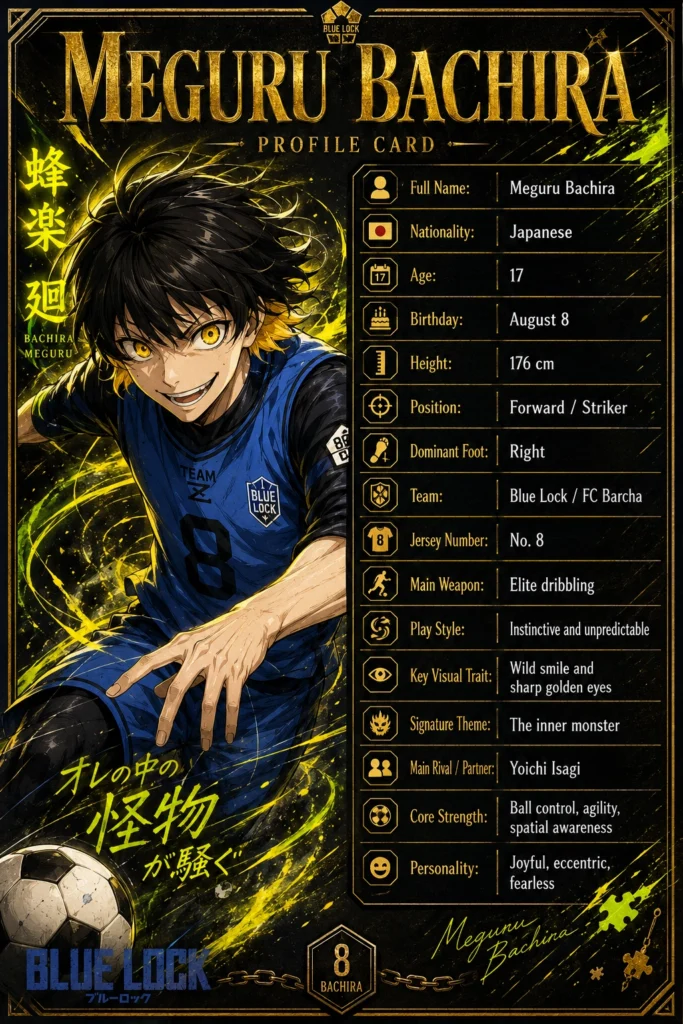
Meguru Bachira makes a strong first impression because he looks and feels unlike anyone else in Blue Lock. His black hair with gold underneath, bright eyes, slim build, and constant wide smile give him a restless kind of presence, like he is already imagining the next move before the play even begins. That design fits his football perfectly. Bachira does not come across as neat or controlled. He feels alive, playful, and hard to predict, which is exactly why he stands out so quickly.
What makes that entrance even more memorable is how naturally Bachira’s personality clashes with Blue Lock’s brutal atmosphere. In Episode 1, while everyone else is tense, prideful, or scared, Bachira feels strangely relaxed. He naps on the floor, reacts with casual violence when Igarashi targets him, and then instantly connects with Isagi when he sees the same hunger in him. He is cheerful and fun-loving, but he is not naive. He reads people through football instinct, and that instinct makes him one of the first characters who feels dangerous in a way that is exciting instead of intimidating.
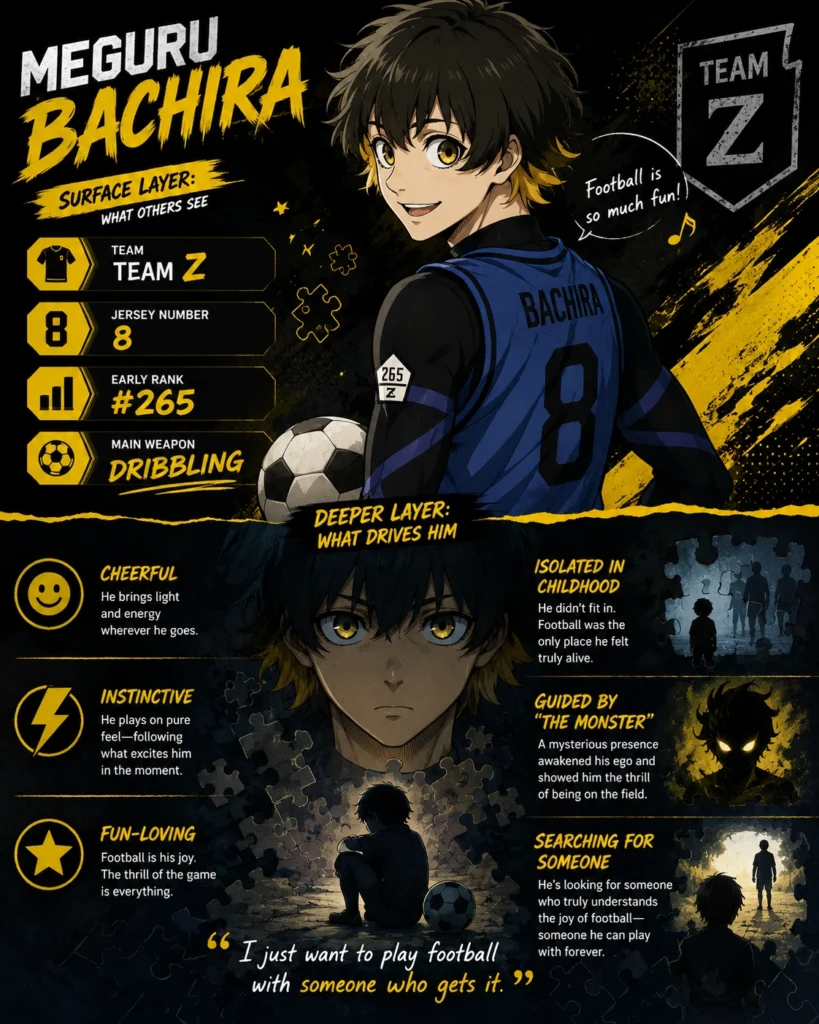
Early on, Bachira’s role is clear even before the story gives him deeper focus. He is part of Team Z, wears the number 8 in the First Selection, and after the entrance test he is shown at rank #265. That ranking matters because it shows how misleading Blue Lock’s first numbers can be. On paper, he is nowhere near the top. On the field, though, he already feels like one of Team Z’s sharpest weapons. The series quickly frames dribbling as his signature strength, and that fits what we see from him right away. He is the kind of player who can break shape, draw defenders, and turn a quiet moment into panic with a single touch.
But the real reason Bachira’s profile goes beyond basic facts is that the story quietly tells us he is carrying more than talent. The official anime site describes him as an eccentric, free-spirited dribbler who created “The Monster” after feeling isolated in childhood, and Episode 2 is where that inner world starts to come into focus. When Bachira tells Isagi that a monster inside him guides his play, the series stops presenting him as just the weird fun one. Suddenly, his unpredictability has emotional weight. His imagination is not random. It is how he survives loneliness and protects the version of football he loves most.
That is also what makes his motivation feel so different from many other Blue Lock strikers. Bachira does want to grow, but early on he is not driven only by goals, status, or domination. He wants football to be fun, alive, and shared with someone who understands it the same way he does. That is why his bond with Isagi matters so much from the start. Beneath the smile and the flair, Bachira is searching for connection. He wants a true partner in the game, someone who can meet the rhythm of the monster inside him. That emotional need gives his entire early arc more depth than a simple character profile ever could.
The Dribbling Prodigy: An Analysis of Bachira’s Unique Skills
Unpacking His Signature Style
Meguru Bachira’s greatest strength is not just that he can dribble past people. It is how he does it. His football feels free, playful, and almost impossible to read. A lot of Blue Lock players overpower opponents with directness or ego, but Bachira breaks them down with rhythm, movement, and instinct. Watching him play feels less like watching a player follow a plan and more like watching someone create one in real time.
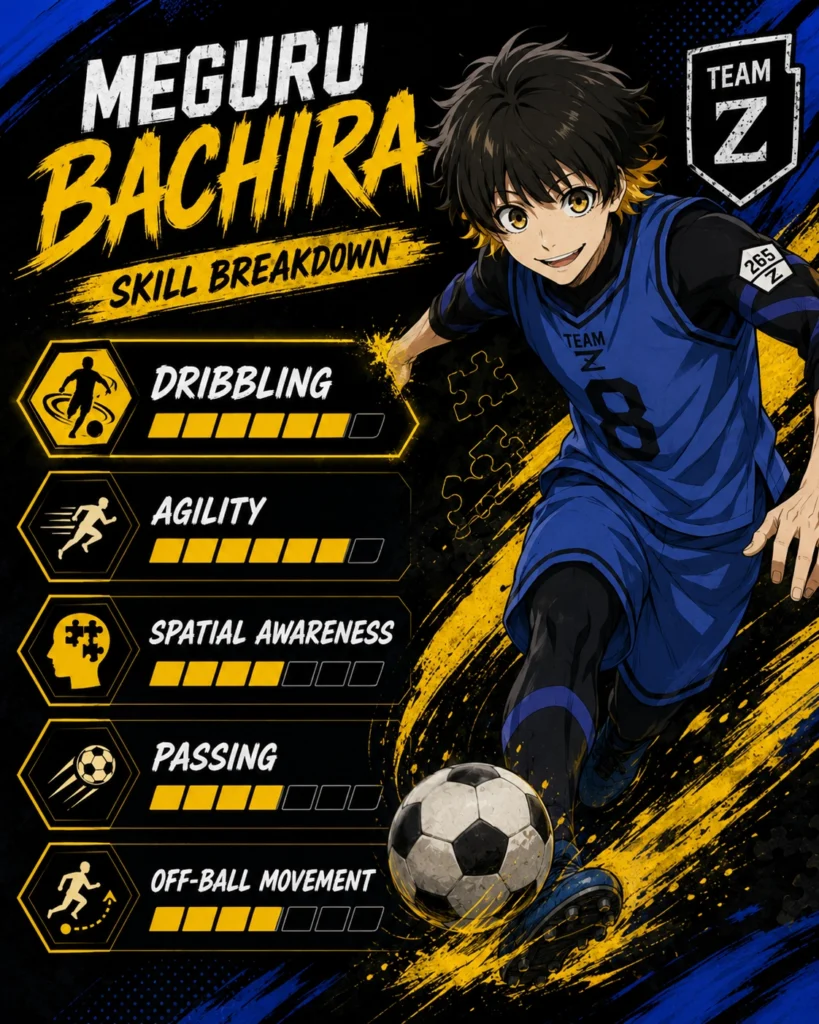
What makes his dribbling so special starts with his agility. Bachira has outstanding body control. He can shift direction in an instant, lower his center of gravity, and slip through tight spaces without losing balance. That is why defenders struggle to pin him down. The moment they think they have his path figured out, he changes his angle, pace, or touch. In the First Selection, this quality makes him one of Team Z’s most dangerous players almost immediately. He does not need much space to create something. A few steps are enough.
His spatial awareness is just as important. Bachira is always reading gaps, pressure, and body positioning. He seems to sense where defenders are leaning before they fully commit. That gives him a huge advantage because dribbling for him is not random. It looks wild, but there is always a hidden logic behind it. He knows where the opening will appear, and he moves as if he can see it a second before everyone else. That is one reason his link-up with Isagi works so well early on. Bachira can feel the space, and Isagi can read the play developing.
Then there is his instinctive style, which may be the clearest expression of who he is as a character. Bachira does not dribble like someone repeating coached patterns. He improvises. His movements feel alive in the moment. He reacts to the defender, to the tempo, and to his own emotion. That is why his football has such a unique identity. It is creative without looking forced. He is not showing off for the sake of it. He is simply following the version of football that feels most natural to him.
His ball control ties all of this together. Bachira keeps the ball so close that it feels attached to him. Even in crowded areas, he can manipulate it with small touches, subtle feints, and sharp directional changes. That touch allows him to stay calm where other players would lose possession. In one-on-one situations, especially during the early stages of Blue Lock, he constantly turns tight pressure into opportunity. Instead of escaping danger, he often dribbles directly into it and comes out the other side.
A big reason his dribbling stands out is the impact it has on defenders psychologically. Bachira does not only beat players physically. He unsettles them. His rhythm is hard to predict, his body language is deceptive, and his next move never feels obvious. That hesitation is all he needs. Once a defender starts doubting their read of him, Bachira already has control of the duel.
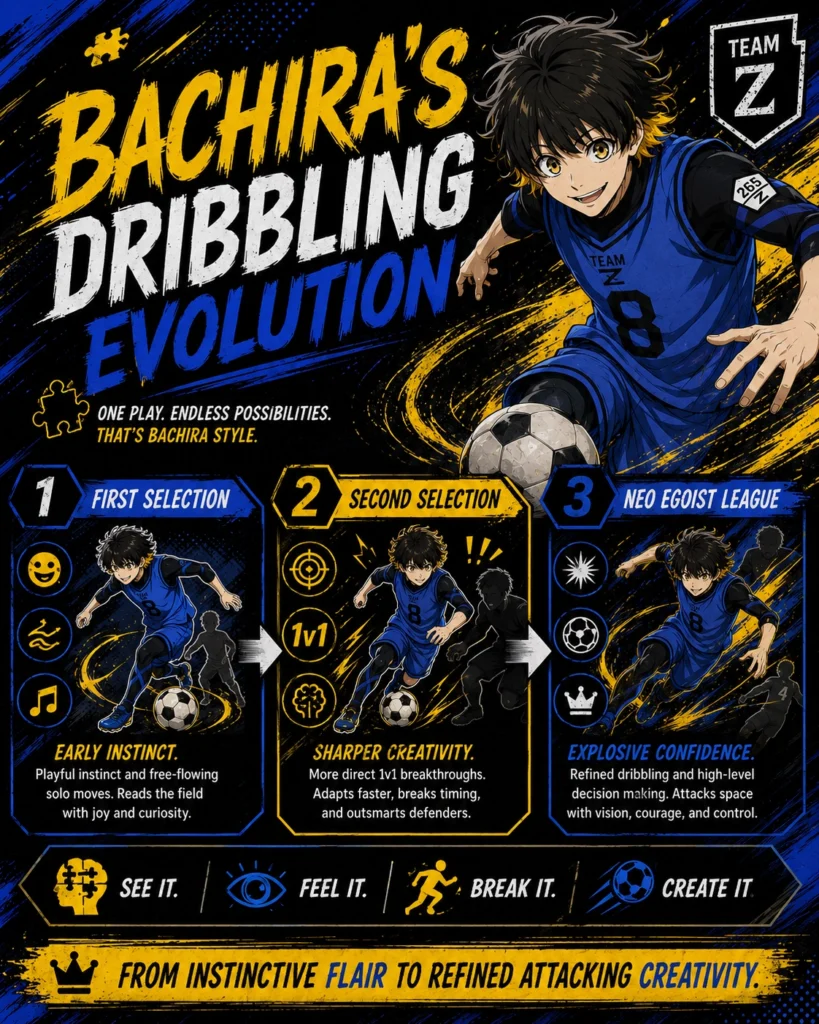
You can see this clearly across different parts of the series. In the First Selection, his dribbling gives Team Z a spark and unpredictability they badly need. Against stronger teams, he becomes the kind of player who can break structure by himself. In the Second Selection, his skill is tested at a higher level, and that is where we see how much of his game is tied to self-expression as much as raw technique. Later, in the Neo Egoist League with FC Barcha, his style becomes even sharper. He still plays with freedom, but there is more self-awareness behind it. He is no longer just looking for someone to share his football with. He is beginning to own it fully as his own weapon.
Bachira’s Key Offensive and Physical Attributes
Dribbling
This is the heart of his game. Bachira combines close control, body feints, and sudden changes of pace to pull defenders out of shape. His dribbling is not only effective, it is disruptive. It forces opponents to react to him.
Agility
His quick feet and rapid shifts in direction make him very hard to contain. He can turn in small spaces, evade tackles, and keep the attack moving even when surrounded.
Spatial Awareness
Bachira has a natural feel for openings. He reads pressure well, spots passing lanes quickly, and knows where defenders are vulnerable. This is why his dribbling often looks smooth rather than desperate.
Passing
He is famous for dribbling, but his passing is underrated. Once he draws defenders in, he can release the ball with smart timing. His combinations with Isagi show that he is not a selfish dribbler. He knows when to create for others.
Off-ball Movement
Even when he is not on the ball, Bachira stays active. He moves into useful pockets, makes himself available for one-twos, and helps stretch the defense. That makes him more complete than a player who only shines in isolated duels.
Bachira’s “Monster” Playbook: 3 Signature Dribble Patterns
If I had to break Bachira’s dribbling into three signature patterns, these are the ones that define him best.
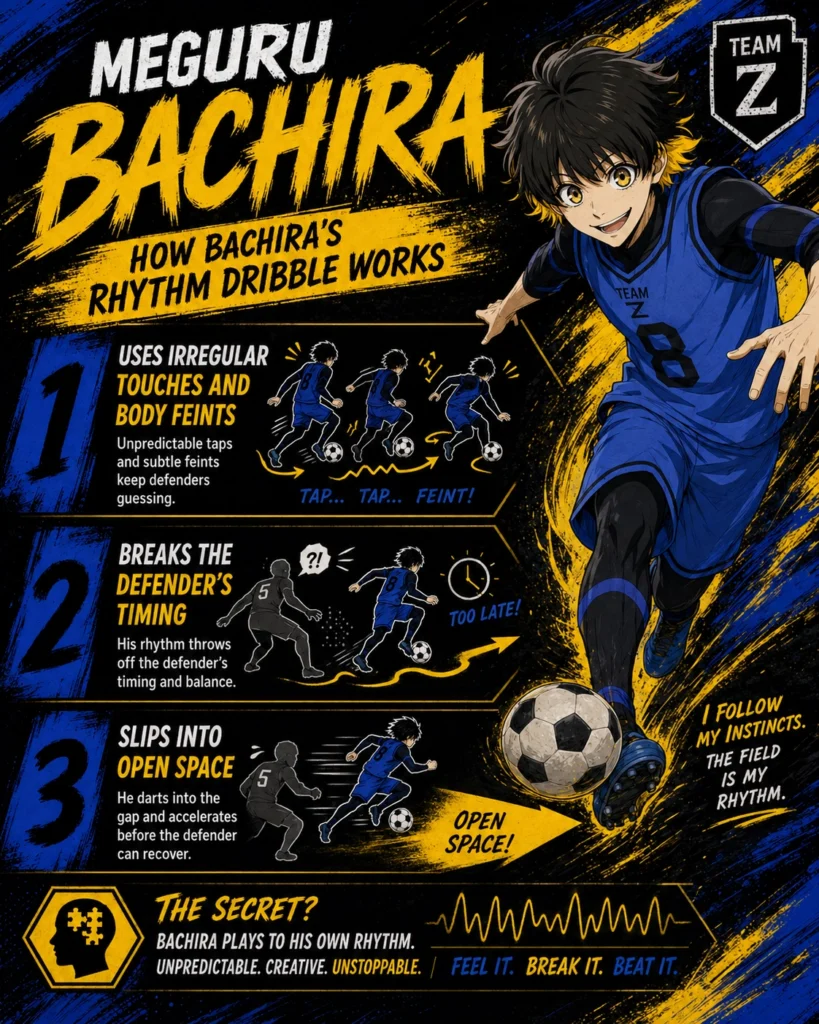
1. The Rhythm Dribble
This is the move that feels most like Bachira. He changes his touch pattern in a way that throws defenders off balance. One touch is light, the next is sharp, then suddenly he slows down just enough to invite pressure before slipping away. His shoulders, gaze, and hips all sell different ideas at once.
What makes this so effective is the broken rhythm. Defenders want something they can time, but Bachira refuses to give them that comfort. He makes them react to false signals, and once they bite, he is already gone. More than a technique, this dribble reflects his personality. It is playful, creative, and full of joy.
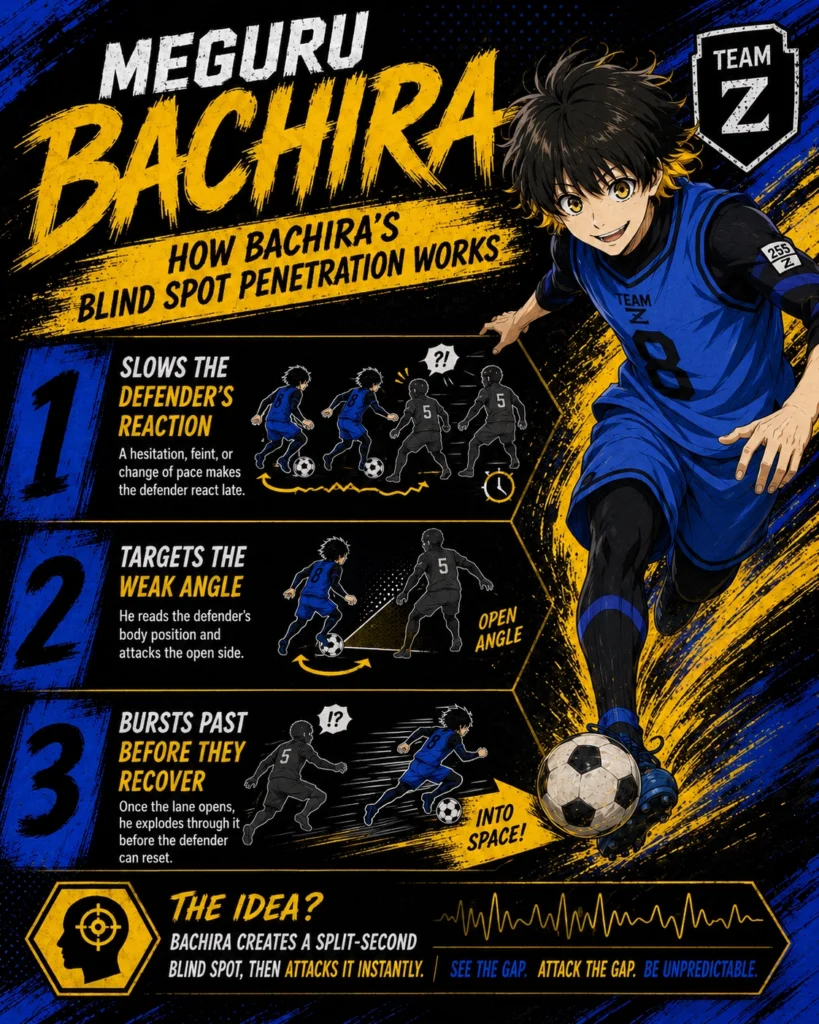
2. The Blind Spot Penetration
This is when Bachira uses speed, timing, and ball placement to attack the space a defender is not fully watching. He may slow down for a moment, almost casually, then burst into the exact angle that the defender cannot recover from in time.
The brilliance here is not only in the acceleration. It is in the setup. Bachira lures the defender into focusing on one line, then escapes through another. The result is a move that makes it look like the ball vanished from their reach. It creates that helpless feeling defenders hate most, where they are close enough to challenge, but never actually in control.
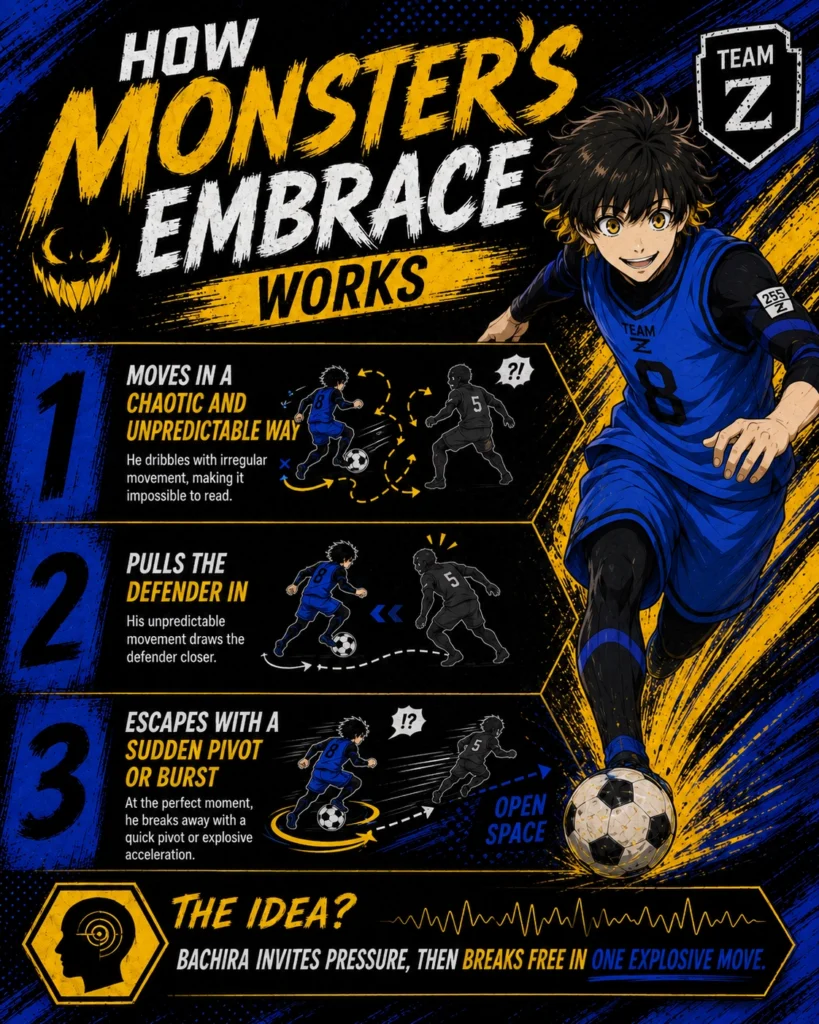
3. The Monster’s Embrace
This is the most emotional side of his dribbling. It is the version of Bachira that looks almost chaotic from the outside but is still guided by instinct deep underneath. He draws defenders in with strange movement, crowded touches, and fearless commitment, then escapes with one sudden action that breaks the whole moment open.
This pattern feels tied most strongly to his inner world. It is not just about mechanics. It is about impulse, imagination, and the pure thrill of football. When Bachira enters this state, it feels like he is not calculating every step. He is embodying the game as he feels it. That is why his best dribbling moments can feel so alive. They are technical, yes, but they are also emotional.
Why His Skill Set Matters So Much
Bachira’s dribbling is not important only because it looks exciting. It matters because it represents who he is. Every touch, feint, and burst forward reflects his desire to play freely and connect through football. His technique is impressive on its own, but it becomes even more powerful when you see it as an extension of his personality.
That is why Bachira never feels like just a flashy player. He is an artist in a system built around survival. His dribbling gives Blue Lock some of its most entertaining moments, but it also gives the series one of its purest forms of football expression. He does not just beat defenders. He reminds us that football can still feel joyful, instinctive, and deeply personal, even in the harshest environment.
The ‘Monster’ Within: Bachira’s Psychological Journey
Origins of the Inner Monster
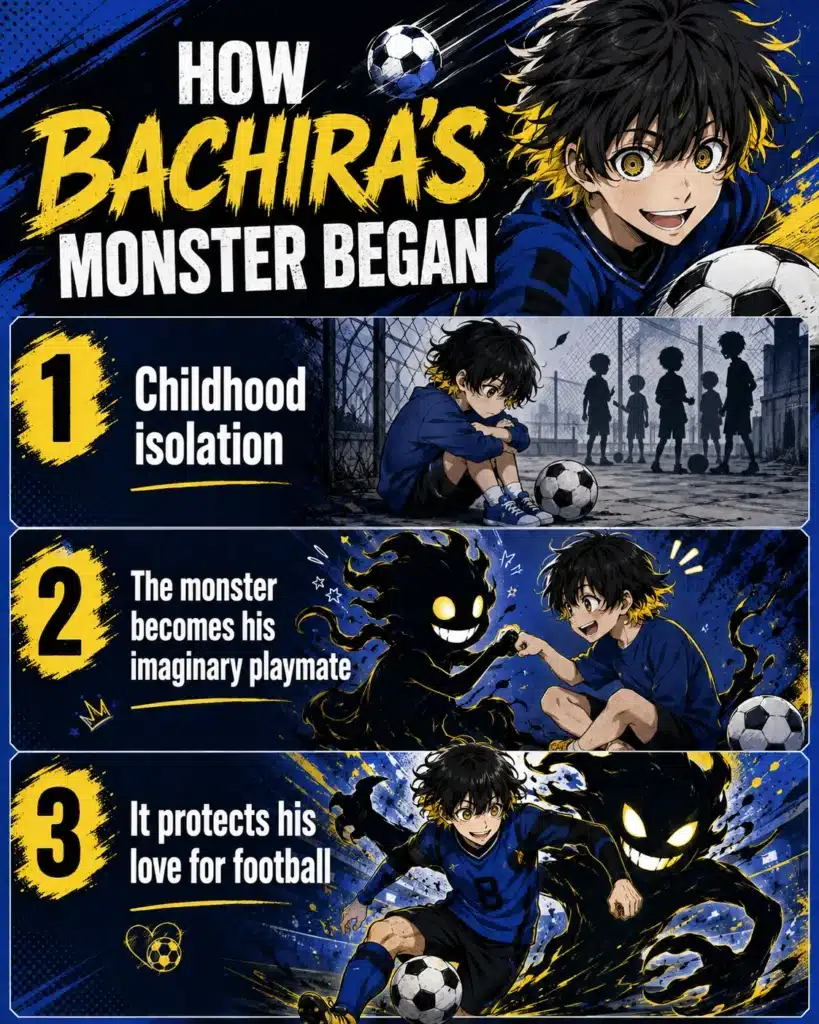
Bachira’s monster matters because it was never just a strange habit or a flashy symbol. It began as a survival tool. As a child, he loved football so naturally and so intensely that other kids could not keep up with him. Instead of connecting with him, they pushed him away, mocked him, and made him feel like the weird one. So the “monster” became the friend he did not have in real life, the one presence that could match his rhythm and make his version of football feel valid. That is what makes his backstory hit so hard. His imagination was not childish nonsense. It was how he protected the part of himself the world kept rejecting.
What makes this even more moving is that the monster was not only a comfort. It was also an ideal. Bachira’s mother encouraged him to trust the voice inside him, and from there the monster became the embodiment of the football he wanted to play: free, daring, creative, and alive. While other players were focused on fitting in or simply winning, Bachira was chasing something more personal. He wanted the kind of football that felt joyful and complete. That is why loneliness sits at the center of his character for so long. He is not just afraid of losing matches. He is afraid of never finding anyone who understands his game.
Evolution of the Monster Concept
When Bachira first enters Blue Lock, the monster acts like a compass. It pushes him toward exciting plays and toward people who feel different. That is why his bond with Isagi forms so quickly. Bachira does not just see Isagi as a teammate. He sees someone who might finally hear the same inner rhythm he does. Early Blue Lock makes that clear when Bachira says the monster inside him told him to pass to Isagi. In other words, the monster is still guiding his choices, still helping him decide who is worth trusting on the field.
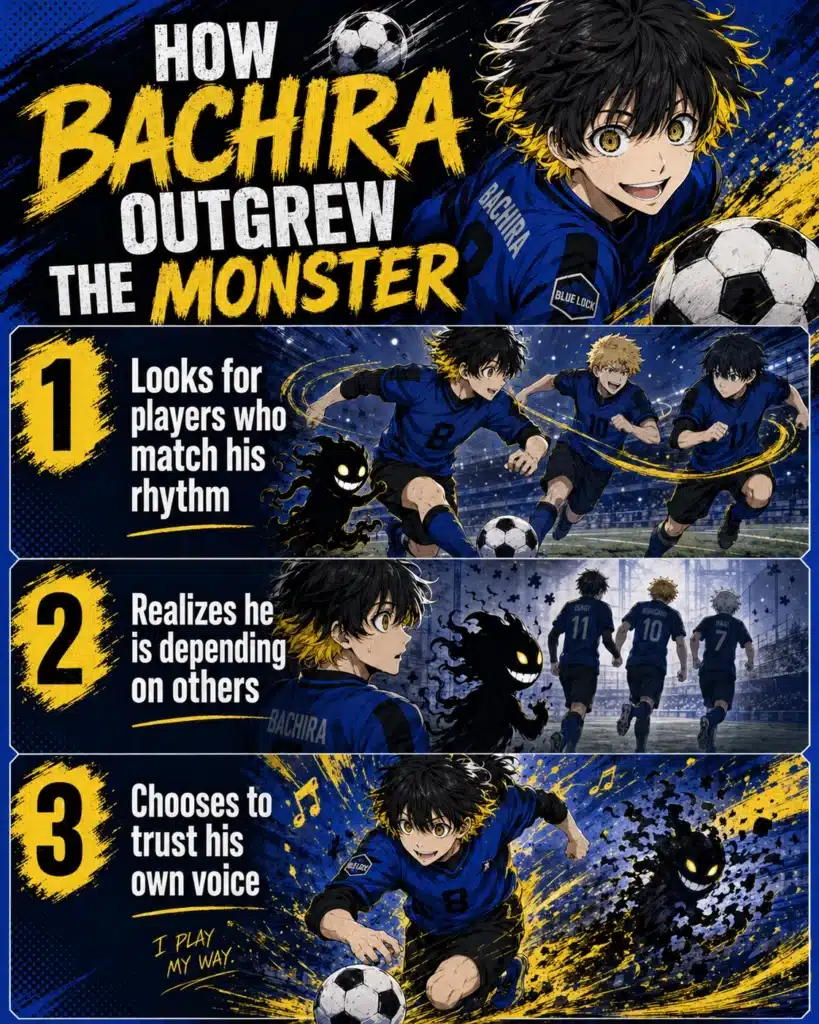
The real turning point comes in the Second Selection, and it is one of the best pieces of character writing in Blue Lock. Bachira starts to realize that his search for another monster has quietly turned into dependence. At first, he is thrilled to chase the world of players like Rin and Isagi. Then the painful truth hits him. They are evolving in front of him, and he is still waiting for someone else to complete the football in his head. That moment hurts because it exposes the weakness behind his freedom. For all his creativity, part of him is still relying on being understood instead of standing alone.
That is why his decision to say goodbye to the monster feels so powerful. He realizes the monster helped him survive loneliness, but it also kept him looking outward for permission, for a partner, for someone to confirm his football. When he chooses to go alone, it is not a rejection of his instincts. It is the first time he truly owns them. He stops treating the monster like a separate being he needs to follow and starts treating that voice as his own. That shift changes everything. The lonely child searching for another playmate becomes a player who can create football from his own ego.
How the Monster Influences His Playstyle
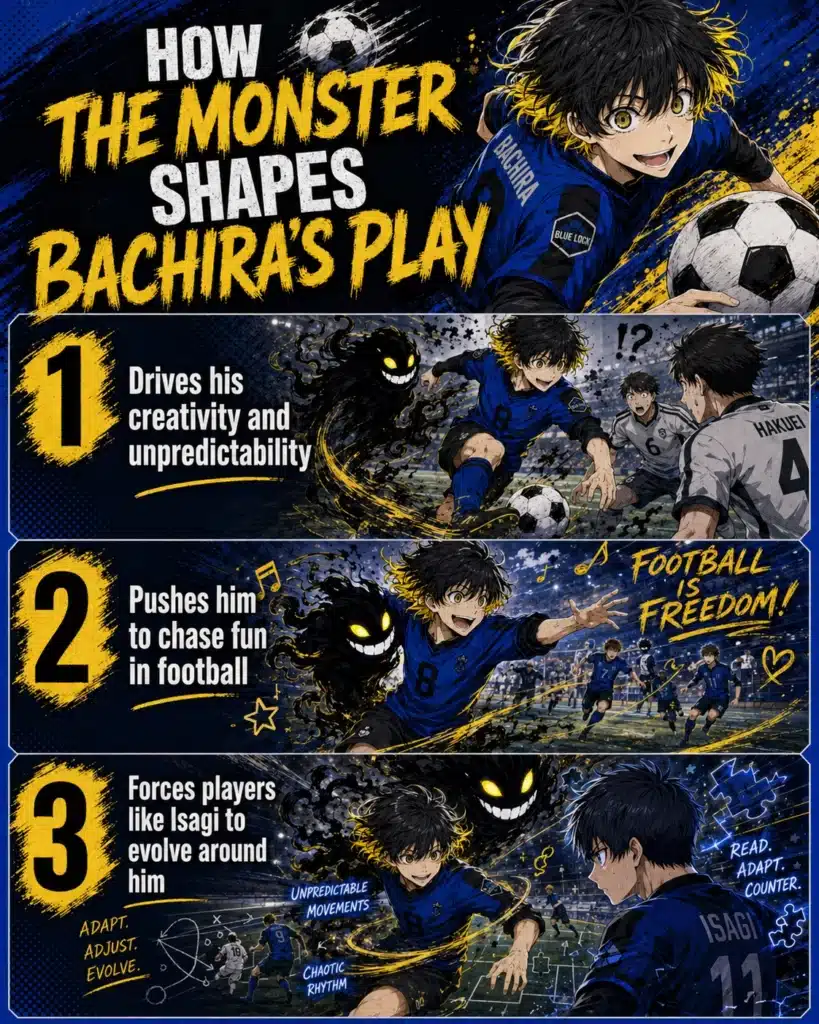
Even after that emotional break, the monster never really disappears. It changes form. Later, Bachira’s best moments show that his instinct, improvisation, and love of risk are still there, but now they come from within instead of from an imagined guide. That is what makes his dribbling feel so alive. It is creative without being lost. Wild without being empty. When he enters that instinct-heavy state and tears through defenders almost on pure feeling, you can see that the monster has become part of his identity rather than something separate from it.
This also explains why Bachira affects other strikers so strongly, especially Isagi. Bachira’s football forces players to respond to freedom, intuition, and sudden change. He does not just challenge defenders. He challenges the way other strikers think about the game. His pass to Isagi at the start of Blue Lock helps trigger Isagi’s path, and later his fearless style keeps pushing the people around him to adapt faster and think deeper. Bachira may not always dominate the story with goals, but he constantly changes the emotional and tactical temperature of the field. That is part of what makes him so special. His monster is personal, but its impact reaches everyone around him.
Key Relationships & Their Impact
Isagi Yoichi: The Ideal Partner and Rival
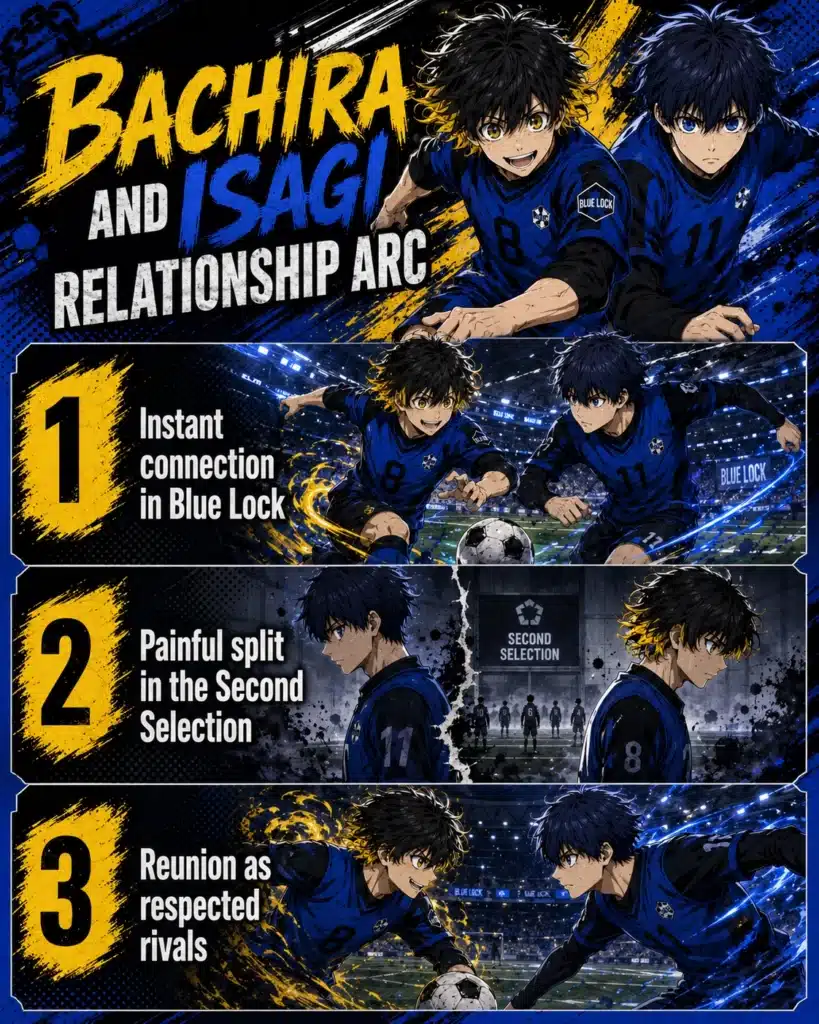
Bachira’s connection with Isagi is one of the most important relationships in Blue Lock because it gives his football a real emotional center. From the very beginning, Bachira sees something in Isagi that other players do not. While most people in Blue Lock are focused on survival, Bachira notices instinct. He feels that Isagi can understand the same kind of football he has been chasing for years. That is why their chemistry feels so immediate. On the field, they connect almost without needing words. Bachira’s creativity and Isagi’s reading of space fit together so naturally that it feels like both of them become more dangerous the moment they trust each other.
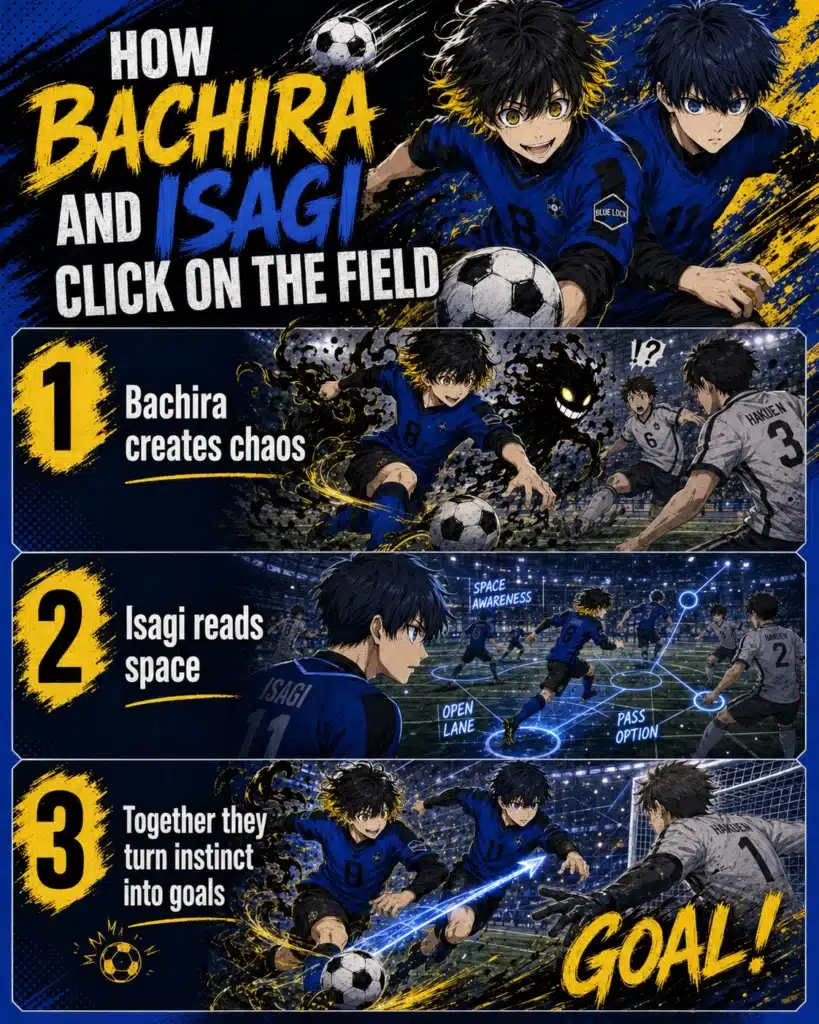
What makes this relationship so strong is that it is never one-sided. Isagi gives Bachira proof that he is not alone, and Bachira gives Isagi a new way to see football. Bachira’s freedom pushes Isagi out of hesitation and into action. At the same time, Isagi’s sharp mind helps Bachira see that instinct alone is not enough. They bring out different parts of each other. Bachira becomes more aware of what his football can do when paired with real vision, and Isagi becomes more willing to trust explosive, risky moments instead of playing too safely. Their link is not just fun to watch. It actively shapes both of their development.
That is why their separation in the Second Selection matters so much. Until then, Bachira had been chasing the dream of finding someone who could play with his monster. But once Isagi starts evolving on his own, Bachira is forced to face something painful. He cannot keep defining himself through the people who understand him. For a while, that split leaves him emotionally exposed. It feels like he is losing the partner he had waited for his whole life. But in truth, that break is necessary. It pushes Bachira to stop waiting for someone else to complete his football and start owning it himself.
When they meet again later, especially as rivals, the relationship feels more mature. The bond is still there, but it is no longer built on dependency. There is respect, excitement, and competition. Bachira does not look at Isagi as someone who must save his football anymore. He sees him as someone worth surpassing. That change is huge. It turns their dynamic from emotional rescue into true rivalry, and that makes both characters stronger.
Team Z and the First Selection: Building Trust Through Freedom
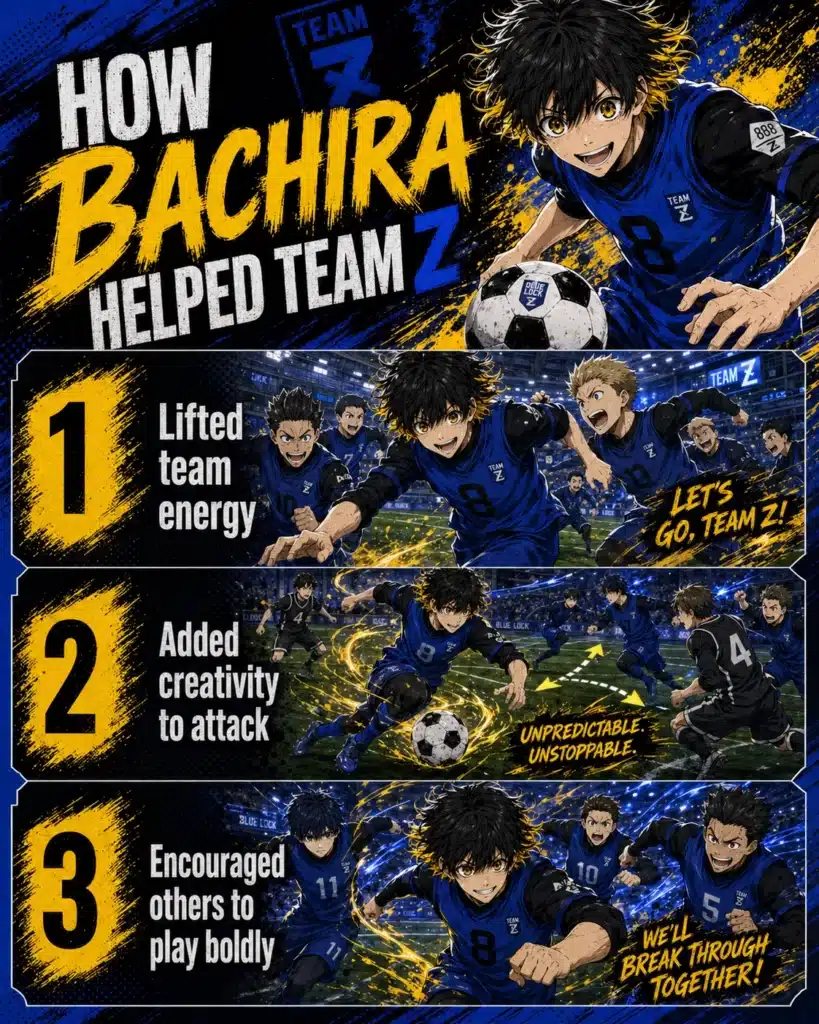
Bachira also plays a major role in Team Z’s early identity. In a team full of strong personalities, insecurity, and pressure, he brings a kind of energy that feels light without ever feeling weak. He keeps the atmosphere from becoming too stiff. That matters more than it first seems. Blue Lock is designed to turn players against each other, so someone like Bachira helps create moments of trust in a place that is built on ego. His cheerful nature, strange honesty, and fearless style make Team Z feel less like a random group of strikers and more like a unit slowly learning how to believe in each other.
With players like Kunigami and Chigiri, Bachira’s impact is not always loud, but it is still important. Kunigami brings power and directness. Chigiri brings speed and elegance. Bachira adds imagination. He is often the one who makes the game feel open instead of rigid. That allows other talents to breathe. His style invites movement, combinations, and risk. In that sense, Bachira helps unlock the team’s attacking identity. He does not just contribute individually. He makes the football around him more fluid.
There is also something valuable in the way Bachira challenges people without sounding harsh. He does not motivate others through speeches or force. He does it by playing without fear. That confidence can be contagious. In a setting where many players are trapped by doubt, Bachira’s willingness to trust his instincts reminds the others what bold football looks like. Even when Team Z is struggling, he keeps the game alive.
The World’s Best: Rivals Who Expanded His Vision
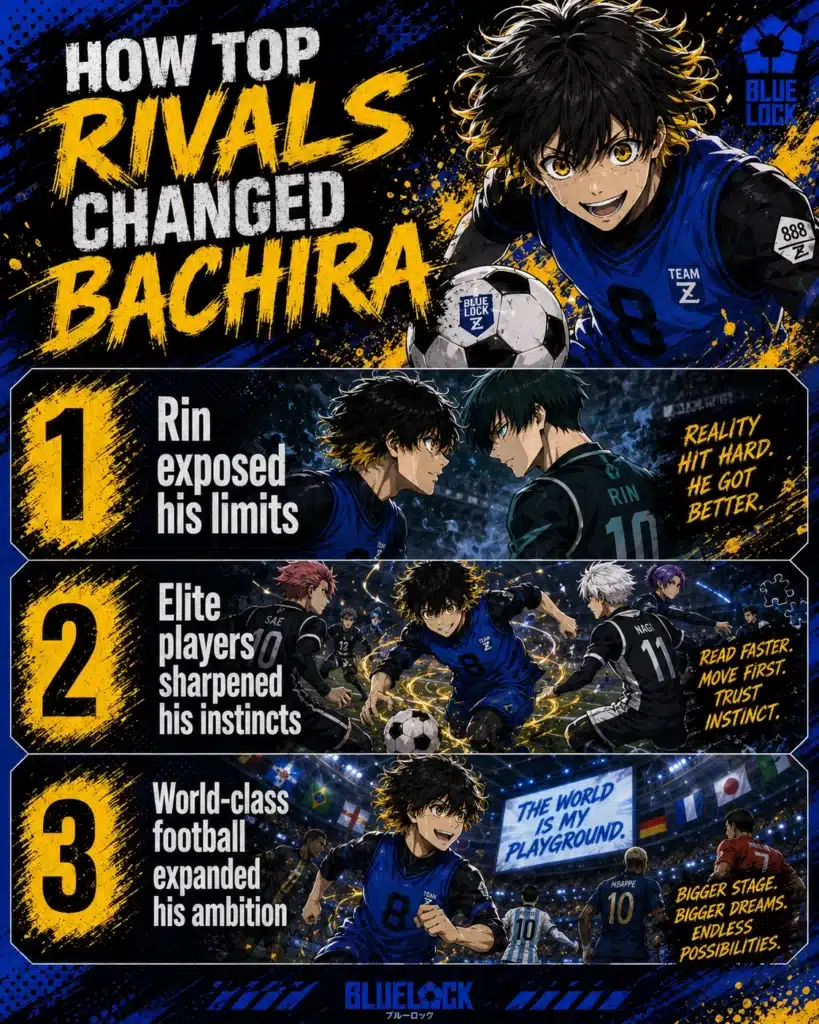
As Bachira moves deeper into Blue Lock, his encounters with elite players push him into a new stage of growth. Players like Rin Itoshi force him to see the gap between natural talent and complete domination. Rin is not just skilled. He controls the field with precision and pressure. Playing against someone like that makes it clear that Bachira’s freedom, while special, still needs a sharper purpose. He cannot rely only on instinct if he wants to stand with the best.
That is part of why these higher-level matchups are so important for him. They do not crush his style. They refine it. Bachira starts to understand that being free does not mean being careless. It means making your creativity strong enough to survive against players who can read, punish, and outplay almost anyone. His football becomes more personal in the best way. Instead of searching for approval or waiting for the right partner, he begins shaping a style that can stand on its own against top-level opponents.
Sae Itoshi represents another important shift in that vision. A player of Sae’s level changes the standard completely. When Bachira sees football at that class, the dream gets bigger. It is no longer just about surviving Blue Lock or finding fun on the field. It becomes about where his football can fit on the world stage. Facing stronger opponents gives his creativity direction. It turns instinct into ambition.
This is why Bachira’s relationships with top players matter so much. They challenge his limits, but they also sharpen his identity. He comes out of those battles with a clearer sense of what his football needs to become. He still wants joy. He still wants freedom. But now he understands that real freedom at the highest level must be earned.
In the end, Bachira’s relationships are powerful because each one reveals a different side of him. Isagi brings out his emotional need for connection and his growth into rivalry. Team Z shows how his energy can change a whole group. Stronger players like Rin and Sae force him to mature. Together, these relationships prove that Bachira is not just shaped by the game. He also shapes the people and the football around him.
Bachira’s Character Arc: Moments of Truth and Transformation
Early Blue Lock: Finding His Place
At the start of Blue Lock, Bachira feels like a contradiction in the best way. He enters a ruthless, ego-driven environment, but instead of becoming cold or rigid, he keeps playing with joy. That is what makes his early arc so interesting. He does not reject Blue Lock’s philosophy, but he also does not copy it in the same way as everyone else. While others treat ego like aggression or domination, Bachira expresses it through freedom. His version of ego is not about crushing the game into something controlled. It is about playing the kind of football that feels most alive to him.
That is why his early development matters so much. Blue Lock gives Bachira something he has been missing for a long time: players who can actually challenge the football inside his head. For the first time, his instincts are not meaningless. His dribbling, imagination, and hunger for exciting football suddenly have a place where they can grow instead of being rejected. This is where Isagi becomes so important. Bachira does not just find a teammate. He finds someone who can respond to his rhythm. That connection gives him both comfort and momentum.
The Second Selection: Crisis and Self-Discovery
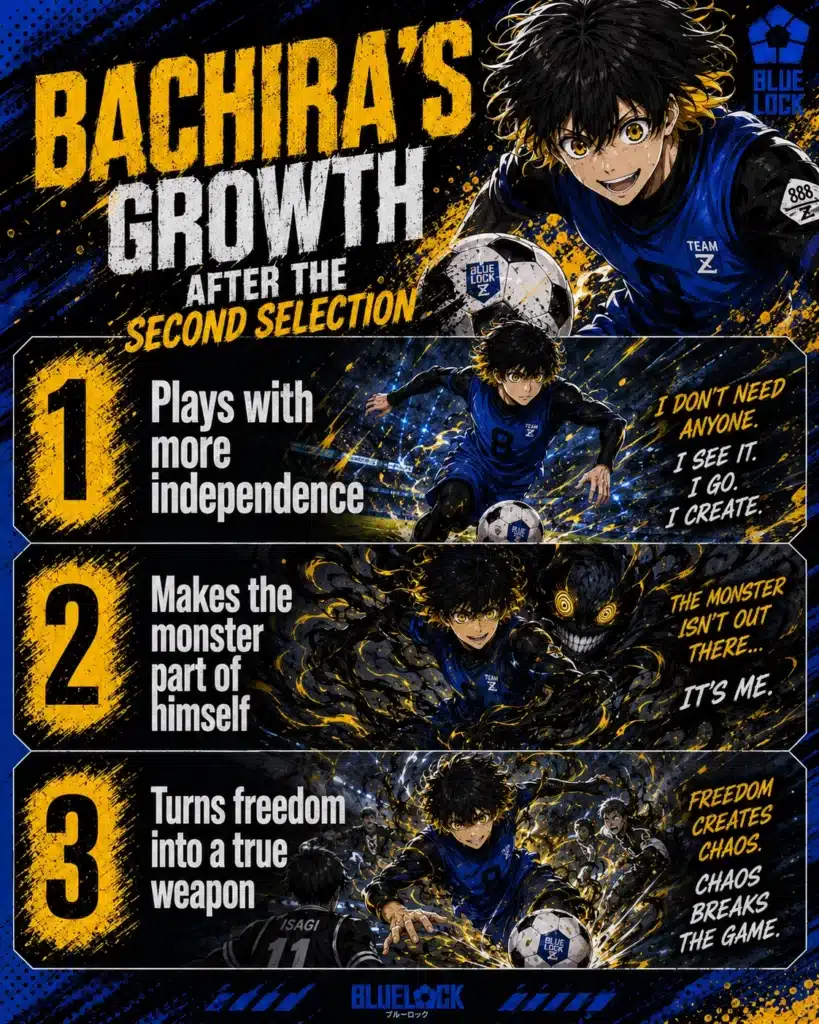
The Second Selection is where Bachira’s arc stops being simply charming and becomes deeply painful. Up to that point, a lot of his football is tied to the joy of finding someone who understands him. But once he is separated from Isagi, that emotional foundation begins to crack. For perhaps the first time, Bachira has to face the fear that he might have built too much of his identity around being understood by someone else. That fear hits hard because it goes all the way back to his childhood. Underneath the smile and the creativity, there is still the lonely boy who wanted one true playmate.
What makes this part of his story so powerful is that the crisis is not really about losing Isagi. It is about losing the idea that someone else will complete his football for him. Bachira starts to realize that if he keeps waiting for the perfect partner, he will never fully become his own player. That realization hurts because it forces him to let go of something that once kept him emotionally safe. The monster, which used to feel like a friend and a guide, now becomes part of the question he has to answer on his own.
His breakthrough is one of the most important moments in his character arc. He stops chasing the version of football that depends on being shared first and starts embracing the version that begins with himself. That does not make him colder. It makes him stronger. He still loves creativity, unpredictability, and connection, but now those things come from his own center. He no longer waits for permission to be the player he wants to be. He chooses it.
Neo Egoist League and Beyond: Embracing Independence
By the time Bachira reaches the Neo Egoist League, his football feels more complete. The freedom is still there. The flair is still there. The joy is still there. But now it is supported by independence. This is the version of Bachira that feels most fully realized because he is no longer split between instinct and identity. He understands that his rhythm is his own, and that confidence gives his play a sharper edge. He is not just reacting to the game anymore. He is shaping it on his terms.
This is also where the “monster” fully changes meaning. Early on, it felt like something beside him, a separate presence he followed. Later, it becomes clear that the monster was never meant to stay separate. It was always a symbol of the deepest part of his footballing self. Once Bachira accepts that, his style becomes more refined without losing its soul. He does not abandon the chaos. He learns how to own it.
That is what makes his evolution so satisfying. A lot of characters in Blue Lock grow by becoming harder, more ruthless, or more calculating. Bachira grows by becoming more honest with himself. He does not lose his authenticity in order to survive. He proves that authenticity can become a weapon when it is backed by self-belief. That is why his arc stands out so much. It is not just about improvement. It is about becoming whole.
My Favorite Bachira Moment: A Personal Reflection
My favorite Bachira moment is the point where he stops waiting for someone else to hear the monster with him and chooses to move forward alone. That scene stays with me because it feels like the moment he truly becomes himself. Before that, Bachira is fascinating, lovable, and brilliant, but there is still a quiet sadness under everything he does. You can feel that part of him is always searching. When he finally lets go of that need, it does not feel like a loss to me. It feels like a release.
What I love most about that moment is how honest it is. Bachira does not suddenly become a different person. He does not reject joy, instinct, or connection. He simply stops letting those things depend on someone else’s presence. That feels bigger than football. It feels human. A lot of people connect with Bachira because they understand what it means to want someone else to validate the part of you that feels different. Seeing him finally say, in his own way, that his football is enough even when he stands alone, is what makes his growth so memorable.
To me, that moment reveals the core of Bachira’s character. He is not special only because he can dribble through defenders or play with wild creativity. He is special because his journey is about turning loneliness into identity and imagination into strength. That is why he remains one of the most emotionally resonant characters in Blue Lock. His best moments are exciting on the surface, but underneath them is something much deeper: the courage to become exactly who you are.
Bachira’s Legacy: Impact on Blue Lock and the Future
A Catalyst for Others
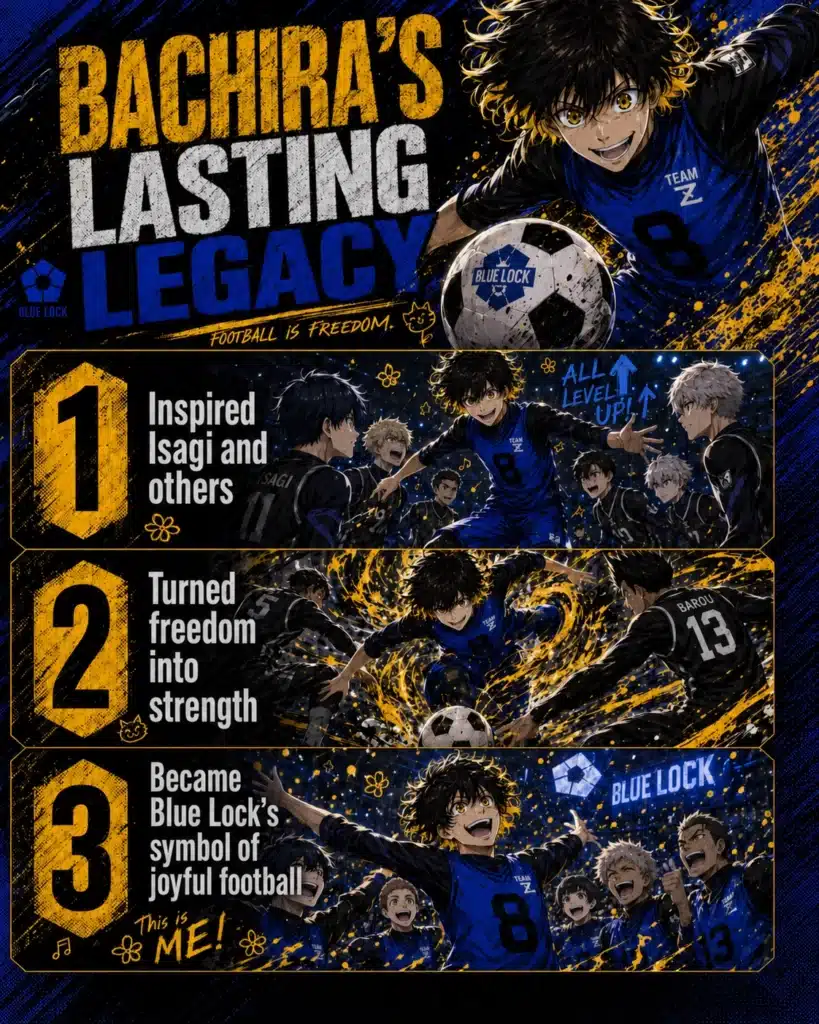
Bachira’s legacy in Blue Lock is much bigger than being the series’ best dribbler. He changes the players around him. The clearest example is Isagi. From the beginning, Bachira is one of the first people to believe in him, pass to him, and recognize that there is something special in the way he sees the game. That trust matters. It gives Isagi a partner who can turn his ideas into real attacking moments, and it pushes him to think faster, move sharper, and play with more courage. In that sense, Bachira is not just part of Isagi’s story. He helps unlock it.
His influence also reaches beyond one character. In a project built around ego, pressure, and survival, Bachira keeps reminding everyone that football can still be creative. He plays with freedom, and that freedom forces others to respond. Some players have to sharpen their reading of space to keep up with him. Others have to embrace their own style more honestly because Bachira proves that individuality is not a weakness when it is fully owned. That is why his impact feels so wide. He does not just beat defenders. He changes the emotional rhythm of the field.
The Embodiment of “Fun” in Soccer
What makes Bachira so valuable to Blue Lock is that he gives the story a necessary balance. Blue Lock often treats football like war. Every match is a test of ego, value, and survival. Bachira does not reject that intensity, but he brings something else into it. He reminds us that the game is also supposed to feel alive. His joy is not softness. It is part of his strength. His best plays happen when instinct, passion, and self-expression all move together. That is why he never feels out of place in Blue Lock even though his energy is so different from the rest. He is proof that loving the game can be just as dangerous as dominating it.
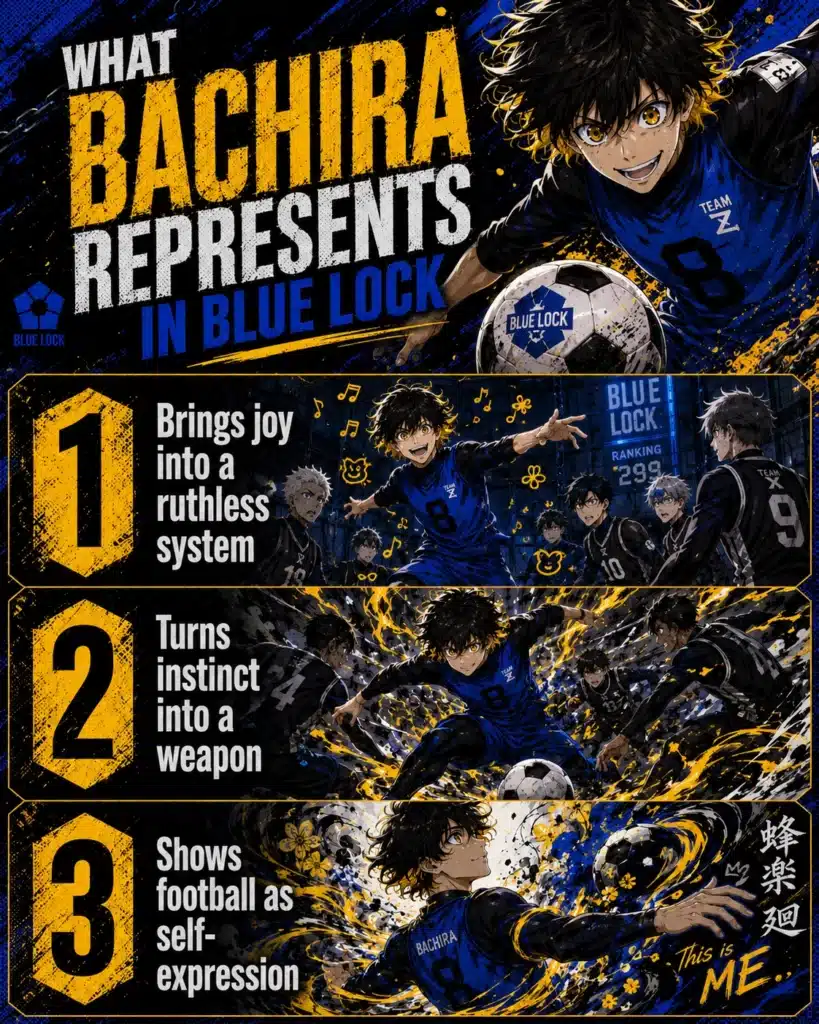
This is also why his dribbling means more than technique. When Bachira dribbles, it feels like release. It is the purest form of his character. The feints, strange rhythms, sudden bursts, and fearless touches all reflect the same core idea: football is where he is most honest. Other players in Blue Lock often become stronger by controlling themselves more tightly. Bachira becomes stronger by expressing himself more fully. That gives his football a kind of emotional truth that very few players in the series can match.
Speculating on His Future
Bachira’s future looks especially exciting because the story has already set him up as more than a flashy specialist. In the Neo Egoist League, he plays as FC Barcha’s center forward, and the league itself exists to shape and select the reconstructed Japan U-20 squad for the U-20 World Cup. Bachira also finishes that stage with strong production and market value, including 5 goals, 2 assists, and a ¥120 million bid from FC Barcha. That tells you something important. His style is not just entertaining. It is valuable at a serious level.
At the manga’s current stage, the story has entered the U-20 World Cup Arc, so the next question is not whether Bachira belongs on a bigger stage. It is how far his style can go once the whole world starts preparing for him. That challenge is exciting because international football will test the one thing that has always defined him: can pure creativity still win when elite defenders study it in advance. Even recent story material points in that direction, with opponents specifically preparing to mark him one on one. My read is that Bachira will remain one of Japan’s most important attacking weapons, but his next evolution will come from learning when to turn freedom into control and when to let instinct take over completely.
That is why Bachira’s legacy already feels secure, even though his story is still moving. He changed to Isagi. He gave Blue Lock one of its clearest emotional identities. He proved that instinct and joy can survive inside a system built on ruthless ambition. And looking ahead, he still feels like one of the players most capable of surprising both the story and the readers. Bachira’s future is not exciting because we expect him to become someone else. It is exciting because every stage keeps showing us a stronger version of the same free spirit.
Conclusion: The Enduring Charm of Blue Lock’s Free Spirit
Meguru Bachira stands out in Blue Lock because he brings together so many things that should not be easy to balance. He is technically brilliant, emotionally complex, and endlessly entertaining to watch. His dribbling gives him instant appeal, but what makes him unforgettable is everything behind it. Bachira is not just a player with flair. He is a character shaped by loneliness, imagination, instinct, and a deep desire to play football in its most honest form. That is what gives him a presence that lasts long after his biggest moments on the pitch.
What makes his journey so satisfying is how complete it feels. Bachira begins as someone guided by his inner monster, searching for a partner who can understand the football in his head. Over time, that search becomes something deeper. He learns that the monster was never just a companion. It was a part of himself that he had to accept fully. Once he stops depending on others to validate that side of him, his football becomes even stronger. He does not lose his freedom. He finally owns it. That is the moment he becomes more than a gifted dribbler. He becomes a true master of self-expression.
That is also why Bachira continues to resonate so strongly with fans. He represents something rare in a series built around pressure and ego. He reminds us that football is not only about results. It is also about joy, instinct, creativity, and the feeling of being fully alive in the game. A lot of characters in Blue Lock are exciting because they dominate. Bachira is exciting because he feels free. That freedom makes him inspiring. It makes him relatable. And it makes him one of the clearest symbols of what it means to love football without losing yourself in the process.
His legacy in Blue Lock is impossible to ignore. He helps shape Isagi’s growth, changes the energy of every team he plays on, and proves that creativity can be just as dangerous as cold efficiency. Even among a cast full of standout players, Bachira feels irreplaceable. He gives the series heart without weakening its intensity. He gives it beauty without taking away its edge. That balance is what makes him so special.
Final Personal Reflection
What I admire most about Bachira is that his growth never comes from becoming less himself. He does not abandon his weirdness, his joy, or his instinct in order to survive. He becomes stronger by trusting those things more honestly. That is why his story stays with me. In a series full of players trying to prove they are the best, Bachira’s journey feels like a reminder that greatness can also come from understanding who you already are.
For me, that is the real charm of Meguru Bachira. He is not just one of Blue Lock’s most talented players. He is its most authentic free spirit. And that is exactly why he will always be one of the series’ most loved and memorable characters.