
BLUE LOCK CHAPTER 4: NOW OR NEVER
Blue Lock Chapter 4 — A Detailed Breakdown
The Boy Who Refuses to Belong
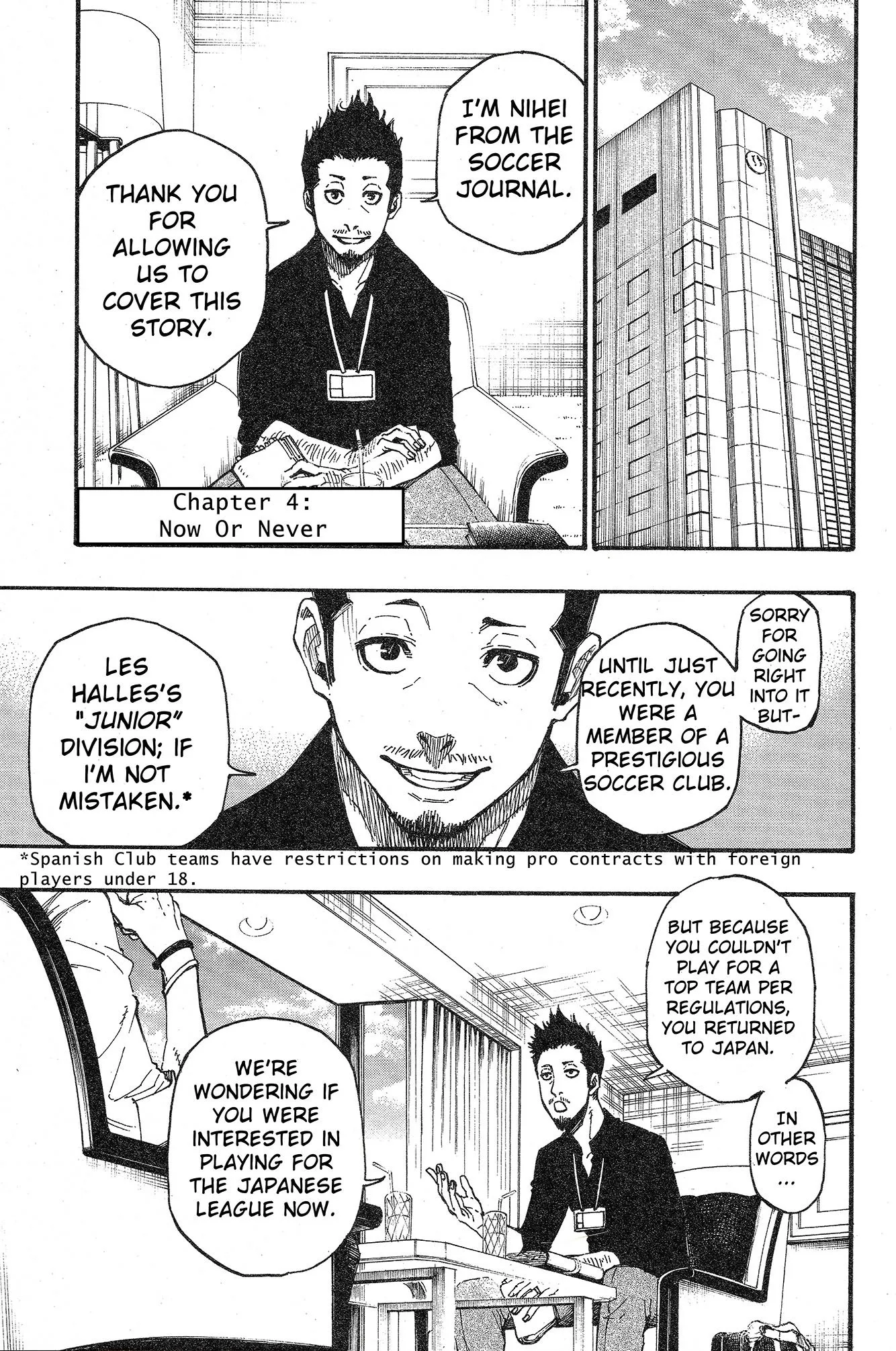
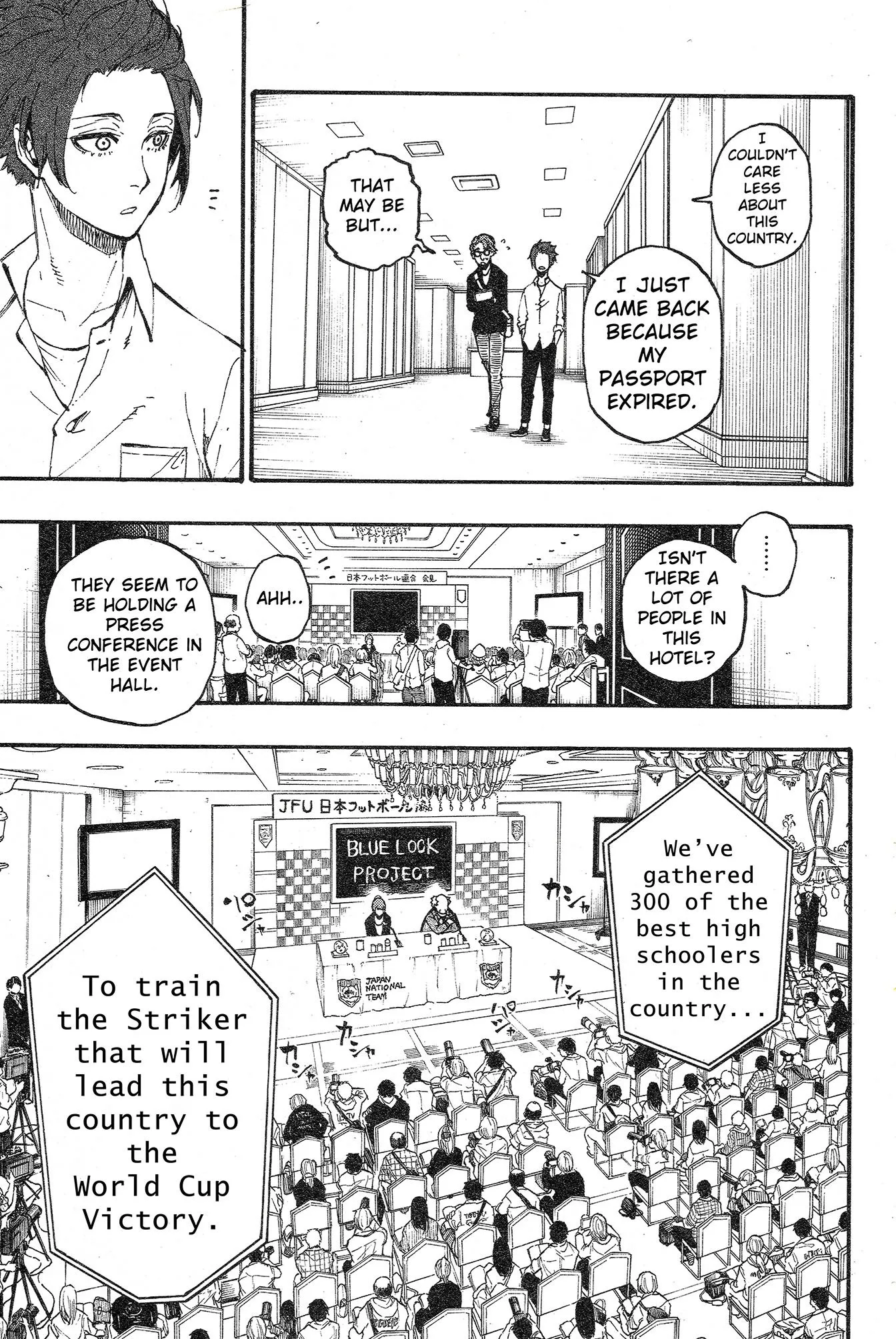
The chapter does not open with the boys of Blue Lock. It opens somewhere quieter — a hotel room, a journalist, and a seventeen-year-old who speaks with the cold certainty of someone who has already decided where he stands in the world.
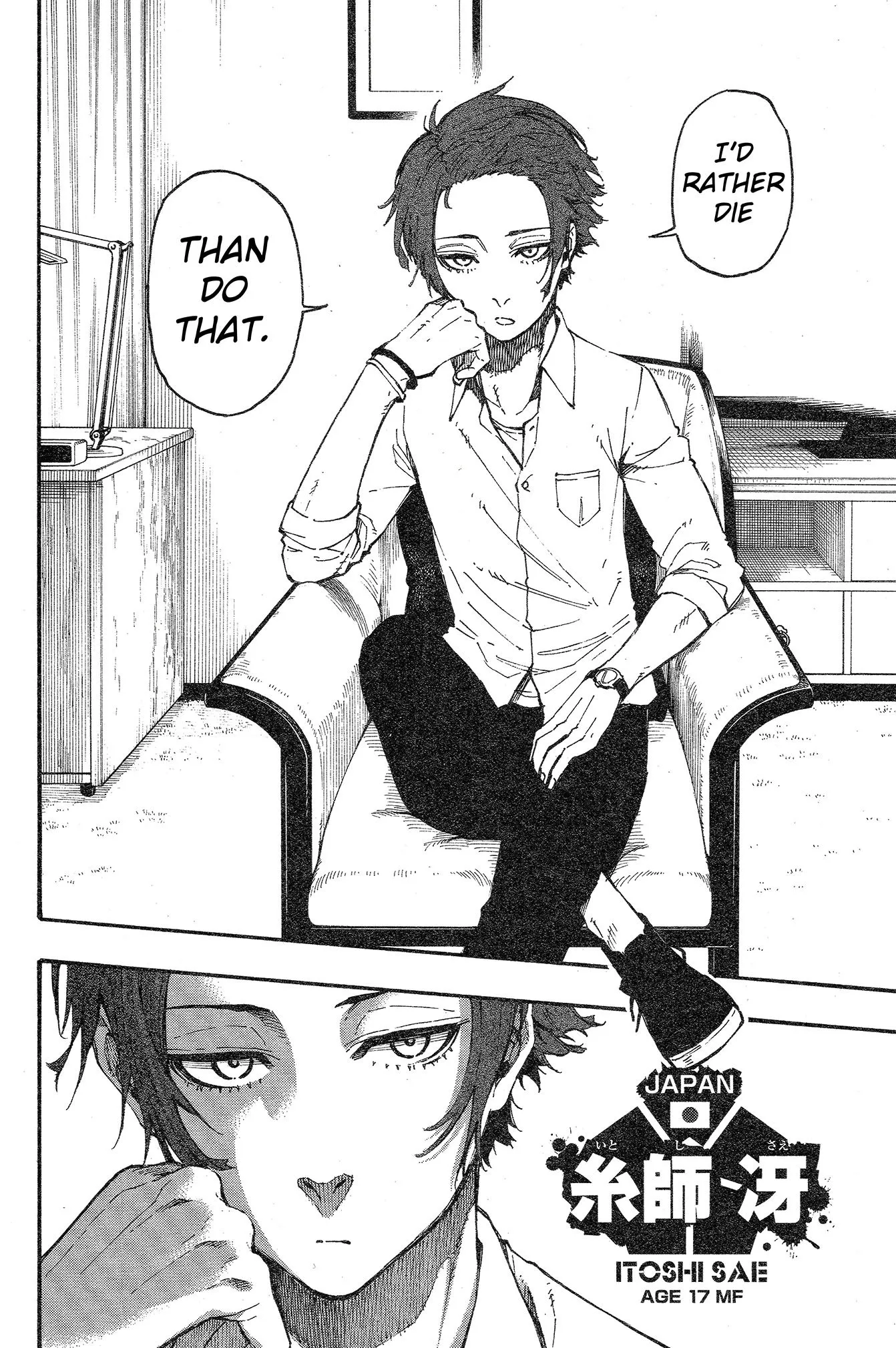
The journalist, Nihei, has come to interview Itoshi Sae — a seventeen-year-old midfielder who had been playing in Spain’s prestigious Les Halles Junior Division. Now, due to regulations that prevent foreign players under the age of eighteen from signing professional contracts with top European clubs, Sae has been forced to return to Japan. Nihei, sensing an opportunity, leans forward and asks the obvious question: would Itoshi Sae consider playing for the Japanese national team?
The answer comes without hesitation, without emotion, and without any attempt at diplomacy:
“I’d rather die than do that.”
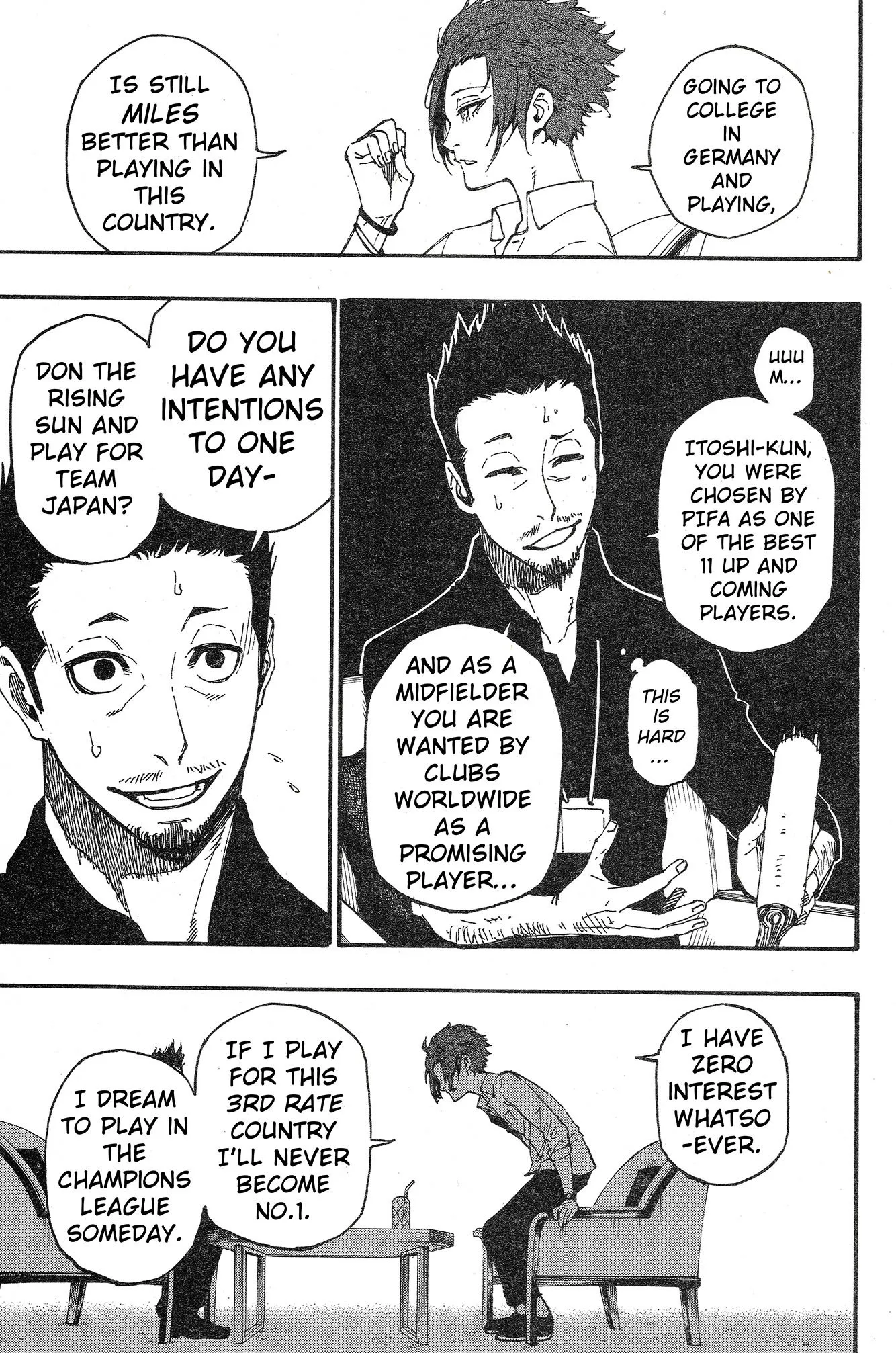
Three words. Five words. And with them, Itoshi Sae dismantles the entire premise of the interview. He does not dress it up. He does not soften it with the language of ambition or gratitude. He simply means it. Going to college in Germany and playing there, he says, is “still miles better than playing in this country.”
Nihei presses on — carefully reminding Sae that PIFA has named him one of the best eleven up-and-coming players in the world, that clubs worldwide are chasing him, that he is wanted. Nihei’s words land like a kind of flattery dressed in logic. But Sae is not impressed by compliments, and he is not moved by logic that does not serve his own purpose.
“I have zero interest whatsoever. I dream to play in the Champions League someday. If I play for this 3rd rate country I’ll never become No.1.”
There is something almost breathtaking about the directness of it. He does not hate Japan. He is not performing arrogance for the cameras. He is stating, as plainly as one might state a fact of physics, that the level of Japanese football cannot support the kind of player he intends to become. And then he says the thing that cuts deepest:
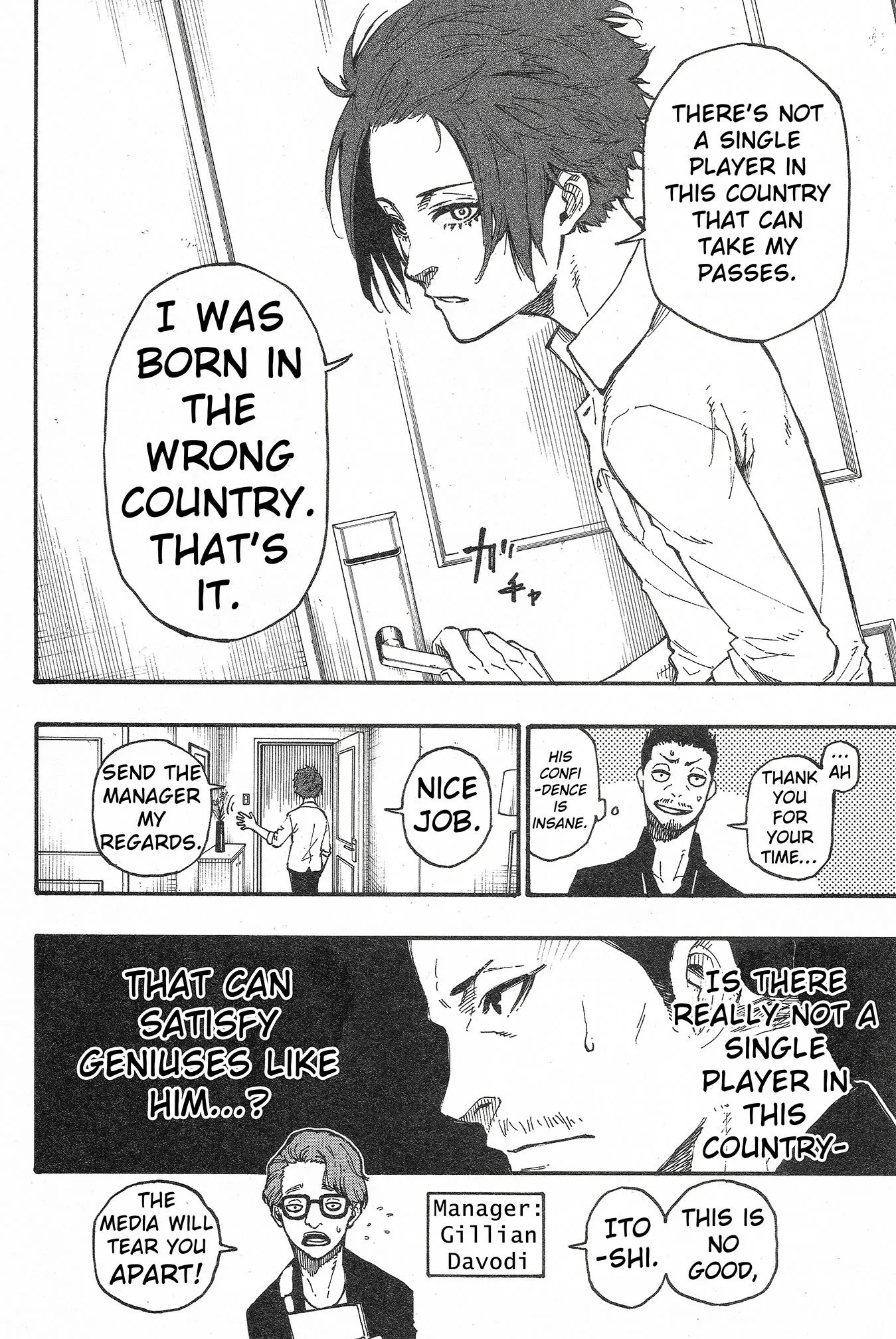
“There’s not a single player in this country that can take my passes. I was born in the wrong country. That’s it.”
He does not storm out. He simply gets up, tells Nihei to send his manager his regards, and leaves. Behind him, Nihei sits alone with a journalist’s worst nightmare — not a story that is too difficult to write, but a truth that is too difficult to ignore.
Nihei wonders to himself: “Is there really not a single player in this country that can satisfy geniuses like him?” It is a question that hangs in the air. And it is a question that the rest of this chapter — and this entire story — will attempt to answer.
A Press Conference That Changes Everything
As Itoshi Sae walks through the hotel corridors — uninterested, unhurried, already planning his route back out of Japan — he notices something. The hotel’s event hall is packed. Cameras. Reporters. A buzz in the air that even someone as deliberately detached as Sae cannot entirely ignore.
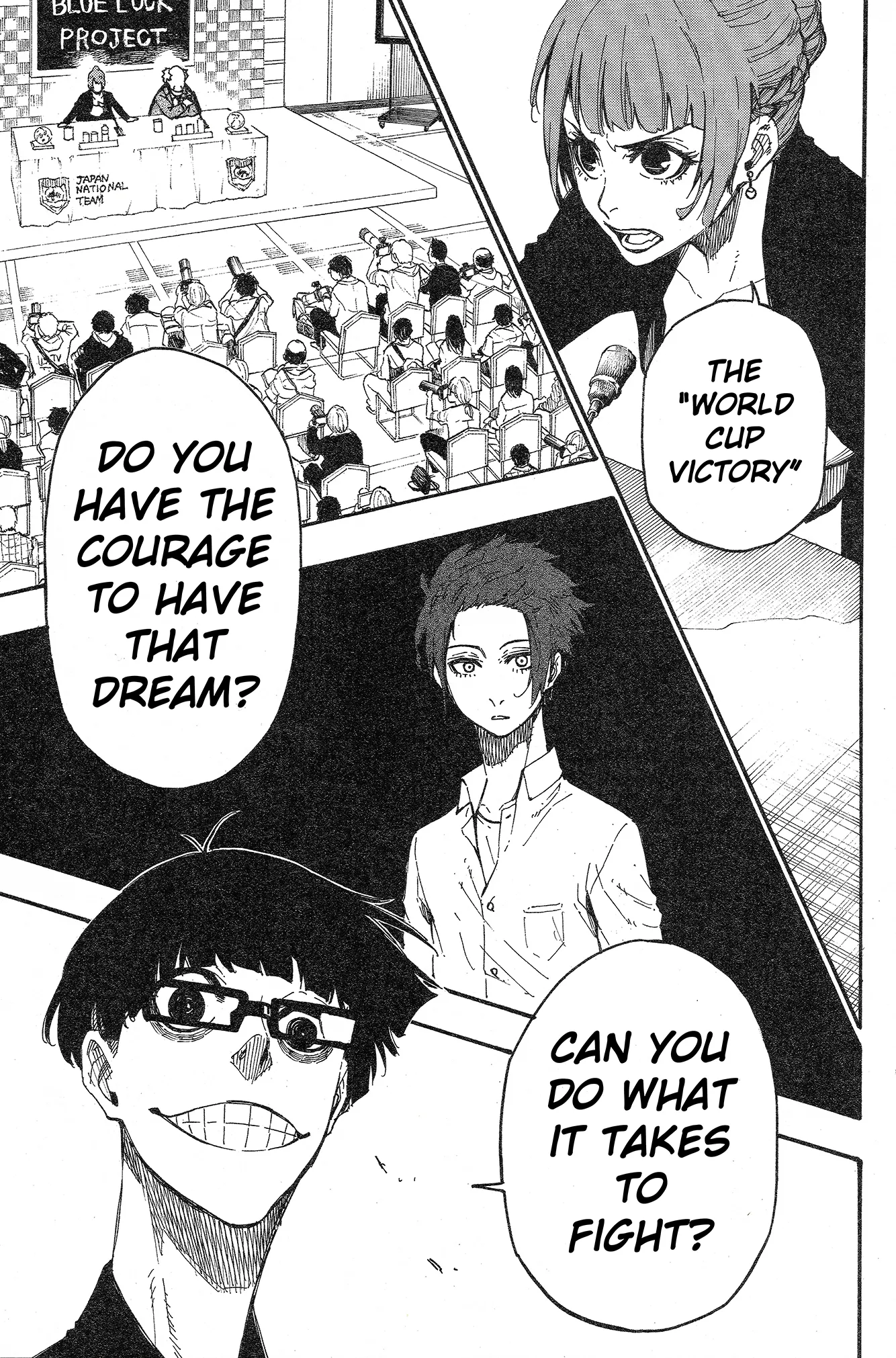
Inside that hall, under the banner of the Japan Football Union, a press conference is already underway. And at the front of the room, behind a microphone, sits a young woman who is about to say things that will make every journalist in the room deeply uncomfortable.
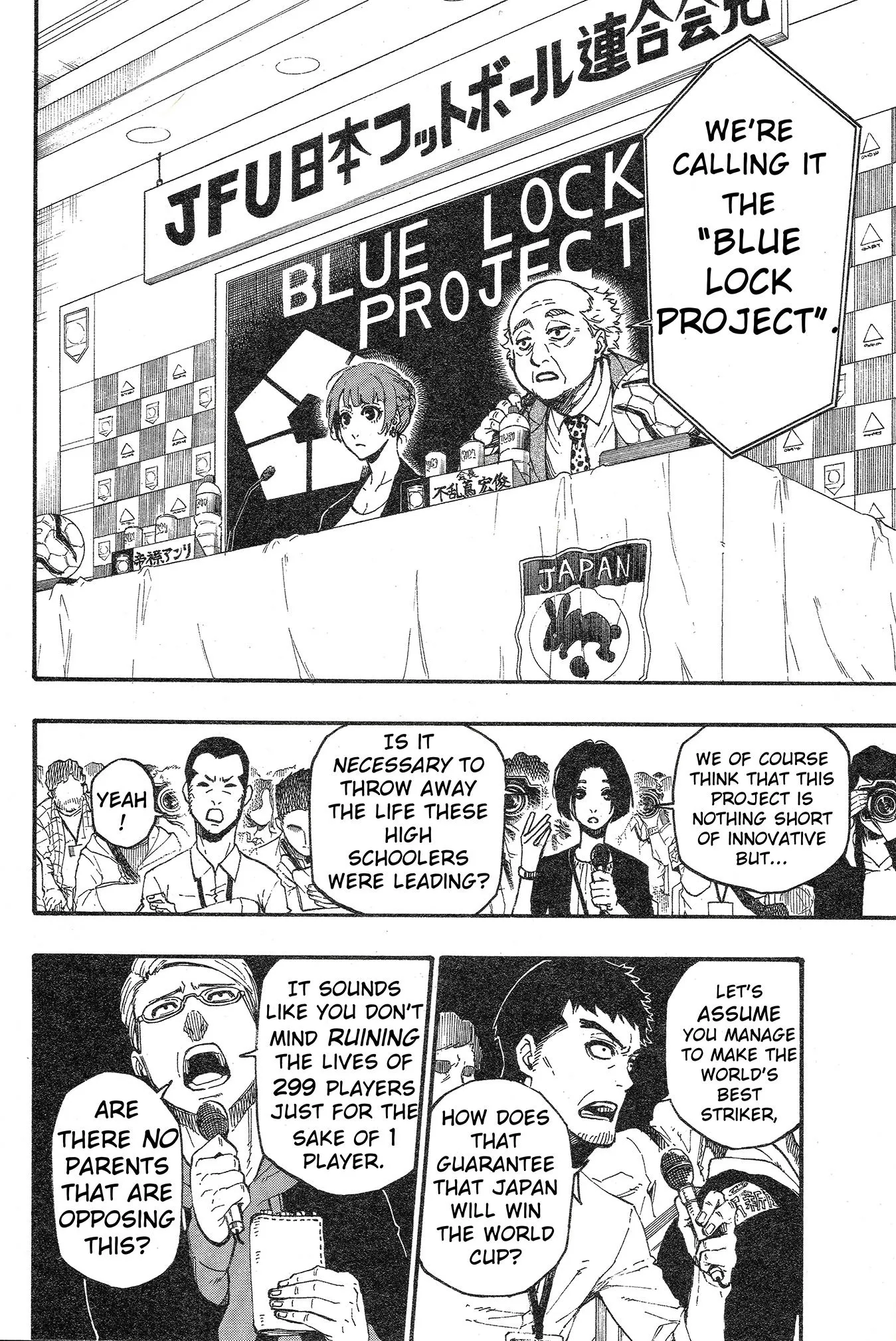
The project is called Blue Lock. Three hundred of the best high school footballers in Japan have been gathered. The goal is singular and unambiguous: to train the one striker who will lead Japan to World Cup victory. Not a group. Not a squad. One.
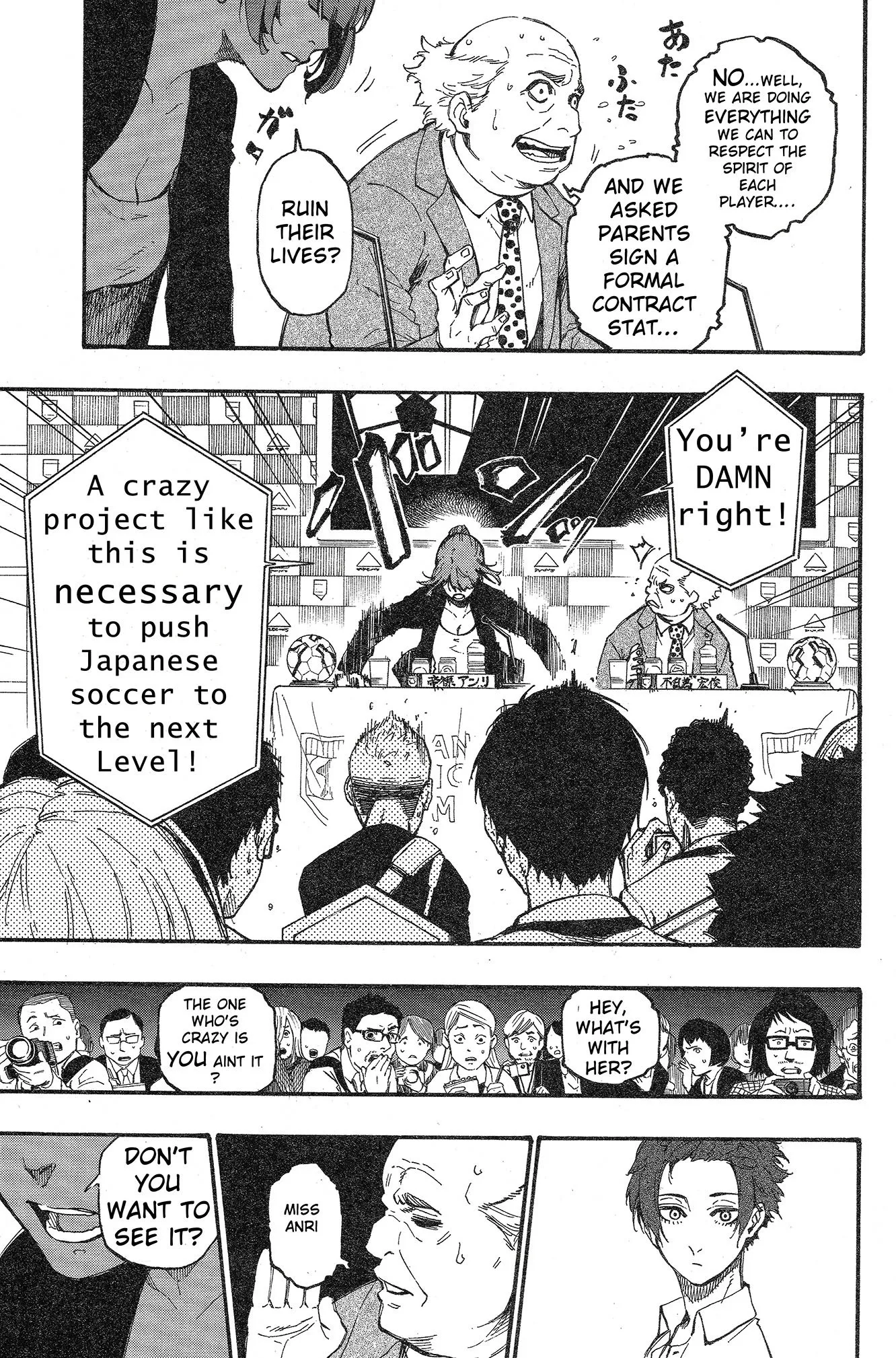
The reporters immediately push back. They point out the obvious — that 299 players will, by definition, be eliminated. That this project could destroy the football careers of hundreds of young men. That parents have signed contracts they may not fully understand. That the entire premise sounds reckless.
The official at the table flinches. He tries to reassure them. He stumbles through words about respecting the spirit of each player, about formal contracts, about good intentions. But before he can finish, the young woman at the microphone has already taken over.
“You’re DAMN right! A crazy project like this is necessary to push Japanese soccer to the next Level!”
The room erupts. Reporters mutter to each other. Someone asks what is wrong with her. But she does not back down. Instead, she leans into the microphone and asks the question that is the beating heart of everything:
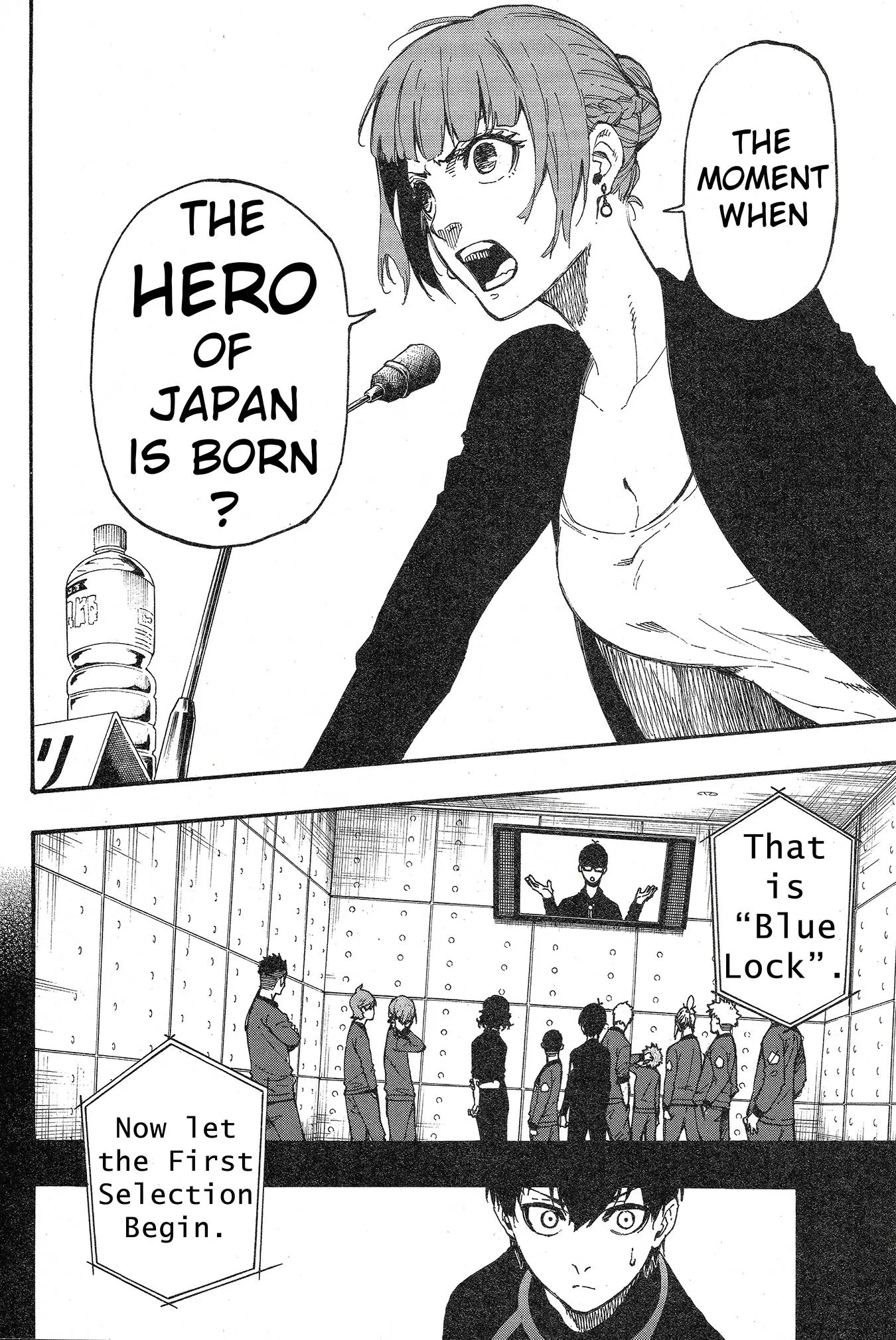
“Don’t you want to see it? The moment when the HERO OF JAPAN IS BORN?”
Her name, as we learn from the nameplate in front of her, is Anri. And whether the room is ready for her or not, she is already moving.
Inside Blue Lock — The First Selection Begins
The scene shifts. We are now inside the Blue Lock facility itself — a place that already feels less like a training ground and more like an experiment. The players, silhouetted against the grid of the building’s walls, stand and watch a screen. On that screen, a figure in glasses speaks. He does not waste time on pleasantries.
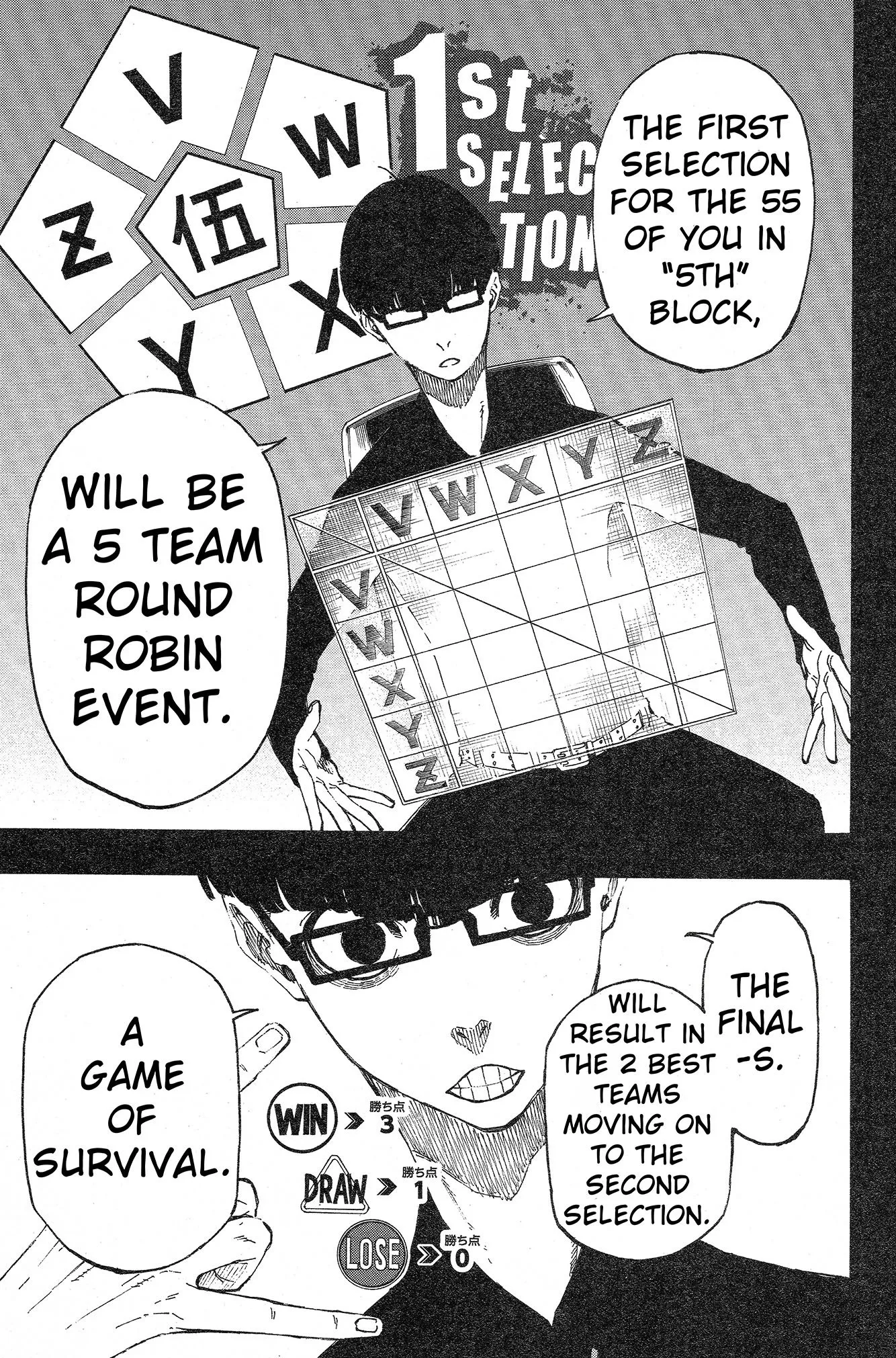
The structure of the First Selection is laid out with clinical precision. The 55 players in Block 5 have been divided into five teams — V, W, X, Y, and Z. They will compete in a round robin format. Win earns 3 points. Draw earns 1. Loss earns nothing. The two best teams at the end move forward to the Second Selection. Everyone else is eliminated — from Blue Lock, and from any future possibility of representing Japan.
“A game of survival.”
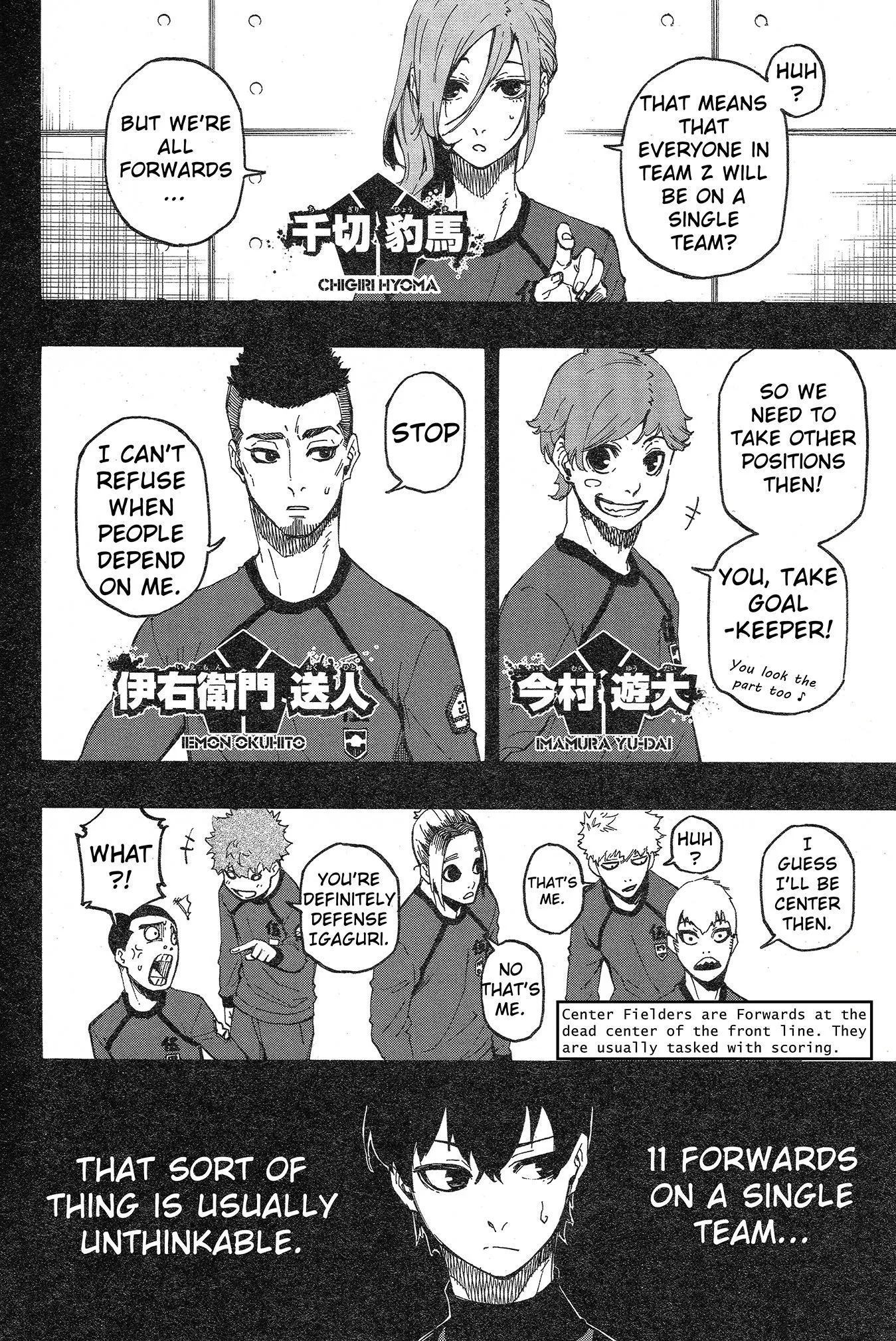
There is something immediately strange about the team compositions. Because every single player in Blue Lock is a forward — a striker, an attacker, someone whose entire identity as a footballer is built around scoring goals. And yet now they must form teams. They must fill positions. Someone has to play defence. Someone has to be goalkeeper.
We see a glimpse of this chaos through the players of Team Z. Chigiri Hyoma, long-haired and sharp-eyed, notes aloud that they are all forwards. Iemon Okuhito, impossibly tall and somehow already reliable, says quietly that he cannot refuse when people depend on him. Imamura Yu-Dai, grinning, decides to assign positions on the spot — pointing at people, announcing roles, cheerful in his chaos. The boys scramble to sort themselves out. It is equal parts comedy and crisis.
Eleven forwards on a single team. As the narration notes — that sort of thing is usually unthinkable.
The Philosophy of Anri — Why Japanese Soccer Must Die to Be Reborn
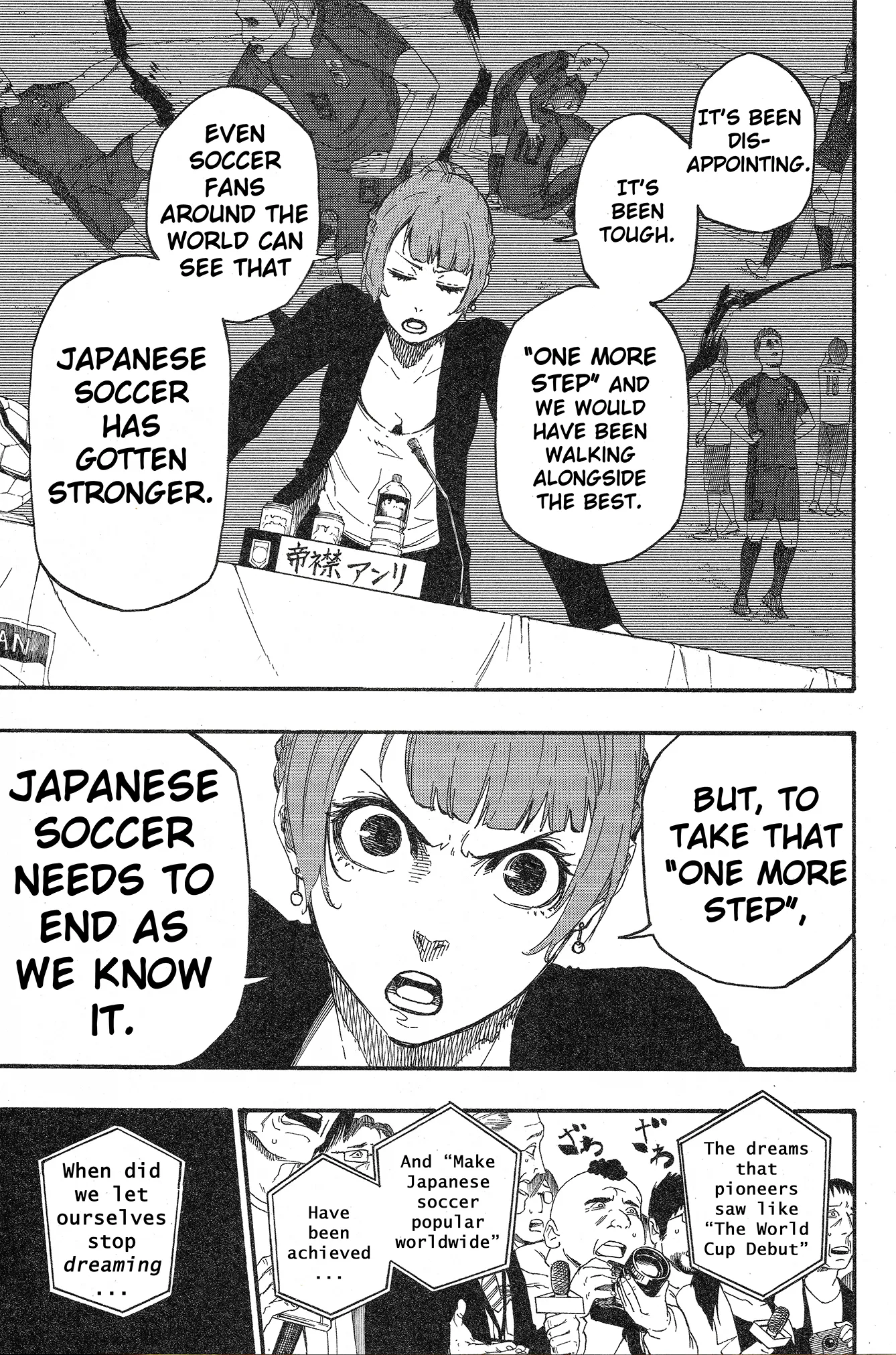
Back at the press conference, Anri is no longer fielding questions. She is delivering a sermon. And it is one worth listening to closely.
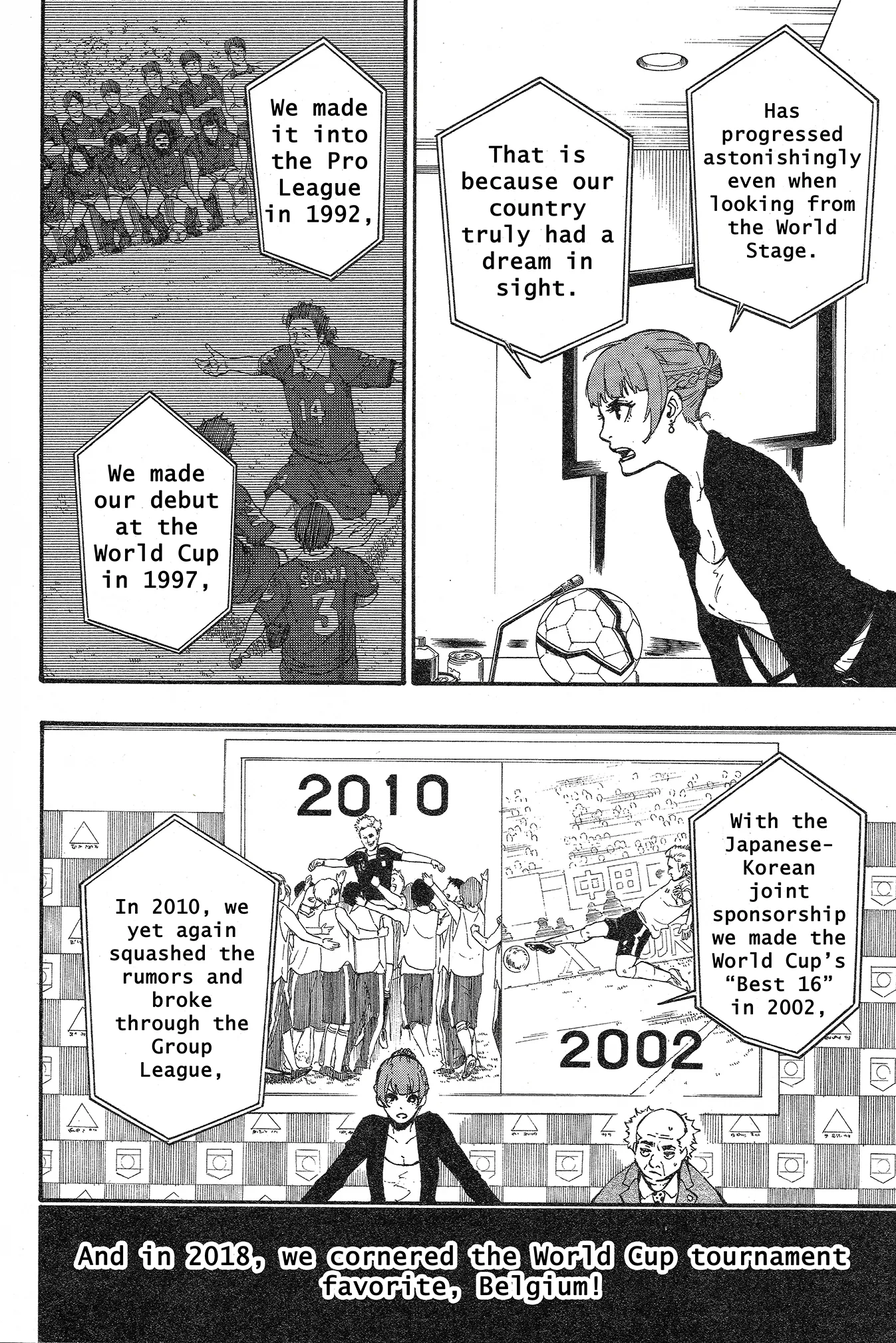
She traces the arc of Japanese football from the beginning — from the formation of the professional league in 1992, to the first World Cup appearance in 1997, to the extraordinary run to the Round of 16 in the 2002 Japan-Korea World Cup, to breaking through the group stage again in 2010, and finally to the remarkable performance in 2018 where Japan cornered Belgium — the tournament favourite — and came agonizingly close to advancing.
Her tone is not triumphant. It is almost mournful.
“It’s been disappointing. It’s been tough. ‘One more step’ and we would have been walking alongside the best. Even soccer fans around the world can see that Japanese soccer has gotten stronger.”
She acknowledges the progress. She does not dismiss it. Japanese football has grown. The world has noticed. But then she turns the knife:
“But, to take that ‘One more step’, Japanese soccer needs to end as we know it.”
The old dreams — the World Cup debut, making football popular worldwide — have been achieved. They are no longer dreams; they are history. And history cannot carry a team forward. She asks the question that no one in the room has dared ask aloud:
“When did we let ourselves stop dreaming?”
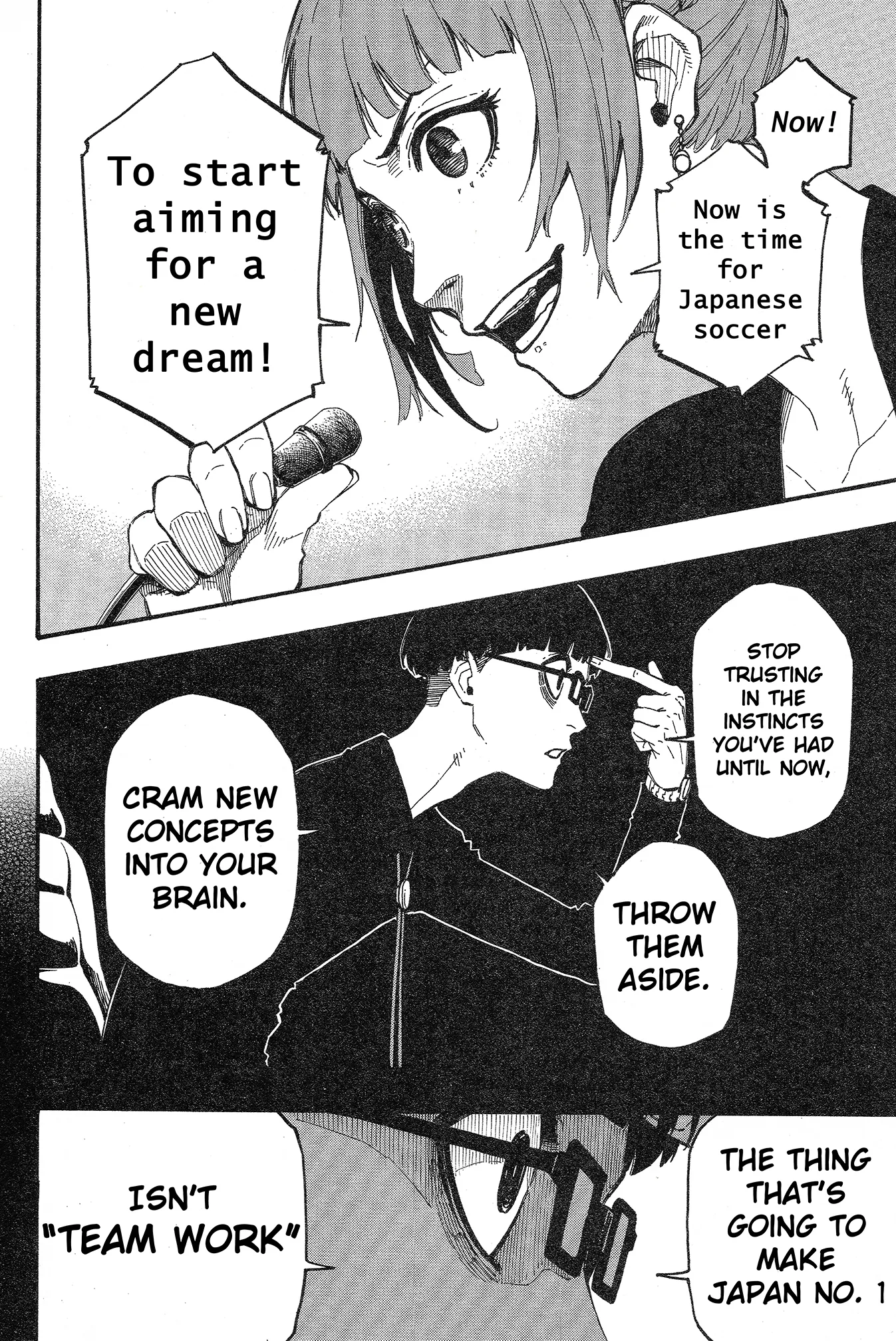
Now is the time, she declares, for Japanese football to aim at something new — something that the pioneers of the sport in Japan would never have dared put into words. World Cup Victory. Not participation. Not Round of 16. Not “one more step.” Victory.
Ego Speaks — The End of Teamwork as Japan Knows It
Inside the Blue Lock facility, the man in glasses — the eccentric, unsettling figure who is the architect of this entire project — is making his own declaration. And it is one that should disturb every conventional football fan on the planet.
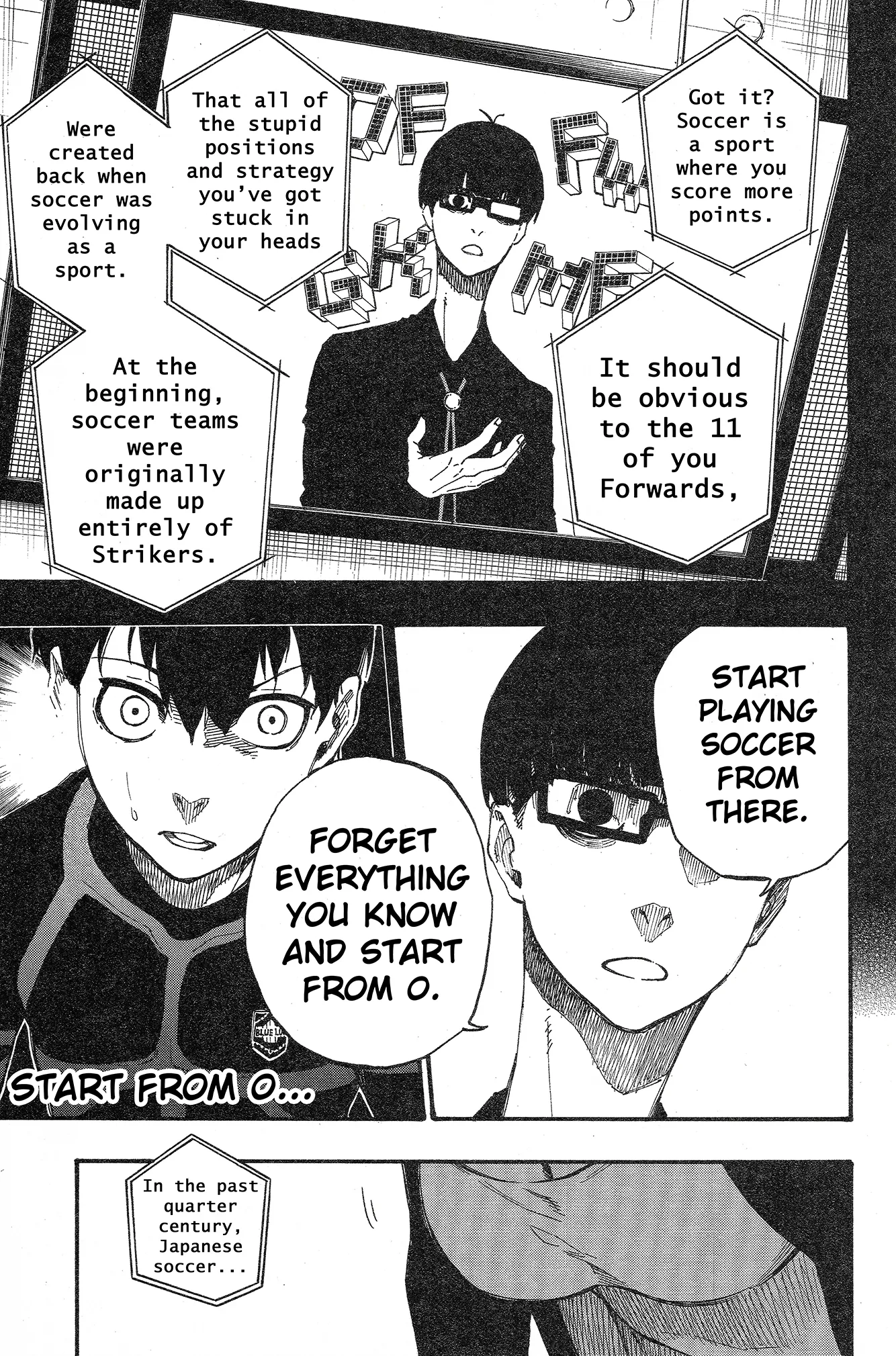
“Stop trusting in the instincts you’ve had until now. Throw them aside. Cram new concepts into your brain.”
He is not interested in refining what these boys already know. He is interested in dismantling it entirely and rebuilding something new in its place. And then he delivers the philosophy that sits at the core of Blue Lock:
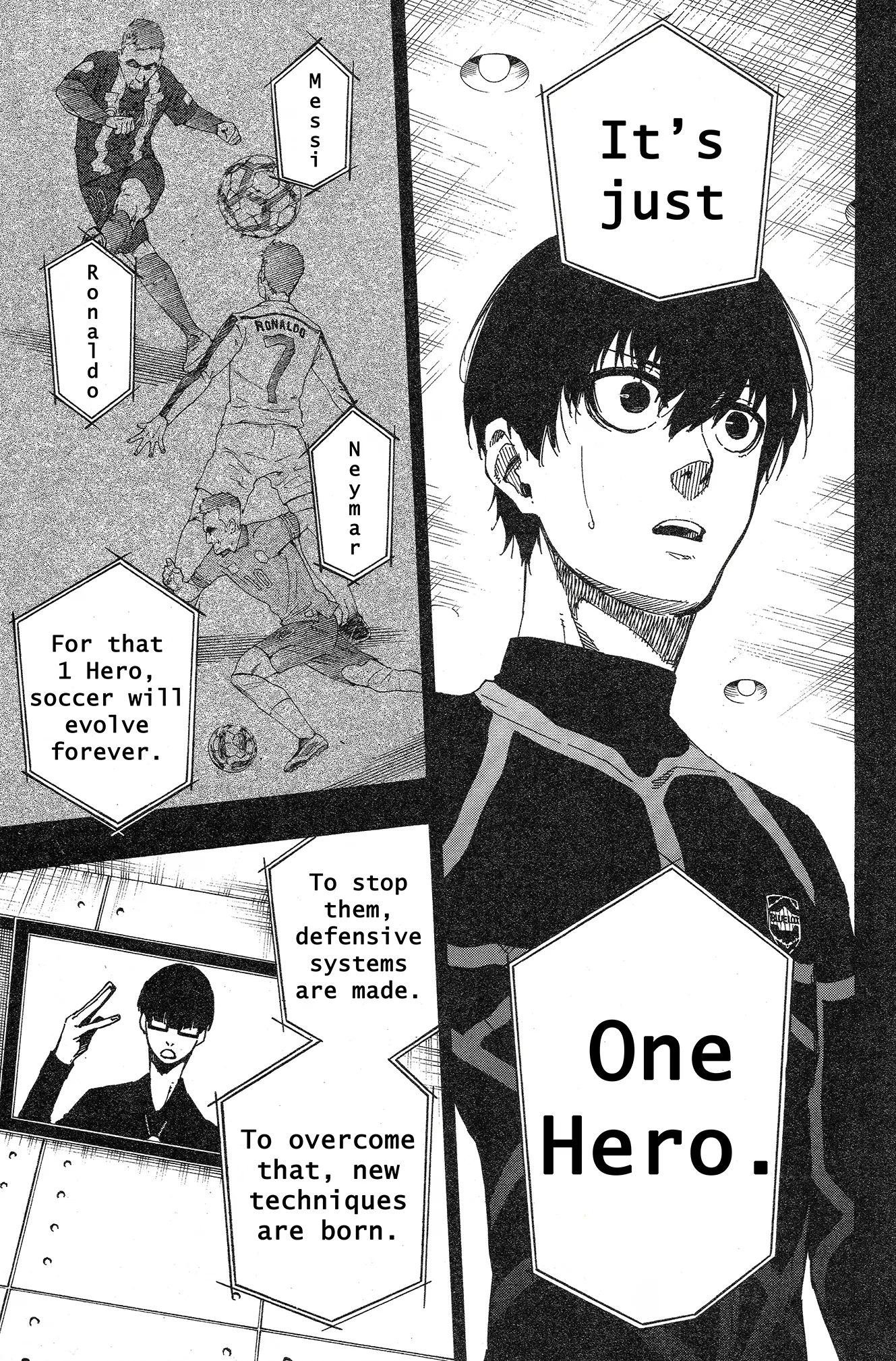
“The thing that’s going to make Japan No. 1 isn’t ‘Team Work’.”
It is the singular genius. The one hero. He speaks of football’s greatest players — those icons whose individual brilliance does not just win matches but reshapes the sport itself. Defensive systems are built to stop them. New techniques are invented to overcome those systems. The game evolves around one person. That is what he wants. That is what he is building inside Blue Lock.
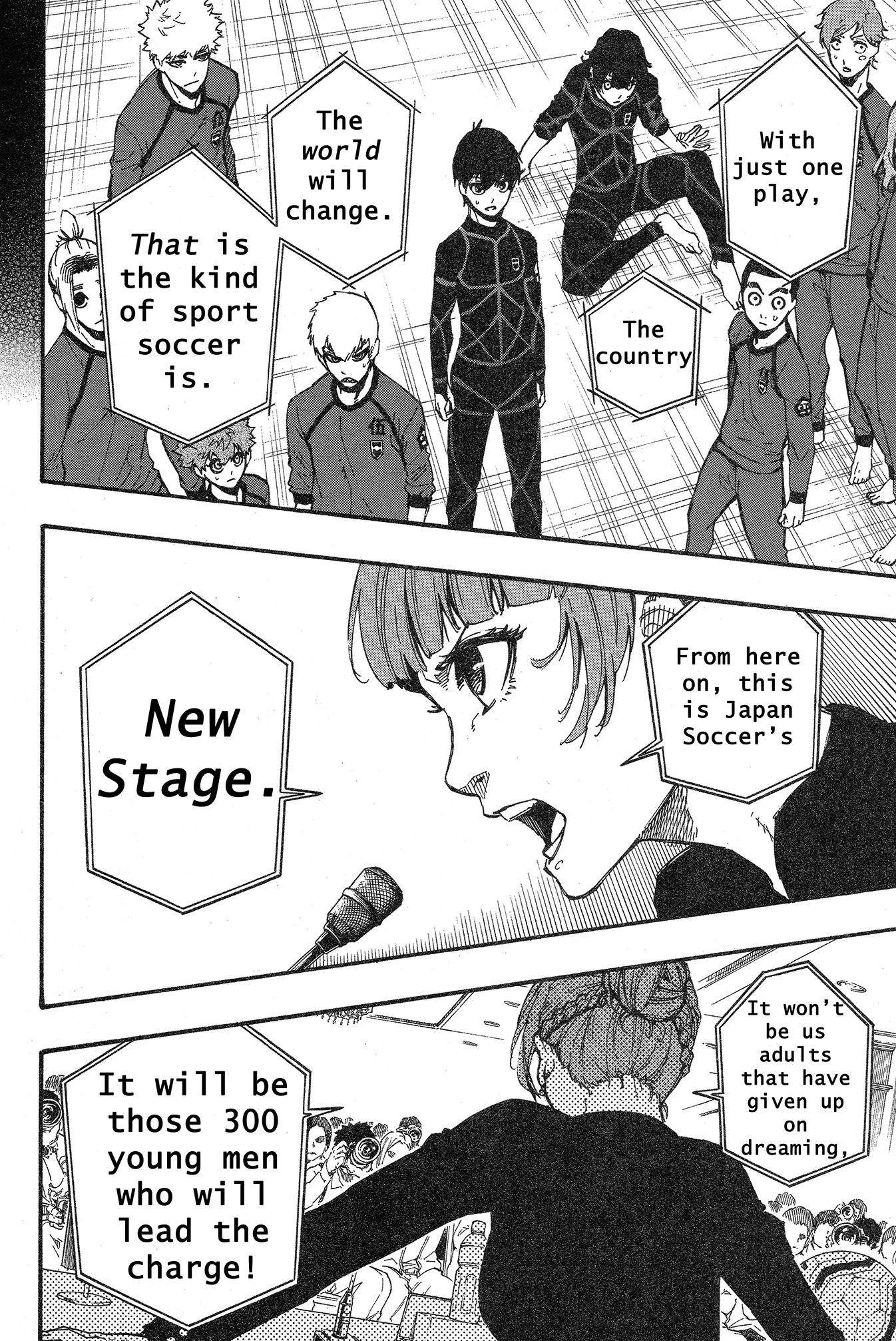
With just one play, the narration tells us, the country changes. The world changes. That is the kind of sport football is.
The Dream and the Courage to Have It
Anri leans forward at her microphone. The room has gone quiet. She looks out at the gathered journalists, the officials, the cameras, and she asks the question directly — not to the media, and not to the JFU, but to the 300 young men who are already inside Blue Lock’s walls:
“The ‘World Cup Victory’ — do you have the courage to have that dream? Can you do what it takes to fight?”
And then she brings the house down:
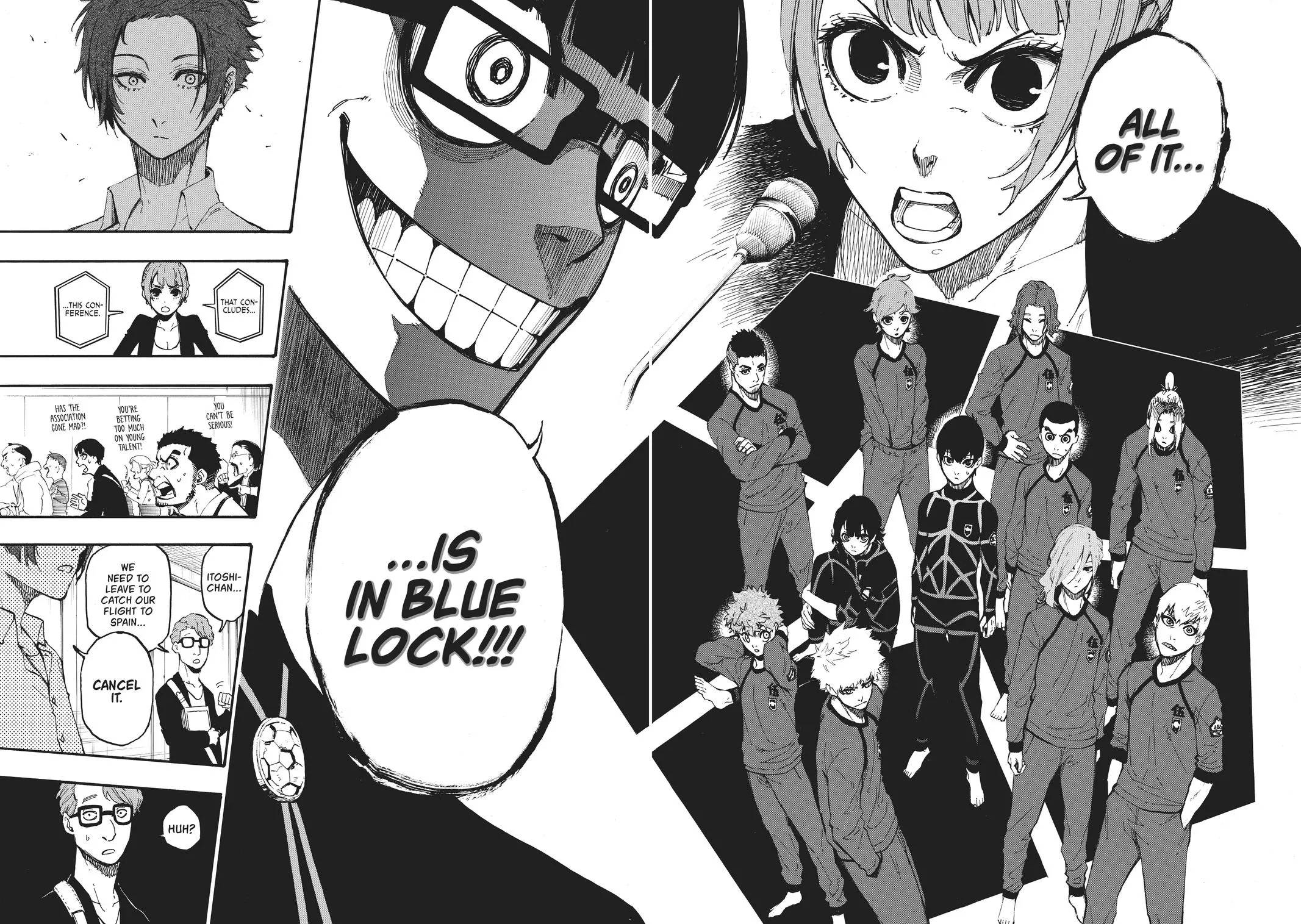
“All of it… …IS IN BLUE LOCK!!!”
The audience fractures into chaos. Voices shout from every corner — “Has the association gone mad?!” and “You can’t be serious!” and, from the more measured among them, a quiet warning: “You’re betting too much on young talent.” But the declaration has been made. It cannot be taken back.
Itoshi Sae Makes a Decision
In the corridor outside, Itoshi Sae has watched part of the press conference. His manager, the ever-anxious Gillian Davodi, materialises at his side to remind him that they need to leave — they have a flight to Spain. Their lives are elsewhere. Japan is just a passport and a layover.
But Sae is not moving. Something has caught his attention — not admiration, not enthusiasm, but something colder and more precise. Curiosity.
“Cancel it.”
Davodi stares. Two words. The flight to Spain — cancelled. The return to Europe — postponed. Because Itoshi Sae, the boy who said he was born in the wrong country, the boy who would rather die than play for Japan, the boy who has never once expressed interest in what this country’s football can offer him — that boy now wants to see something.
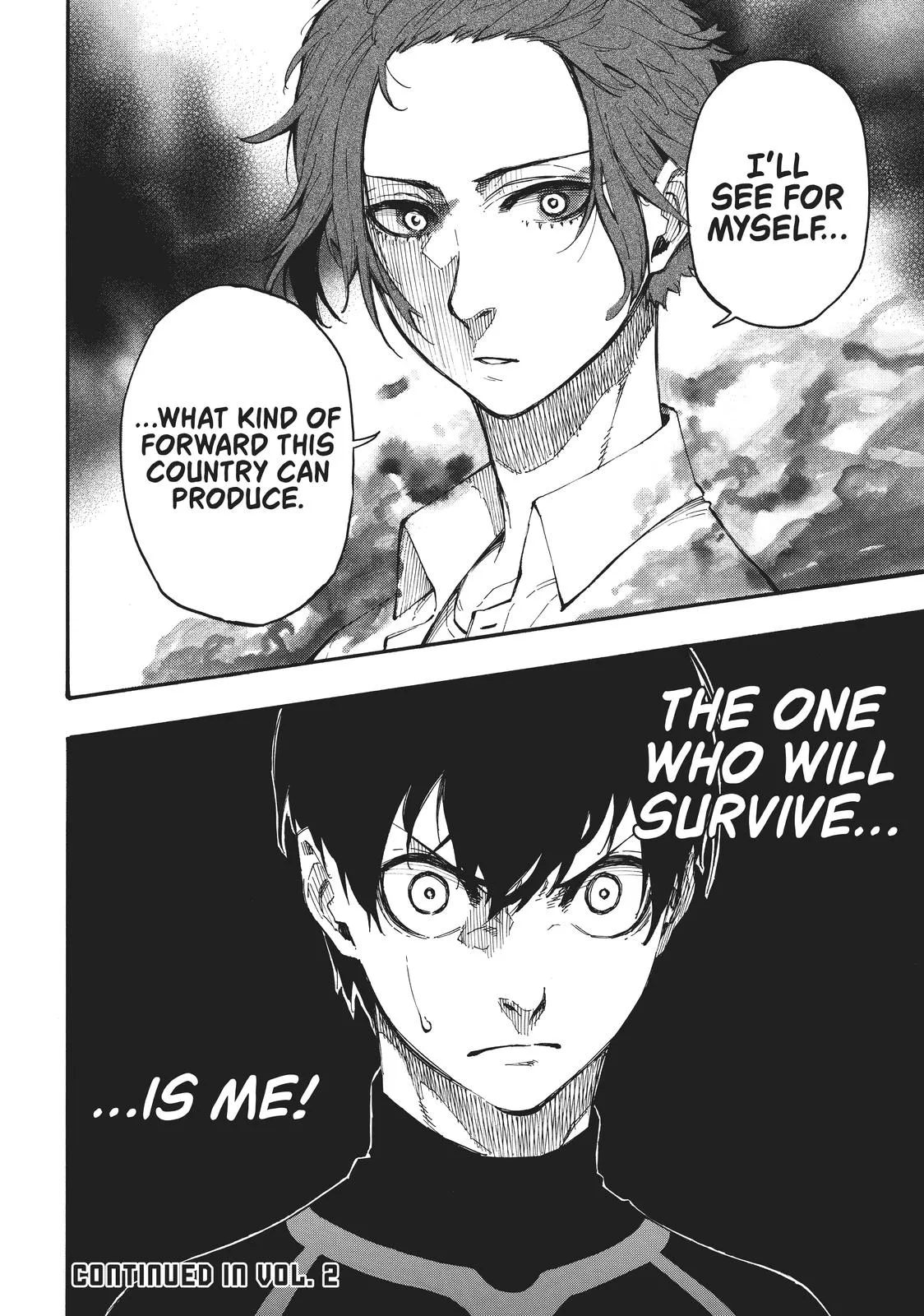
“I’ll see for myself… …what kind of forward this country can produce.”
It is not a change of heart. It is a test. He wants to know — personally, with his own eyes — whether there is anyone inside Blue Lock who can live up to the standard he demands. Whether there is a forward in Japan who can receive his passes. Whether this country, which he has spent his entire young life dismissing, is capable of producing the kind of player that his genius requires.
The One Who Will Survive — Is Me
The chapter ends where it began — not with Sae, but with the boy at the centre of this story. Inside Blue Lock, standing in the dark, eyes wide and burning with something that is equal parts fear and resolve, our protagonist stares into the chapter’s final panel and declares:
“The one who will survive… …IS ME!”
The world of Blue Lock is now fully visible. The philosophy is clear. The battlefield is set. Three hundred boys, all hungry, all forward-facing, all competing for a single dream — and watching from the outside, arms crossed, unmoved by sentiment but quietly, dangerously interested, is the best young midfielder Japan has ever produced. A boy who does not believe in this country. A boy who might, if the right forward emerges from inside these walls, finally be given a reason to.
Chapter 4 is a chapter of declarations. Everyone in it is announcing, in one way or another, who they are and what they want. Sae declares his contempt for the ordinary. Anri declares war on complacency. Ego declares the death of teamwork as the old world understood it. And the boy at the centre declares, perhaps more desperately than any of them, the only thing he has left to declare:
That he will survive this.
The rules have been set, the philosophy delivered, and the stakes made brutally clear. Three hundred boys. One dream. And only the one who wants it most will survive long enough to see it through.
But declarations are easy. Surviving them is another matter entirely.
The words have been spoken. The countdown has begun. And in Blue Lock Chapter 5, the reality of what all of this actually means — for Isagi, for Team Z, and for every forward desperate enough to believe they could be the one — finally arrives.
The talking is over. It is time to play.